Most organizations don't have a knowledge problem. They have a scattering problem.
The architecture decision lives in a slide deck. The incident postmortem lives in a SharePoint folder nobody can find. The roadmap lives on a Mural board. The runbook lives in a wiki that drifted from reality two reorgs ago. The code lives in 400 repos, each owned by a team that has never read the other 399.
Every one of those is a silo. And every silo is a wall — for new hires, for the team next door, and now for the AI agents we are asking to help us.
There is a better shape for all of this. Call it a Super Corpus.
What is a Super Corpus?
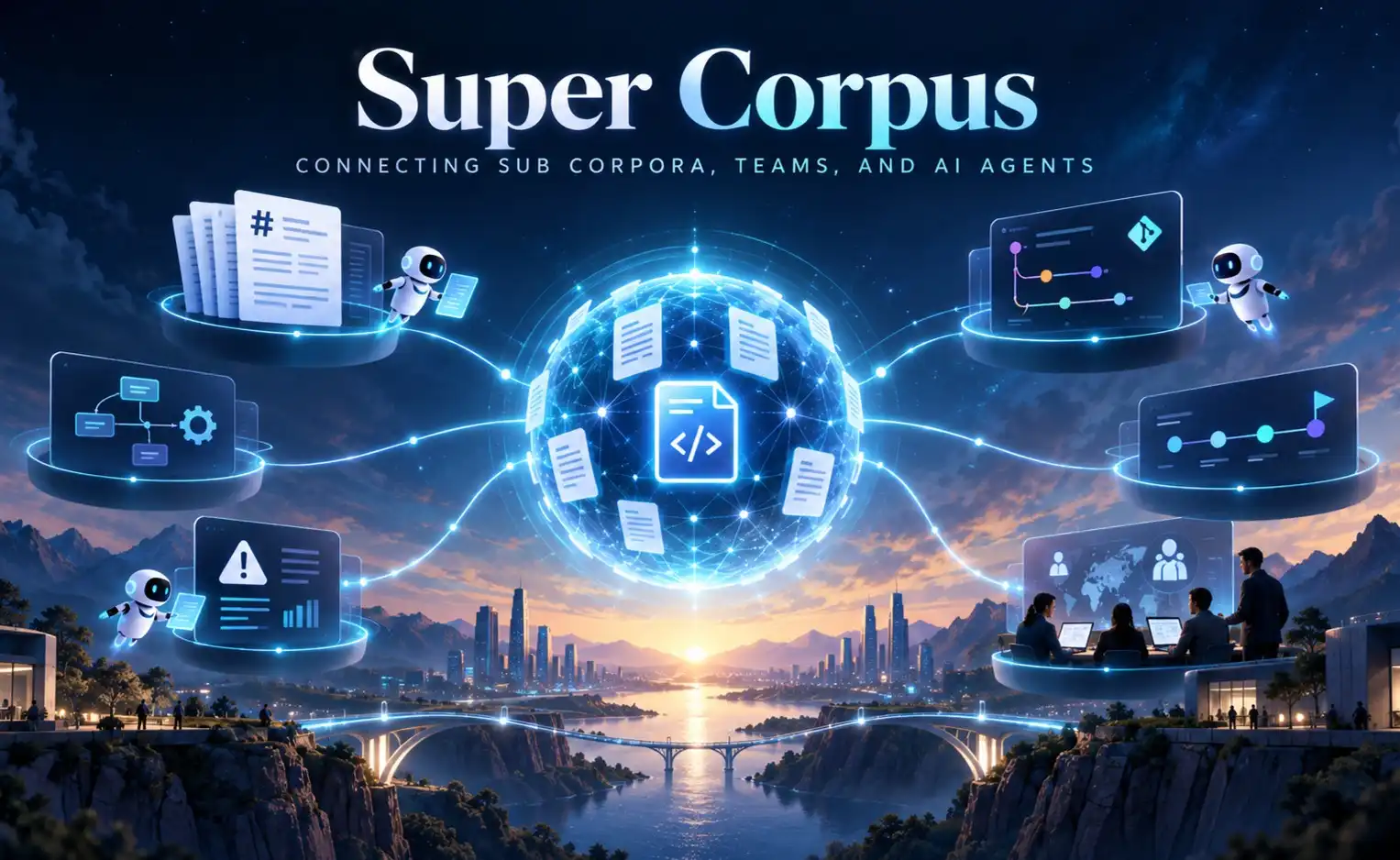
A corpus is just a body of text. A Super Corpus is one place that pulls together many smaller bodies of text — Sub Corpora — so that people and AI agents can see, search, and reason across all of them at once.
A Sub Corpus might be:
- a team's codebase
- a product's documentation
- an operations runbook
- a folder of incident reports (RCAs)
- goals, OKRs, and roadmaps
- design decisions and meeting notes
- an upstream open source project you depend on
Each Sub Corpus keeps its own owners and its own history. The Super Corpus doesn't take them over — it composes them. You add a Sub Corpus the way you'd add a book to a library shelf: it stays the same book, but now it sits next to everything else.
Plaintext in version control
The rule that makes this work is simple: everything is plaintext, and everything is in version control.
Plaintext means Markdown, code, YAML, CSV — files a human can open in any editor and a machine can read without a proprietary API. Version control (Git) means every change has an author, a timestamp, a reason, and a way to review it or undo it.
That combination is the best medium we have ever had for shared knowledge:
- People can read it, diff it, review it, and propose changes to it.
- Agents can read all of it, instantly, with no export step and no screen-scraping.
- History is never lost. You can see what a process looked like last year and why it changed.
- Nothing is locked in. Plaintext outlives every vendor.
Compare that with SharePoint, Mural, slide decks, and closed wiki silos. They are hard to search, hard to diff, hard to review, and nearly opaque to an agent. They feel collaborative, but they quietly keep knowledge trapped. It's time to stop writing important things in formats that can't be versioned, reviewed, or read by a machine.
You don't need one giant repo
Google famously runs on a single monorepo — one enormous repository with nearly all of its code. That proved the value of having everything in one place: anyone can find anything, and a single change can fix a problem everywhere.
But most of us can't — and shouldn't — move everything into one literal repository. Teams need independence. Open source projects have their own maintainers.
A Super Corpus can instead be a meta repo: a lightweight repository that pulls in many independent repositories (for example, as Git submodules) and adds the shared glue on top — docs, conventions, scripts, and agent instructions. You get the monorepo's view without the monorepo's politics.
A real example: ZUU
ZUU — the Zcash User Universe — is a Super Corpus for the Zcash ecosystem. It vendors around thirty upstream Zcash repositories as submodules, and builds Free2Z's apps against them from source at upstream HEAD, alongside architecture docs, status ledgers, protocol specs, and contribution doctrine for humans and agents (AGENTS.md).
The result: one checkout gives a developer — or an agent — the wallet libraries, the protocol code, the apps built on them, and the reasoning behind the design. When something is wrong upstream, the fix goes upstream, and everyone benefits.
Why this changes what agents can do
AI agents are only as good as the context they can reach. An agent that can see one repo can fix one repo. An agent that can see a Super Corpus can work across an entire organization.
Example: a security vulnerability. A critical CVE drops in a widely used library. In a siloed org, someone sends an email, dozens of teams each investigate on their own schedule, and a spreadsheet tracks who has replied.
In a Super Corpus, one agent — or one engineer with an agent — searches every Sub Corpus at once: which projects use the library, which versions, which code paths actually call the vulnerable function, and which runbooks and past RCAs are relevant. It can draft the fix, the pull requests, and the incident write-up in the same pass. Dozens or hundreds of Sub Corpora, checked in minutes instead of weeks.
The same pattern works for:
- Onboarding: "Explain how billing works, end to end" — across code, docs, and decisions.
- Consistency: find every service that violates a new logging or privacy standard.
- Planning: compare the roadmap to what the code actually does today.
- Incident response: pull every prior RCA touching the failing component.
With MCP (Model Context Protocol), agents can also reach the live systems around the corpus — issue trackers, CI, monitoring, chat — while the Super Corpus remains the durable, reviewable source of truth.
Improvements compound
In a silo, a good idea stays where it was born. One team writes a great deploy checklist; nobody else ever sees it.
In a Super Corpus, improvements are reproducible and shareable. A better script, a sharper agent prompt, a clearer runbook, a new CI check — once it's committed, every person and every agent can find it, reuse it, and improve it again. Everyone is literally on the same page, because the page is a file, and the file has a history.
Getting started
You don't need a big migration. Start small:
- Create a meta repo for your team, department, or ecosystem.
- Add Sub Corpora — existing repos as submodules, plus new folders for docs, runbooks, RCAs, and roadmaps.
- Move one silo into plaintext. Pick the most-used SharePoint doc or whiteboard and convert it to Markdown.
- Write an
AGENTS.mdthat tells humans and agents how the corpus is organized and how to contribute. - Review changes like code. Pull requests for processes, not just programs.
Then keep adding shelves to the library.
The takeaway
Silos aren't broken by reorgs or mandates. They're broken by putting knowledge where everyone can reach it — in plaintext, under version control, composed into a Super Corpus that people and agents share.
Do that, and your organization stops re-learning what it already knows. Your agents stop guessing. And every improvement anyone makes becomes an improvement for everyone.