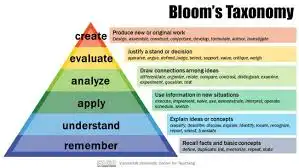

Blooms Taxonomy
What is it?
Blooms Taxonomy is typically a pyramid diagram representing different levels of thinking and linking them to academic outcomes. It is typically used by people when writing standardized tests or by individual teachers to meet their students at certain levels based on their grade-level or individual prowess.
Level 1 - Remember and Regurgitate information
This level is focused on reading re-reading and than stating and re-stating facts. This level is tragically the level that the public school pedagogy is centered around and as this level is the most tedious, it can trick students into hating subjects, for example, in some history classes students are forced to collect quotes from a textbook and tediously copy the quotes onto a computer document as "notes".
Level 2 - Comprehend and Explain concepts
This level focuses on being able to actually understand and explain how and why things happened or present facts about a subjects and explain how something works, like a mathematical formula. This level still involves reading and remembering but also re-itterating moreso than regurgitating.
Level 3 - Application and Real life problem solving
This is the level where what you comprehend can directly help you solve real life problems. These problems could include budgeting and other job related ventures such as writing code, persuasion, accounting, and marketing.
Level 4 - Analyze, compare and contrast information
This level is about being able to compare and contrast information. This level of thinking is important for developing skills such as cognitive dissonance; analyzing and comparing dates, places, and time periods to make logical connections between events. This level is also important in math for making logical deductions for proofs.
Level 5 - Evaluating, and prioritizing information
In my opinion, general knowledge is a necessity but knowing and learning what information will be more important for something like a job is an essential skill. It is also a general rule to invest more time in learning subjects that will help you perform better in the job you have or want.
Level 6 - Hypothesis, and discovery
This level is about being able to make educated guesses and prove and disprove them to make discoveries in your field. This is also the realm where I place conspiracy theorizing, given that the theory in question has substantial evidence and a viable solution to a problem. The thing about this level is that
once you master it you will have effectively mastered all the other ones before it.
Practicing
Since a lot of people here will have already been in and out of school and the public school system at least in the U.S. does not want you to reach the higher levels of thinking, when practicing, AI is your friend. You can simply ask the Chat2Z AI to ask you questions about a subject at a specific level on the taxonomy.
Biography of Benjamin Bloom
Benjamin Bloom was born in pennsylvania to a familly of Jewish immigrants from Ukraine