The proposed funding mechanism aims to democratize fund allocation in decentralized communities by combining votes, donations, and coin time to ensure fair distribution of funds that reflects community sentiment. This approach addresses sybil resistance, scalability, and privacy concerns while balancing community engagement and security. It requires a clear community goal, available matching funds, and a reliable voting system to implement effectively, with mitigations in place to handle potential attacks and risks. This mechanism supports a broad base of smaller projects, encouraging innovation and community-driven development.
Goals
The proposed scalable, sybil-resistant funding mechanism aims to democratize fund allocation within decentralized communities while maintaining robust privacy and efficiency. Traditional funding models often centralize decision-making power into small committees, which can lead to a lack of granular, iterative, and scalable community feedback. This approach tends to favor a few large grantees over potentially numerous smaller, yet impactful projects.
The goal of this mechanism is to enable fair distribution of funds to a broad base of smaller grantees while ensuring sybil resistance. By leveraging a variant of quadratic funding principles, the mechanism aims to more accurately reflect community sentiment and prioritize projects that resonate deeply with the collective interest. This mechanism seeks to balance privacy concerns with the need for transparent and accountable funding processes.
The core objectives of this mechanism are:
- Decentralization: Distribute funding power across a wide community base to prevent centralization of influence and decision-making.
- Scalability: Ensure the system can handle hundreds of small grants efficiently, without compromising on fairness or security.
- Sybil Resistance: Implement mechanisms to prevent vote manipulation and ensure that each participant's influence is proportional and legitimate.
- Privacy: Maintain the privacy of participants, leveraging advanced technologies to protect identities while ensuring transparency in fund allocation.
- Efficiency: Optimize the allocation of funds to maximize impact, adhering to market principles while ensuring fair distribution.
This mechanism is applicable to decentralized systems with privacy and sybil resistance requirements. The aim is to create a funding mechanism that empowers community-driven projects, fosters innovation, and upholds the principles of decentralization, privacy, efficiency, and fairness.
Prerequisite Knowledge
To understand the proposed funding mechanism, it's essential to grasp several foundational concepts. Here are key topics and resources for deeper exploration:
Quadratic Funding and Variants:
- Definition: A funding mechanism where the amount received by a project is influenced by contributions, but in a non-linear way to favor broad support.
- Resources:
Sybil Resistance:
- Definition: Techniques to prevent or mitigate the impact of Sybil attacks, where an adversary creates multiple identities to gain disproportionate influence.
- Resources:
These resources provide a foundational background to understand the principles behind the proposed funding model. Familiarity with these topics will facilitate a deeper comprehension of how the system functions and its potential impact on decentralized community funding.
Prerequisites to Implement the Proposed System
Implementing the proposed funding mechanism requires several key conditions to ensure its feasibility and effectiveness. Understanding the situations where this system might work well and where it might face challenges is crucial.
Required Conditions
Community with a Clear Goal:
- A community must have a well-defined purpose or mission that aligns with the funding mechanism’s objectives. This ensures that the projects seeking funds are aligned with the community's values and priorities.
- Example: An open-source software development community aiming to fund various contributors and projects.
Available Matching Funds:
- Adequate matching funds must be available to distribute among grantees. The source of these funds can be community contributions, donations from larger entities, or a combination of both.
- Example: A community treasury funded by donations and grants from supporting organizations.
Voting Mechanism with Sybil Resistance:
- A reliable method for participants to vote on projects is essential. This mechanism must include robust sybil resistance techniques to prevent manipulation by multiple fake identities.
- Example: Using unique, verifiable identifiers or integrating with systems that have built-in sybil resistance features.
Situations Where This System Might Not Work
Lack of Available Funds:
- If there are no sufficient funds available for matching, the mechanism cannot function effectively.
- Example: A community without a central treasury or sufficient donor support.
Absence of a Clear Community Goal:
- Without a clearly defined purpose or mission, it becomes challenging to align projects with the community's interests.
- Example: A loosely connected group with diverse, unaligned objectives.
Lacking Fund Management:
- Effective fund management is crucial, whether handled by trusted individuals offchain or through a decentralized smart contract. Without a reliable method for managing and verifying the fund allocation process, the system's integrity can be compromised.
- Example: A community lacking trusted individuals or a secure, bug-free smart contract to manage the central treasury.
Low Community Engagement:
- The success of the funding mechanism depends on active participation from the community. Low engagement can undermine the system's effectiveness.
- Example: A community where members are not actively participating in the voting and funding process.
By recognizing these prerequisites and potential limitations, it becomes possible to identify the appropriate contexts for deploying the proposed funding mechanism and ensure necessary preparations for its successful implementation.
Basic Description
Imagine a community that has pooled together a treasury of funds specifically for supporting innovative projects. Members of this community can propose their ideas and projects, detailing how they would use different levels of funding to achieve their goals. Once a proposal is submitted, the project creators promote their idea within the community to gather support.
Community members play a crucial role in this process. They have the opportunity to vote on the projects they believe in and want to see succeed. Each member can vote on multiple projects, expressing their support without needing to contribute financially. Voting helps signal which projects have broad community backing.
Separately, community members can also donate funds to the treasury. When donating, they specify the project they want their donation to support by tagging it with the project's username. It's important to note that donations and votes are distinct actions in this system. Donations don't count as votes, which helps prevent vote manipulation by splitting donations into multiple smaller ones.
The duration for which donated funds remain in the treasury also impacts the matching funds a project receives. This concept, known as "coin time," means that funds held longer in the treasury contribute more significantly to the project's matching score.
Voting can be conducted either offchain or onchain, depending on the community's infrastructure and preferences.
Fund Organizers
Role and Responsibilities:
- Announce the availability of matching funds from the community treasury.
- Establish and communicate clear criteria for project proposals and voting.
- Oversee the submission, review, and promotion of projects.
- Ensure transparency in the allocation of matching funds.
- Manage the treasury and verify fund disbursement.
Process:
- Set up the treasury and determine the total amount available for matching.
- Invite community members to submit project proposals.
- Facilitate a voting period where community members can vote on projects.
- Collect donations from community members, tagged with the recipient's username.
- Calculate matching funds based on votes, donations, and coin time.
- Disburse funds to the projects according to the calculated matching scores.
People Seeking Funds
What to Do:
- Submit a Proposal: Describe your project and how different funding levels will be used.
- Promote Your Idea: Engage with the community to explain the benefits and impact of your project. Use social media, community forums, and other platforms to gather support.
- Gather Votes and Donations: Encourage community members to vote for your project and donate to the treasury with your username tagged.
Experience:
- Submission: Easy-to-use platform for submitting detailed proposals.
- Promotion: Tools and tips for effective project promotion within the community.
- Tracking: Real-time updates on votes and donations received.
People Who Want to Participate/Vote
What to Do:
- Meet Criteria: Ensure you meet the voting criteria set by the fund organizers (e.g., community membership, reputation).
- Review Projects: Look through the submitted project proposals and evaluate them based on their merits and alignment with community goals.
- Vote: Cast votes for as many projects as you support. Voting is separate from donating.
Experience:
- Engagement: Access to a platform where all project proposals are listed with detailed descriptions.
- Participation: Simple voting process without the need to donate.
- Transparency: Clear visibility into how votes are counted and how they influence funding decisions.
People Who Want to Donate
What to Do:
- Donate Funds: Contribute to the treasury with a specific username tagged to direct matching funds to your preferred project(s).
- Support Projects: Choose projects you believe in and support them financially, knowing that your donation will be matched.
Experience:
- Contribution: Secure and straightforward process for making donations.
- Impact: Assurance that donations will be matched, amplifying the impact of contributions.
- Tracking: Ability to see how donations are being used and the progress of supported projects.
This system is designed to be user-friendly and transparent, ensuring that all participants can easily engage with the funding process and contribute to the community's goals.
Tradeoffs
Strengths
Community Engagement:
- Benefit: The system encourages active participation from community members, who are incentivized to propose, read, think, vote, and donate. This engagement fosters a vibrant and interactive community environment.
- Impact: By creating incentives for participation, the mechanism can be enjoyable and stimulating for community members, potentially increasing overall involvement and cohesion.
Diverse Funding Distribution:
- Benefit: The mechanism supports a wide range of projects, allowing both large and small initiatives to receive appropriate levels of funding based on community support.
- Impact: This enables highly supported projects to receive substantial funding, while still allowing niche or emerging projects to gain traction and support.
Democratic and Programmatic Allocation:
- Benefit: Funding levels are determined through a democratic process that genuinely reflects community sentiment. The process is programmatic and auditable, ensuring transparency and accountability.
- Impact: Community members know their voices are heard, and the funding process maintains integrity and fairness.
Reflective of Community Sentiment:
- Benefit: The mechanism leverages community votes and donations to gauge the popularity and perceived value of projects.
- Impact: Projects that resonate most with the community are more likely to receive funding, aligning resource allocation with collective preferences.
Retroactive Incentives:
- Benefit: Since there is a lag between announcing the matching pool and finalizing the voting and donation process, recipients are incentivized to demonstrate their project's value and iterate based on feedback.
- Impact: This encourages continuous improvement and accountability among project creators.
Shortcomings
Centralized Treasury Risks:
- Drawback: The centralized treasury can be a target for hacks and scams, introducing significant security risks. Managing a central fund involves trust assumptions and potential audit overhead, which can be labor-intensive and expensive.
- Impact: The reliance on a centralized treasury could lead to vulnerabilities and inefficiencies in fund management.
- Potential Mitigation: Establishing clear, transparent protocols for fund management and incorporating checks and balances can reduce the risk of mismanagement. Exploring secure, decentralized alternatives for fund management in future iterations can also help.
Non-Instant, Non-P2P Disbursal:
- Drawback: Funds are held in the treasury for a period to facilitate matching calculations, rather than being disbursed directly and instantly. This is necessary to prevent manipulation through self-dealing but adds complexity and delays.
- Impact: This may deter some participants who prefer immediate, direct transactions.
- Potential Mitigation: Communicating the reasons for delayed disbursal clearly and ensuring the benefits of the matching mechanism are understood can help manage expectations. Future iterations could explore ways to streamline the process while maintaining integrity.
Voting Mechanism Limitations:
- Drawback: Some community members might find the voting mechanism burdensome, be unable to meet the criteria for voting, or simply dislike the chosen platform. Enforcing sybil resistance can place additional demands on legitimate participants and result in a biased voting sample.
- Impact: This could reduce participation and introduce bias depending on the chosen platform for voting.
- Potential Mitigation: Providing clear guidelines and support for meeting voting criteria can help reduce barriers. Exploring different sybil resistance methods to balance security and accessibility can improve inclusivity. Considering alternative voting platforms or methods that can accommodate broader preferences may also be beneficial.
Legal and Regulatory Challenges:
- Drawback: Depending on legal and regulatory requirements, recipients might need to undergo KYC or other compliance processes. These requirements can be intrusive and contrary to the community's privacy preferences.
- Impact: Compliance measures can be a significant barrier for participants and may conflict with the community's values.
- Potential Mitigation: Exploring technical solutions such as ZK KYC (Zero-Knowledge Know Your Customer) and other privacy-preserving compliance methods, in addition to consulting with legal experts, can help address these challenges.
Smart Contract Limitations:
- Drawback: While the use of smart contracts could theoretically decentralize fund management, they are not available in Zcash for the first iteration. Even when available, smart contracts come with their own risks, such as potential bugs and security vulnerabilities.
- Impact: Trusting either manual processes or smart contracts introduces different sets of challenges, balancing security, and decentralization.
- Potential Mitigation: Conducting thorough security audits and employing best practices in smart contract development can help mitigate these risks. Planning for gradual integration of smart contracts with continuous monitoring and improvement can enhance security and efficiency.
By recognizing and addressing these tradeoffs, the system can be refined to maximize its strengths and mitigate its weaknesses, paving the way for a more effective and fair funding process.
Potential Attacks
1. Self-Dealing to Inflate Matching
Attack:
- Description: An attacker donates a significant amount to their own project to inflate the donation total and subsequently receive a larger share of the matching funds.
- Impact: This could result in an unfair allocation of matching funds, where certain projects receive disproportionate support due to self-dealing.
- Example: A wealthy individual donates $50,000 to their own project to maximize their matching funds, knowing that their donation will be enhanced by the matching formula.
Some Potential Mitigating Measures:
- Voting Mechanism: Ensure that donations alone do not determine matching funds. The combination of votes and donations, with votes having a significant impact, makes it harder to manipulate outcomes through donations alone.
- Minimum Vote Requirement: Implement a minimum number of votes required to qualify for matching funds, making it difficult for a single entity to dominate without broad community support.
- Caps on Matching: Set caps on the amount of matching funds a single project can receive to prevent disproportionate allocation due to large donations.
- Coin Time Weighting: Use the amount of time the coins are in the treasury to give weight to the donations, reducing the impact of short-term, large donations.
2. Sybil Attacks
Attack:
- Description: An attacker creates multiple fake identities to vote for their project, manipulating the voting results to gain more matching funds.
- Impact: This skews the allocation of funds, making it difficult to accurately reflect true community sentiment.
- Example: An attacker creates 100 fake accounts to cast votes for their project, artificially boosting its support.
Some Potential Mitigating Measures:
- Robust Sybil Resistance: Utilize badges, reputation criteria, and account age to ensure that qualifying for voting is costly and time-consuming, making sybil attacks economically unfeasible.
- Incentives in Formula: Design the voting and donation mechanisms to balance the cost of creating multiple accounts against the benefits, ensuring attackers pay more than they are rewarded.
3. Rich Donor Manipulation
Attack:
- Description: A wealthy donor could make large donations early in the process to maximize their impact on the matching score and influence voting through incentives or coercion.
- Impact: This could result in disproportionate allocation of funds to projects backed by wealthy individuals rather than those with genuine community support.
- Example: A wealthy donor contributes a large amount to a project they favor and offers incentives to other community members to vote for it.
Some Potential Mitigating Measures:
- Caps on Matching: Set limits on the maximum matching funds a single project can receive to prevent excessive influence from large donors.
- Game Theory: Structure the matching formula to ensure that the cost of attempting to manipulate the system outweighs the benefits.
- Minimum Vote Requirement: Require a certain number of unique votes to qualify for matching funds, making it harder for wealth alone to dominate the allocation.
4. Central Treasury Vulnerabilities
Attack:
- Description: The central treasury can be a target for hacks, scams, and fraud, posing a significant risk to the security of the funds.
- Impact: A successful attack on the treasury could result in the loss of funds, undermining the integrity of the entire system.
- Example: A hacker breaches the treasury's security and siphons off the funds.
Some Potential Mitigating Measures:
- Security Measures: Employ advanced security measures, such as multi-signature wallets and cold storage for the treasury funds.
- Transparent Management: Clear, transparent protocols for fund management can reduce the risk of mismanagement.
- Exploring Decentralization: Future iterations could explore decentralized fund management options, using secure smart contracts as they become available and practical.
By focusing on these realistic and specific attack vectors, the system can be better designed to mitigate potential manipulations and ensure a fair and effective funding process.
Formal Mathematical Description of the Proposal
Matching Score
Where:
- is the Matching Score of project
- is the number of Votes received by project
- is the total amount Donated to project
- is the Coin Time of donations to project
Explanation
Votes ():
- Role: Represents the number of unique votes a project receives.
- Purpose: Ensures that community support is a primary factor in determining the matching score, with a quadratic influence to emphasize broader support.
Donations ():
- Role: Represents the total amount of funds donated to a project.
- Purpose: Encourages financial contributions while damping the influence of large donations to prevent dominance by wealthy donors. The square root transformation ensures diminishing returns on larger donations.
Coin Time ():
- Role: Represents the cumulative time that donated funds have been held in the treasury.
- Purpose: Rewards early and sustained contributions, mitigating the impact of last-minute large donations. The logarithmic influence ensures that the effect tapers off over time.
Combined Effect
The formula combines these three components multiplicatively, amplifying projects that perform well across all metrics. The squaring of the votes and donations product, combined with the logarithmic coin time factor, ensures that projects with comprehensive support are significantly rewarded.
Portion of Matching Fund to Project
To obtain the portion of the matching fund that goes to project , divide the Matching Score of project by the sum total of all the projects' Matching Scores:
Where:
- is the percentage of the matching fund for project
- is the number of projects receiving matching
This ensures that the sum of all for all projects equals 1 (the whole matching fund):
Distribution
The actual amount received by project from the matching fund is then calculated by multiplying by the total matching fund amount.
This approach effectively balances the influence of votes, donations, and coin time, while providing a clear and fair mechanism for distributing matching funds based on comprehensive support. The use of quadratic voting, square root transformation, and logarithmic weighting ensures that no single factor can dominate the allocation, promoting a well-rounded and equitable distribution of resources.
Variants
The matching score formula can be modified by introducing different constants and parameters to adjust the influence of each component. Here are some potential variants and their effects on the matching score:
Generalized Formula
Where:
- , , , and are adjustable parameters.
Parameters and Their Effects
Exponent on Votes ()
- Description: Adjusting the exponent on votes changes how strongly the number of votes influences the matching score.
- Effect:
- Increasing : Increases the weight of votes, making projects with more votes significantly more influential.
- Decreasing : Decreases the weight of votes, reducing their influence on the overall score.
Exponent on Donations ()
- Description: Changing the exponent on donations modifies the effect of the total donated amount.
- Effect:
- Increasing : Enhances the impact of donations, making financial contributions more critical to the score.
- Decreasing : Reduces the impact of donations, making it less significant relative to votes and coin time. For example, using cube root () makes the influence of donations less powerful.
Overall Exponent ()
- Description: The overall exponent determines the non-linearity of the combined votes and donations product.
- Effect:
- Increasing : Amplifies the combined effect of votes and donations, making high-scoring projects stand out more.
- Decreasing : Smooths the differences between projects, leading to a more even distribution of scores.
Logarithm Base ()
- Description: Using different bases for the logarithm of coin time affects how coin time influences the matching score.
- Effect:
- Using a larger base (): Reduces the influence of coin time, making the duration less impactful.
- Using a smaller base (): Increases the influence of coin time, giving more weight to early and sustained donations.
Examples of Parameterized Variants
Reducing the Impact of Donations
- Formula:
- Effect: Reduces the influence of donations by using the cube root, making financial contributions less powerful in determining the score.
- Formula:
Increasing the Impact of Early Donations
- Formula:
- Effect: Increases the weight of coin time by using a smaller base for the logarithm, making early and sustained donations more influential.
- Formula:
Reducing the Overall Impact
- Formula:
- Effect: Creates a more balanced distribution of matching funds by reducing the overall influence of votes and donations.
- Formula:
By adjusting the parameters , , , and , the matching score formula can be tailored to emphasize different aspects of community support. These variants allow for flexibility in how the matching funds are distributed, ensuring that the system can be adapted to meet the specific needs and values of the community.
Visualization
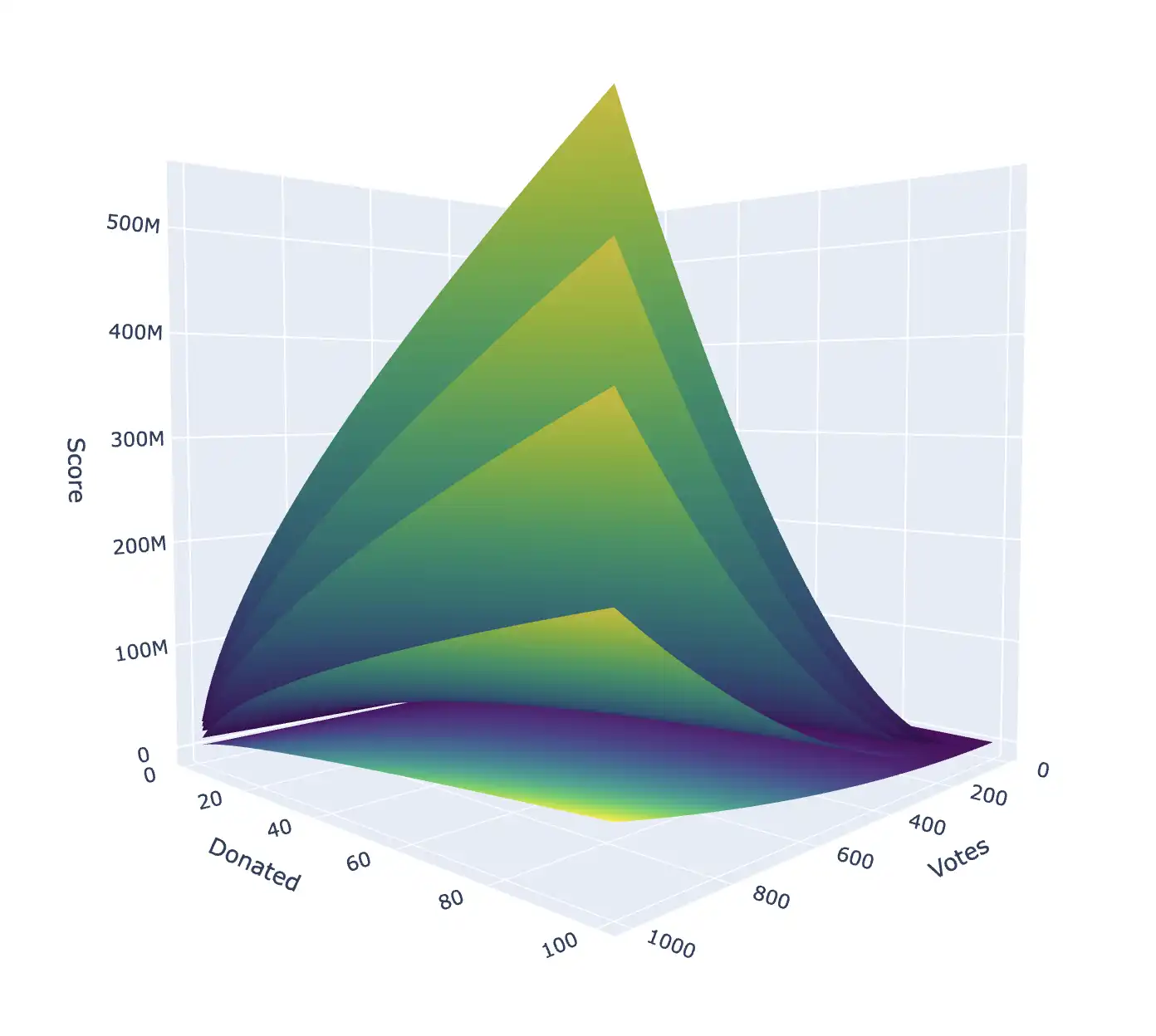
To better understand how the matching score (MS) is calculated based on the number of votes (V), the amount donated (D), and the coin time (CT), we use a 3D graph. This visualization illustrates the impact of each variable on the matching score and their interactions.
Matching Score Formula
The formula for calculating the matching score is:
Where:
- is the Matching Score of project
- is the number of Votes received by project
- is the total amount Donated to project
- is the Coin Time of donations to project
Explanation of the Formula
- Votes (): The number of votes a project receives. More votes indicate higher community support and significantly boost the matching score.
- Donations (): The total amount of funds donated to a project. The cube root of donations is used to prevent large donations from having an outsized influence, but the total amount still matters.
- Coin Time (): The cumulative time that donated funds have been held in the treasury. Early and sustained donations get a bonus, making coin time an important factor.
Visualization Code
The following Python code generates a 3D graph to visualize the matching score for different values of votes, donations, and coin time. The graph shows how these variables interact to determine the matching score for various projects.
import numpy as npimport plotly.graph_objects as go # Define the function MSdef MS(Votes, Donations, CoinTime): return (Votes * np.cbrt(Donations)) ** 2 * np.log(1 + CoinTime) # Create a grid of values for Votes, Donations, and CoinTimeVotes = np.linspace(1, 1000, 50)Donations = np.linspace(1, 100, 50)CoinTime = np.linspace(1, 1000000, 50) # Create mesh grids for Votes, Donations, and CoinTimeVotes, Donations = np.meshgrid(Votes, Donations) # Calculate MS for different levels of CoinTimeCoinTime_levels = [ 10, 10000, 10000000, 1000000000, 100000000000,] # Different CoinTime values for separate plots fig = go.Figure() for CT in CoinTime_levels: Z = MS(Votes, Donations, CT) fig.add_trace(go.Surface(z=Z, x=Votes, y=Donations, colorscale='Viridis', showscale=False, name=f'CoinTime={CT}')) # Update plot layoutfig.update_layout( title='3D Graph of MS = (Votes * cbrt(Donations))^2 * log(CoinTime)', scene=dict( xaxis_title='Votes', yaxis_title='Donated', zaxis_title='Score', ), autosize=True,) # Show the plotfig.show()Interpreting the Visualization
- Votes (X-axis): Indicates the number of votes a project receives. More votes lead to a higher matching score.
- Donations (Y-axis): Shows the total amount donated. The cube root transformation ensures that even smaller donations add value without letting large donations dominate.
- Coin Time (CT): Represents the duration funds are held in the treasury. Longer coin time adds more to the matching score, but with diminishing returns.
Using the Matching Score
- Votes: Gather as many community votes as possible. More votes mean higher community support.
- Donations: Raise funds for your project. The total amount of donations influences the score.
- Coin Time: Encourage early and sustained donations. The longer the funds stay in the treasury, the higher your score.
Determining the Portion of the Matching Fund
- Calculate the sum of all matching scores:
- Find the percentage of the matching fund for your project:
- Multiply this percentage by the total matching fund to get the amount due to your project.
This method ensures projects need a mix of community support, financial backing, and commitment from donors to succeed. Voting counts more than donation size, but without some donations and coin time, projects won't get much.
Differences with "QF" as in Gitcoin
Visualization of a Potential Implementation of This System
graph TD
  A[Community] --> B[Voting System]
  B --> D[Disbursement Calculation]
  C[Community Donations] --> E[Multisig Wallet]
  F[Matching Funds] --> E
  E --> D
  G[Signatures] --> D
  D --> H[Recipients]

  subgraph .
    E[Multisig Wallet]
    D[Disbursement Calculation]
    G[Signatures]
  end

  style A fill:#bbf,stroke:#333,stroke-width:2px
  style B fill:#bbb,stroke:#333,stroke-width:2px
  style C fill:#bbf,stroke:#333,stroke-width:2px
  style D fill:#bfb,stroke:#333,stroke-width:2px
  style E fill:#bfb,stroke:#333,stroke-width:2px
  style F fill:#bbb,stroke:#333,stroke-width:2px
  style G fill:#bfb,stroke:#333,stroke-width:2px
  style H fill:#fbb,stroke:#333,stroke-width:2px
Simplified Visualization of How Gitcoin Works
graph TD
  A[Donors] --> B[Verified Donors]
  B --> C[Smart Contract]
  D[Signatures from Multisig] --> C
  E[Matching Funds] --> C
  C --> F[Recipients]

  style A fill:#bbf,stroke:#333,stroke-width:2px
  style B fill:#fbb,stroke:#333,stroke-width:2px
  style C fill:#bfb,stroke:#333,stroke-width:2px
  style D fill:#bbb,stroke:#333,stroke-width:2px
  style E fill:#bbb,stroke:#333,stroke-width:2px
  style F fill:#fbb,stroke:#333,stroke-width:2px
Key Differences:
- Smart Contracts: Gitcoin utilizes smart contracts to automate the entire process, including collecting donations and disbursing funds. The proposed system can function both on-chain and off-chain, depending on the context. This adaptability allows it to operate in environments where smart contracts are not feasible, such as with Zcash or in face-to-face community settings.
- Off-Chain Voting: The proposed system employs an off-chain voting system to gather community sentiment. The voting data is then used in the disbursement calculation, which can be executed on-chain or managed by a multisig wallet setup for transparency and security.
- Multisig Wallet: Both systems use multisig wallets to enhance security. In the proposed system, the multisig wallet holds community donations and matching funds. Keyholders review and approve the final disbursement calculations, ensuring a secure and collaborative decision-making process.
- Privacy: The proposed system supports private, on-chain donations without requiring users to interact with a specific platform. This feature accommodates the use of privacy-focused technologies like Zcash, enabling donations to be made privately and securely.
This flexible design allows the proposed system to adapt to various contexts and requirements, ensuring fair and secure fund distribution without being limited by the availability of smart contracts.
Conclusion
The proposed funding mechanism offers a novel approach to democratizing fund allocation in decentralized communities by combining votes, donations, and coin time. It aims to reflect community support while addressing challenges related to sybil resistance, scalability, and privacy. The goal is to empower a broad base of smaller projects, fostering innovation and community-driven development. While there are tradeoffs and potential attacks to consider, various mitigating measures have been outlined. Future work will involve simulating different scenarios to further evaluate and refine the system. This approach seeks to provide a flexible and fair solution to fund distribution, aligning with the principles of decentralization, privacy, and efficiency, but remains to be tested and validated.
This post is already too long but I will follow up with some simulations of how the calculation would work out in different scenarios.