
Quadratic Funding (QF) is a public goods funding mechanism aimed at optimizing the allocation of resources based on community preferences. It addresses several limitations of traditional funding approaches by gently weighting the number of donations more than the size of donations, thus ensuring a more democratic and equitable distribution of funds.
History and Origin
Quadratic Funding was introduced by Vitalik Buterin, Zoe Hitzig, and E. Glen Weyl in their 2018 paper "Liberal Radicalism: A Flexible Design for Philanthropic Matching Funds." This concept builds on the principles of Quadratic Voting, which was also co-developed by Weyl and others, to address inefficiencies in funding mechanisms for public goods by better capturing the preferences of a diverse population.
Problems Addressed by Quadratic Funding
Free Rider Problem: Traditional funding methods often struggle with the free rider problem, where individuals benefit from a public good without contributing to its cost. QF mitigates this by amplifying the impact of a larger number of smaller contributions, thereby incentivizing broader participation.
Centralized Decision-Making: Conventional funding decisions are typically made by a few large donors or centralized bodies, which may not align with community needs. QF decentralizes the decision-making process, making it more democratic and reflective of community preferences.
Underfunding of Public Goods: Public goods often suffer from chronic underfunding because individuals do not see the direct impact of their contributions. QF leverages matching funds to increase the resources allocated to projects with widespread, smaller contributions, thus enhancing funding for these goods.
Popularity and Adoption
Quadratic Funding has gained popularity due to its ability to democratize funding for public goods and better capture the true preferences of a community. It has been adopted in various contexts, notably in the Ethereum ecosystem through Gitcoin Grants, where it has successfully funded numerous open-source projects. The mechanism’s transparency, fairness, and efficiency in resource allocation make it appealing to communities and organizations seeking to support public goods in a decentralized manner.
Mathematical Definition
Let $$ C $$ denote the total contribution to a project, $$ c_i $$ the contribution from individual $$ i $$, and $$ M $$ the matching fund provided by a central entity.
The total funding $$ F $$ received by a project under Quadratic Funding is given by:
where $$ n $$ is the number of contributors.
To incorporate matching funds, let $$ m $$ be the matching coefficient. The adjusted total funding $$ F $$ becomes:
Simplifying, we get:
This formula shows that the total funding is a quadratic function of the sum of the square roots of individual contributions, thereby gently weighting the number of donations more than the size of individual donations.
High-Level Lesson on Quadratic Funding
Quadratic Funding is an approach to funding public goods that addresses critical issues inherent in traditional mechanisms. By leveraging the principles of quadratic voting, it ensures that funding allocations more accurately reflect community support.
Concepts:
Square Root Transformation: The use of the square root of contributions in the formula ensures that smaller contributions are given more relative weight. This amplifies the collective impact of widespread, smaller donations.
Matching Funds: The incorporation of matching funds multiplies the total funding based on community contributions, providing significant resources to projects with broad support.
Decentralization and Democracy: By decentralizing the funding decision process, QF ensures that outcomes are more democratic and aligned with community needs, as opposed to being dominated by large donors or centralized entities.
Practical Applications:
Gitcoin Grants: Gitcoin has successfully implemented Quadratic Funding to support open-source projects within the Ethereum ecosystem. This has resulted in a diverse range of projects receiving funding based on community support.
Local Public Goods: QF can be applied to fund local public goods, such as parks, community centers, and public art, by allowing residents to contribute and have their contributions matched based on the quadratic formula.
Challenges and Considerations:
Sybil Attacks: One major challenge is the potential for Sybil attacks, where individuals create multiple identities to manipulate the funding outcomes. Mechanisms such as identity verification and quadratic voting with weighted tokens can mitigate this risk.
Complexity and Understanding: The quadratic formula and the concept of matching funds may be complex for the general public to understand. Effective communication and educational initiatives are necessary to ensure broad acceptance and participation.
Visualization
Here's an interactive visualization of the function using the total donation amount (Donated) and the number of votes (Votes):
import numpy as npimport plotly.graph_objects as go # Define the function Mdef M(Votes, Donated): AvgD = Donated / Votes return (Votes * np.sqrt(AvgD)) ** 2 # Create a grid of values for Votes and DonatedVotes = np.linspace(1, 100, 100)Donated = np.linspace(1, 100, 100)Votes, Donated = np.meshgrid(Votes, Donated) # Calculate M for each pair of (Votes, Donated)Z = M(Votes, Donated) # Create the 3D plotfig = go.Figure(data=[go.Surface(z=Z, x=Votes, y=Donated)]) # Update plot layoutfig.update_layout( title='3D Graph of M = (Votes * sqrt(Donated))^2', scene=dict( xaxis_title='Votes', yaxis_title='Donated', zaxis_title='Score', ), autosize=True,) # Show the plotfig.show()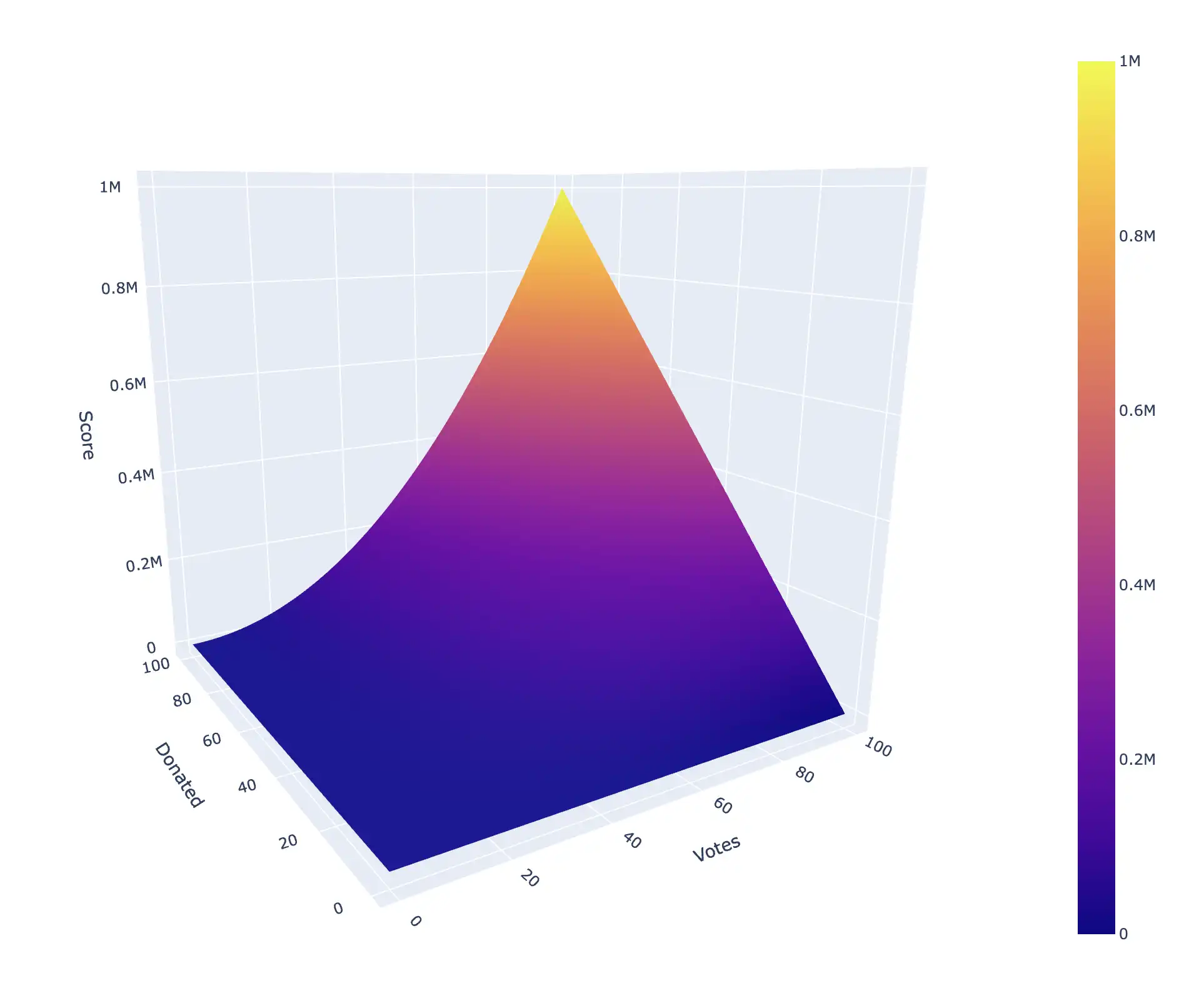
This visualization uses the total donation amount and the number of votes to create a 3D surface plot of the funding function.
Conclusion
Quadratic Funding represents a potentially valuable tool for more efficiently allocating resources to public goods based on community support. While it addresses several issues of traditional funding mechanisms, such as the free rider problem and centralized decision-making, it is not without challenges. Sybil attacks and the complexity of the formula are notable concerns. However, with proper implementation and safeguards, Quadratic Funding could significantly improve the funding landscape for public goods.
References:
- Buterin, V., Hitzig, Z., & Weyl, E. G. (2018). Liberal Radicalism: A Flexible Design for Philanthropic Matching Funds. Retrieved from https://papers.ssrn.com/sol3/papers.cfm?abstract_id=3243656
- Weyl, E. G., & Zhang, L. (2020). Quadratic Finance: Effective Altruism Through Democratic Funding. Economics for Inclusive Prosperity.