
萃行王假有廟利見大人謂用大牲吉欲往)
Oracle Bone and Bronze Script Origins
萃 (cuì – “to gather”) – Likely a later compound character. The hexagram name 萃 literally means “assembling.” In the Zhou Yi commentary it is glossed as 聚 (“to gather together”) (Cui - Book of Changes : Yi Jing - Chinese Text Project). The character is composed of the “grass” radical (艸) atop 卒 (originally depicting a crowd or soldier). While not attested in Shang oracle bone script, its form suggests a picture of things clustering (like plants growing densely). Thus 萃 originally conveyed the idea of a thick gathering or accumulation (as of people or offerings).
行 (xíng – “to go; move”) – Pictograph of a road or crossroads. In oracle bone script, 行 was drawn as intersecting paths or footprints, representing a road or walking (彳 Chì | "Step with the Left Foot" - The Learning Lotus Project). It literally meant “to go” or “to travel.” The modern form still hints at two parallel roads. In early usage, 行 simply denoted movement or the act of going. (Only much later did it also come to mean “conduct” or “behavior.”)
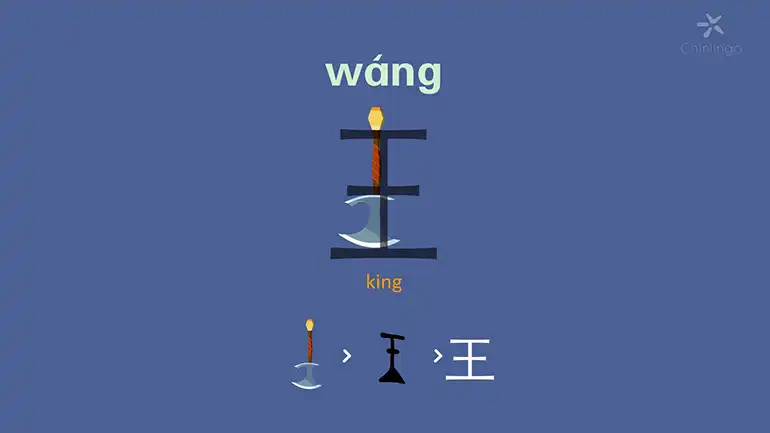
王 (wáng – “king”) – Pictograph of a great axe or authority symbol. Oracle bone forms of 王 resemble a large axe with a long handle (the top as the grip and the bottom as the blade) (Chinlingo Chinese character: 王 | Chinlingo). In Shang times the axe was a symbol of power and authority, so 王 was used to mean the sovereign (Chinlingo Chinese character: 王 | Chinlingo) (the kanji 王 | KANJI PORTRAITS). Some scholars also interpret the oracle graph as three horizontal lines (heaven, earth, people) linked by a vertical line – the king as the axis connecting the realms. Either way, the earliest meaning of 王 was the literal king/ruler who wielded power (often the Shang king himself in divinations).
(Chinlingo Chinese character: 王 | Chinlingo) Evolution of 王 (“king”) from a large battle-axe pictogram (left) to the modern form (right) (Chinlingo Chinese character: 王 | Chinlingo).
假 (jiǎ – “to proceed toward”) – Original meaning “to approach/arrive at.” In the context of the Zhou Yi, 假 is read in an archaic sense (pronounced gé) meaning “to go to” or “to arrive” (translation - What's the meaning of 登假 in old daoist scriptures like Zhuang Zi? - Chinese Language Stack Exchange). The character is phono-semantic: the 言 radical (speech) was added later for the sense “to borrow” or “false” in other contexts, but in early usage (without the speech connotation) 假 meant 至 (“to reach”). For example, 王假有廟 in the Zhou Yi literally means “the king arrives at (goes to) the ancestral temple.” The bronze inscription form of 假 shows a person (亻) with an element indicating phonetics, used here to convey movement toward a place.
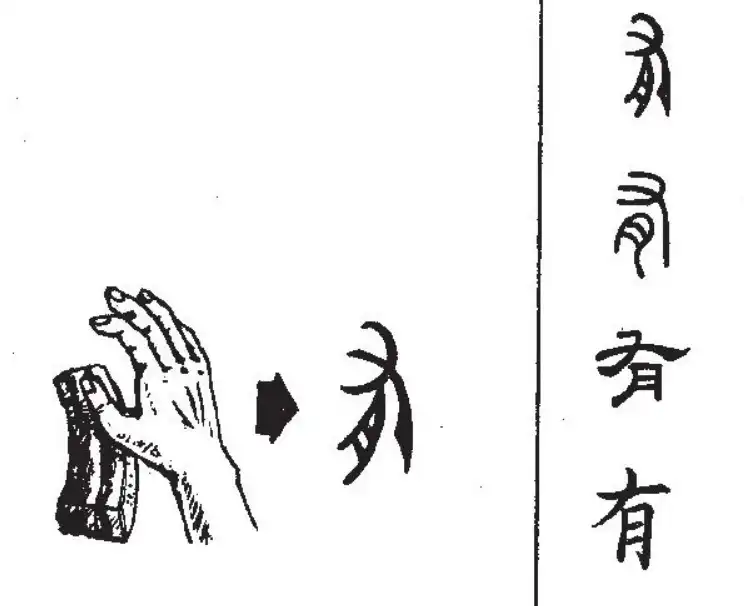
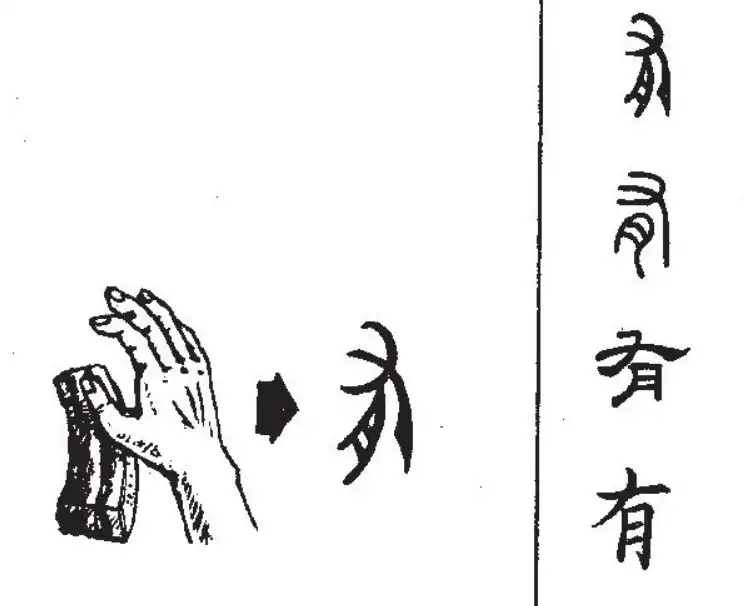
有 (yǒu – “to have; to possess”) – Pictograph of a hand holding meat. Oracle bone characters for 有 depict a hand (又) grasping a piece of meat 月 (which stands for rou, “flesh”) (有 - Dong Chinese dictionary). The image literally conveys “to hold meat [in hand],” symbolizing possession of a prized good. Thus the earliest meaning of 有 was “to have [food/wealth] in hand” or more generally “to possess/exist.” Over time, the flesh component was stylized (and later misidentified as the “moon” radical), but the idea remained “to have” (有 - Dong Chinese dictionary). In Shang oracle inscriptions, 有 commonly appears in questions like “Will there be (有) rain?” indicating existence or occurrence.
(国际中文日 | 汉字有一“手” - 中国日报网) Oracle bone form of 有 (“have”) showing a hand holding a piece of meat, illustrating the original meaning “to possess [meat/offerings]” (有 - Dong Chinese dictionary).
廟 (miào – “temple, ancestral shrine”) – Ideograph of a roofed ancestral hall. The character 廟 combines 广 (“roof/building”) with 朝 (phonetic cháo, originally “morning” or “court”) (庙 miáo - Chinese Etymology - Obsidian Publish). In early bronze script, it likely depicted a lineage hall where morning rites to ancestors were held. The concept of 廟 was the ancestral temple – a sacred hall for enshrining ancestors’ tablets and making offerings. In Shang or early Zhou inscriptions, the ancestral temple is sometimes indicated by related characters like 宗 or described contextually, but 廟 as written in the Zhou Yi conveys this building used for worship of royal forebears (庙 miáo - Chinese Etymology - Obsidian Publish). The original meaning is specifically an ancestral shrine (not a generic “temple” for any deity, but the family hall of past kings).
利 (lì – “benefit; favorable”) – Ideograph from harvesting grain with a knife. The character 利 is formed by 禾 (“grain stalk”) and 刂/刀 (“knife”), literally picturing the cutting of grain (Chinese character lì 利 sharp). This signified a good harvest – a tangible profit/benefit to agrarian people. Thus the earliest sense of 利 was “to reap a profit” or “advantageous” (much like a successful harvest is beneficial) (Chinese character lì 利 sharp). In oracle bone script, a similar graph was used to ask if an outcome would be favorable (利). The idea of 利 in Shang divinations was a positive, advantageous result. Over time 利 broadened to mean “sharp” (as a knife) and abstract “benefit,” but its root meaning is the favorable gain one gets (originally from the land’s bounty).
見/见 (jiàn – “to see; meet”) – Pictograph of an eye on a human figure. The traditional form 見 shows an eye (目) atop human legs or a person (儿) – literally “an eye seeing (a person)” (见- Dong Chinese dictionary). This vividly conveys the act “to see/meet.” Oracle bone and bronze forms depict an eye with legs, indicating seeing or visiting. The character originally meant to see (actively) or to appear (passively) before someone. For example, 見大人 in the Yi text means “to see (meet with) the great man.” The simplified 见 retains an abstracted eye shape. The core concept in antiquity was concrete – the physical act of seeing or encountering (见- Dong Chinese dictionary).
大人 (dà rén – “great person”) – Composite term: “big person,” meaning a person of high rank. 大 is a pictograph of a person standing with arms outstretched, denoting “big” or “great” (每日中文 Daily Zhongwen: Dà 大[Big] —— 字&词). 人 is the basic character for “person.” Together, 大人 literally “big person” was an epithet for an adult or noble. In early inscriptions and texts, 大人 referred to someone of great stature or importance – e.g. a chieftain, lord, or elder. It did not merely mean morally “great” but rather socially eminent (a dignitary or superior). For instance, in the Zhou Yi “利見大人” implies it is beneficial to see the great man, likely meaning to consult or be received by a person of authority. Thus 大人 in the early Zhou context indicated a real aristocratic figure or elder statesman, revered for status and influence (including possibly an ancestor spirit in some contexts).
謂/谓 (wèi – “to say; to call”) – Phonetic compound with “speech” radical. The character 謂 is composed of 言 (“speech”) + 胃 (phonetic, pronounced wèi). Its original meaning was “to say” or “to name.” In bronze inscriptions, forms of 謂 would have the speech element, indicating it involves speaking. Early usage included phrases like “X 謂 Y” (“X says that Y…” or “calls Y [something]”). In the Zhou Yi’s early language, the concept behind 謂 is simply to speak or express – there is no esoteric meaning yet. (For example, “所謂” in archaic texts means “what is called…”.) The character’s construction shows a voice issuing forth (言) with the wèi phonetic hinting the sound. Thus originally 謂 = “to say (that)…”.
用 (yòng – “to use; to employ”) – Pictograph/ideograph of an object in use. In Shang oracle bone inscriptions, 用 frequently appears as a verb meaning “to use [for sacrifice]”. The graph in oracle script may depict a hand or device brandishing something (some scholars think it shows a vessel or a pole with meat, indicating an offering in use). By the Western Zhou bronze era, 用 was a common term for “to use, to take” and specifically in divination language it often introduced sacrificial offerings (e.g. “用牛” – “use an ox [in sacrifice]”). The character’s earliest function was as a verb of employing or expending something in a ritual or action. In the Zhou Yi text, 用 retains this concrete sense (as in 用大牲 – “to use a great sacrificial animal”). Essentially, 用 signified “to make use of” – here, to make an offering or take action.
大 (dà – “big; great”) – Pictograph of a person with outstretched limbs. As noted above, 大 in oracle bone form is a stick figure of a human standing tall with arms and legs spread wide (每日中文 Daily Zhongwen: Dà 大[Big] —— 字&词), expressing the concept of largeness or greatness. The Shang scribes used it to mean “great” in size or importance. It often appears in descriptions like 大吉 (“great auspiciousness”) or 大示 (great ritual). The simplicity of 大 made it one of the most stable characters from oracle bone to modern script. Its original meaning was purely “big”, whether literally large or metaphorically important.
牲 (shēng – “sacrificial animal”) – Ideograph: cow + life. The character 牲 combines 牛 (“ox/cow”) with 生 (“life/birth”). In ancient writing the 生 component likely indicated a living creature. Sheng originally meant a domestic animal reserved for sacrifice (牲stroke order). In oracle bone records, real animals – oxen, sheep, pigs – were frequently offered to ancestors or spirits. 牲 thus denoted a live sacrificial beast, typically an ox in the highest ceremonies (a “whole ox” offering) (牲stroke order). The Shuowen dictionary glosses 牲 as “full-grown ox used in sacrifice.” In early Zhou usage, 大牲 meant a “great victim” – usually a large animal like an ox – as opposed to smaller livestock. The character encapsulates the ritual practice of slaughtering livestock to communicate with or honor the spirits.
吉 (jí – “auspicious; lucky”) – Ancient symbol of good fortune from an offering vessel. The oracle bone form of 吉 showed a container or altar with a lid or possibly a wine jar topped by a ritual object (the kanji 王 | KANJI PORTRAITS). One interpretation is that it was a vessel filled with offerings and securely covered, indicating that the offering was accepted and sealed – a sign of good omen (the kanji 王 | KANJI PORTRAITS). Another view is that it depicts a boar’s head or halberd over a bowl, signifying a successful ceremonial feast. In any case, from the Shang oracle records, 吉 was the standard term for an auspicious outcome. Diviners would inscribe 吉 when the omen was favorable. The character’s original meaning is unequivocally “fortunate” or “propitious.” For example, an oracle inscription might read that the crack result was 曰吉 (“declared auspicious”) (the kanji 王 | KANJI PORTRAITS). Thus 吉 began as a ritual verdict signifying that the gods or ancestors were pleased – a positive sign. (Its opposite was 凶 “inauspicious.”)
欲往 (yù wǎng – “to desire to go [forth]”) – Phrase composed of “desire” and “go.” The character 欲 (yù) originally combines 谷 (“valley,” phonetic) with 欠 (“yawn/open mouth,” indicating desire or lack). Early on, 欲 meant “to want” or “to long for,” with connotations of craving something one does not have. The graph may have suggested hunger (a open mouth) for grain (谷) – literally desiring food. 往 (wǎng) as a character joins the 彳 “step” radical with an element like 主/土 indicating direction (往stroke order). In oracle bone form it was often 止 + 土, meaning “to depart from a place,” i.e. to go toward a destination (往stroke order). In the Zhou Yi text, 欲往 appears as a condition: “(if one) desires to proceed”. Each part carried its literal sense – 欲 simply “wants,” 往 “to go.” There is no moral judgment in the terms themselves; they describe the intention to act. Thus in early usage 欲往 conveyed the scenario of *intending to undertake a journey or venture. (Notably, the Zhou Yi often says “利有攸往” – “it is favorable to have somewhere to go,” implying that having a forward aim is auspicious.) The phrasing reflects the straightforward idea of desiring to go forth on some mission or expedition.
Pre-Zhou Yi Usage in Divination and Ritual Contexts
In the Shang and early Zhou period (c. 1200–800 BCE), these characters were not abstract concepts but practical terms in divination, state ritual, and daily governance. Many appear in the Zhou Yi (Book of Changes) as part of oracular statements reflecting real activities of that era:
King and Ancestral Temple (王假有廟): The phrase “王假有廟” (ZY Translation Workbook 08 (Teacher 3 TNR)) in Hexagram 45’s judgment literally means “the king proceeds to (or reaches) his temple.” This reflects an actual royal practice: before major undertakings, the Zhou king would visit the ancestral shrine (廟) to offer sacrifices and consult the ancestors. In Western Zhou bronze inscriptions, kings frequently report making offerings in the宗廟 (ancestral temple) to seek favor or guidance. The Zhou Yi preserves this by showing the ideal response to a time of gathering (萃) is the king performing ancestral rites. Thus, 王假有廟 indicates a ruler engaged in a divinatory sacrifice at his lineage temple – a central act of state religion. It grounds the omen in a concrete political ritual: the king solidifying ancestral support for collective action.
Favorable Audience with the Great Man (利見大人): Many Yi oracles state “利見大人”, “it is beneficial to see the great man” (ZY Translation Workbook 08 (Teacher 3 TNR)). In an early Zhou context, this advised seeking out a “大人” – a great person of authority or wisdom. That could mean consulting a high elder, a sage counselor, or even invoking an ancestral spirit (the Great Person could be an esteemed ancestor in the shrine). In practical terms, a noble in trouble should go meet his lord or an expert for help. This shows the importance of hierarchy and counsel in Zhou society: guidance from those of high status (or ancestral powers) was considered key to success. The oracle’s language implies that in times of decision, one should audience with a superior (or wise advisor) – very much a reflection of how political and military decisions were made via council and ancestor worship. There is nothing mystical in “大人” here beyond the literal important personage who can affect the outcome.
Offering Large Sacrifices (用大牲吉): The judgment text “用大牲吉” declares “Using a big sacrificial victim [brings] good fortune.” This directly mirrors Bronze Age ritual norms. In Shang and Zhou rites, sacrificing a large animal (牲) – typically an ox – was the highest form of offering to the spirits. Oracle bone inscriptions show oxen, sheep, and pigs were common sacrificial animals, with oxen being especially prestigious (Shang Sacrificial Animals (Chapter 1) - Animals through Chinese History). A successful sacrifice of a “大牲” (literally “great sacrificial beast”) was believed to please the ancestral spirits and Di (High God), resulting in a 吉 (auspicious) outcome. The Yi text is essentially prescribing a ritual: if you want a favorable result, make a grand offering. This illustrates the close tie between divination and sacrificial practice – the divination’s promise of 吉 is conditional on performing the proper rite (用大牲). It also reflects the political reality that kings demonstrated piety and secured Heaven’s mandate through lavish sacrificial ceremonies. In early Zhou, offering an ox could be part of royal legitimization ceremonies or prayers for victory, and the Yi’s language encapsulates that tradition succinctly.
Having a Direction to Go (利有攸往): Phrases like “利有攸往” (literally “favorable to have someplace to go”) occur in the Zhou Yi, including Hexagram 45 (ZY Translation Workbook 08 (Teacher 3 TNR)). In the oracle context, this means the omen is good if one has a forward purpose or undertakes something. This reflects the mindset of practical divination: a reading wasn’t just for contemplation, but to guide action. An empty omen was wasted – having “somewhere to go” (some mission or campaign) was deemed advantageous under the circumstances. In early Zhou, leaders regularly asked oracles whether it was 利往 (“favorable to go”) on a campaign, journey, or other endeavor. The Yi text generalizes this as a positive indication for those who 欲往 (wish to proceed) on an enterprise. It encourages initiative: if the cracks or hexagram are auspicious, one should proceed with one’s planned venture. Notably, this phrase shows that the early Zhou Yi was concerned with worldly outcomes – success in war, travel, or projects – very much in line with the divinations recorded on bones.
Divination Outcomes (吉/凶) Declared by the King: In Shang oracle bone inscriptions, the king (王) himself often pronounced whether the omen was 吉 (auspicious) or not after interpreting the cracks. For example, one unearthed oracle text reads: “王曰吉” – “the king said: ‘It is auspicious.’” (the kanji 王 | KANJI PORTRAITS). This highlights that 王 was the central actor in divination, and 吉 was a desired verdict. The Zhou Yi preserves these terms as generic outcomes (吉, 利, or “no blame,” etc.), but originally they were the actual judgments given in ritual. The fact that “吉” is paired with sacrifices and royal actions in the Yi suggests those texts evolved from scenarios where the king performed a rite and obtained a favorable sign. Early Zhou rulers continued this Shang practice of seeking 吉兆 (lucky omens) to validate decisions. Thus, characters like 王 and 吉 in these texts are direct echoes of the divinatory ritual: the king interpreting a positive crack as auspicious (the kanji 王 | KANJI PORTRAITS).
Overall, before later philosophical layers accrued, these terms were used very pragmatically in the early Zhou. The Zhou Yi judgments likely originated as concise records of divinations pertaining to royal activities: assembling allied lords (萃) for an event, the king going to the ancestral temple (王假有廟) to make offerings with an ox (用大牲) and seek ancestral blessing (求吉). If all went well, the result would be 吉 and it would be 利有攸往 – the venture could go forward under favorable auspices. Each character thus slots into a real-life ritual context familiar to a Western Zhou noble.
Notably, none of these terms had yet acquired the heavy moral or abstract meanings that they would in later classical interpretation. They were rooted in court rituals (廟 offerings), social hierarchy (王, 大人), and divinatory practice (吉, 利, 用) in a very matter-of-fact way.
Ritual, Social, and Political Implications in Early Zhou
The usage of these characters in early Zhou sources reveals how closely religion, governance, and society were intertwined:
Sacral Kingship: The king (王) in Shang and Zhou was not only a political leader but also the high priest of the state. The phrase 王假有廟 shows the king legitimizing his rule through ancestral rites. By “proceeding to the temple,” the king acknowledges that political authority flowed from ritual authority. Early Zhou kings, as heirs to the Mandate of Heaven, had to continually affirm their ancestors’ approval. The ancestral 廟 was the spiritual center of power – decisions of war, alliances, harvest, etc., were ratified in the shrine. Thus, these characters highlight that religious ritual (廟 sacrifices) was a foundation of political legitimacy. A king who properly performed sacrifices (用大牲) and obtained auspicious omens (吉) could claim divine sanction for his commands, strengthening his rule over the nobles.
Ancestral Worship and State Rites: The term 廟 (ancestral temple) underscores the importance of lineage in Zhou society. Each noble house had its 廟 where the spirits of predecessors were consulted. By using 有廟 (“having a temple”), the text suggests that a ruler with an established ancestral cult can draw on the collective power of his forefathers. Sacrifices of 牲 (animal victims) in the 廟 were not merely religious piety but a social occasion to reinforce kinship bonds among the living aristocracy – a time when lords gathered (萃) and reaffirmed their loyalty to the Zhou king, often in grand feasts following the rites. In early Zhou political structure, the ancestral temple was also where covenants were sworn and historical precedent evoked. These characters, then, point to the ritual glue that held the feudal order together: regular homage to ancestors ensured continuity of authority from one generation to the next.
Role of the Elite and Advisors: The concept of 大人 (great men) in the early context has implications for Zhou social structure. It acknowledges a class of wise, influential figures whose counsel or presence is advantageous (利見大人). In practical terms, this validated the role of advisors, elders, and regional lords in governance. The kings of Zhou, especially in the early period, ruled through a network of such “great persons” (often blood relatives enfeoffed as lords). Consulting the 大人 could mean holding council – an early Zhou king making decisions would convene his trusted chiefs for advice. It could also hint at the practice of seeking out sages or even the reclusive wise (as King Wen is mythologized to have done). Thus 利見大人 reflects the collegial and hierarchical nature of Zhou rule, where a ruler’s success depended on the support and knowledge of other powerful individuals. Socially, it reinforced respect for elders and superiors as bearers of luck and order.
Divination as Decision-Making Tool: Terms like 利, 吉, 用, and 往 show that early Chinese decision-making was highly based on divination. Before undertaking endeavors (be it a military campaign, a hunt, or a large construction), the ruler or noble would divine whether it was 利有攸往 – advantageous to proceed. A positive sign (吉) was taken as Heaven’s approval. This ritualized system gave a spiritual warrant to political and military actions. It also imposed a check: if omens were unfavorable (不吉 or 凶), the action might be delayed or cancelled. The presence of these terms in the Yi text indicates it served as a guide for such deliberations. Importantly, the combination 用大牲吉 encapsulates the notion that human action (offering a sacrifice) could influence divine favor, which in turn influenced human action (whether to go forth or not). In early Zhou governance, this created a feedback loop between ritual and policy – the ruler performs the correct rites, and the oracle dictates the auspicious course of action.
Heaven’s Mandate and Moral Order (proto-concepts): While overt moralization is absent, we see the seeds of the Mandate of Heaven idea. If the king faithfully performs sacrificial rites (致孝享 as the Tuan Zhuan says, meaning “carrying out filial offerings” (Cui - Book of Changes : Yi Jing - Chinese Text Project)) and consults the 大人, then Heaven (via the ancestors) grants 利 and 吉. This implies that right conduct in ritual yields divine approval. Early Zhou inscriptions often credit success to ancestral blessing – for example, a bronze inscription might say a victory was fu (阜) or 吉 thanks to the ancestors. Thus the Yi’s prescription of ritual and propriety for good fortune reflects how Zhou leaders believed social harmony and political success were achieved: through reverence (to ancestors and superiors) and compliance with ritual duty. This was not yet the ethical philosophy of Confucius, but a religious-social formula – do the proper rites, respect the hierarchy, and the result will be favorable. In a sense, it was pragmatic morality rooted in ritual correctness.
In summary, each of these characters illuminates an aspect of early Zhou culture: 王 and 廟 show the sacral kingship and ancestor veneration; 大人 and 行/往 show the structured social action (leaders and movement); 利, 吉, 牲, 用 show the interplay of ritual and fortune; and 萃 (gathering) shows the collective dimension (assembling the community for ritual or war). Far from abstract concepts, they were keys to maintaining order and legitimacy in the Zhou world. Sacrifice and divination were deeply political acts, and the written characters of the Zhou Yi capture that reality.
Early Meanings vs. Later Interpretations (Peeling Away Later Glosses)
It is important to note that our analysis above sticks to the original, early Zhou meanings of these terms, without the layers of commentary that accrued in subsequent eras. Later Confucian and Neo-Confucian scholars reinterpreted many of these characters in a moralistic or cosmological light, often obscuring their concrete origins:
For example, in later readings of the I Ching, 大人 (“the great man”) came to symbolize the exemplary sage or junzi, almost a moral archetype. But in the Bronze Age context, 大人 simply meant a powerful aristocrat or ancestor – an actual personage, not an ethical ideal (ZY Translation Workbook 08 (Teacher 3 TNR)). We avoid the later moral gloss and keep 大人 grounded in its original social context.
Similarly, 王 in Zhou Yi commentaries might be allegorized as any leader or even the inner self, and 廟 as abstract “spiritual focus.” In our analysis, 王 is the literal king and 廟 his literal ancestral temple – as it was in 10th-century BCE practice. This literalism reveals the text’s authentic setting: early Zhou court rituals, rather than, say, an allegory for “the kingly way within one’s heart.”
利 and 吉 in later philosophy were sometimes read as “profit” vs. “righteousness” (with a mistrust of 利 as selfish gain in Confucian thought). But on the oracle bones and in the Yi’s original usage, 利 was unequivocally favorable advantage, with no negative connotation (Chinese character lì 利 sharp). And 吉 was a simple auspicious omen, not a moral reward for virtue – unless performing the rite is counted as a virtue. We’ve treated 吉/利 as pragmatic terms of divination, avoiding later ethical overlay.
The character 欲 (“desire”) later, under Daoist or Buddhist influence, took on a sense of earthly desire that should be controlled. In 欲往 during the Zhou, there is no such connotation of impropriety – it is just “wanting to go.” By focusing on the early usage, we see that 欲 was value-neutral, not yet laden with guilt or stigma as “craving.” The text is concerned with whether that desire to act will meet with fortune or misfortune, not with suppressing desire itself.
行 in modern Chinese can mean “conduct” or moral behavior (as in xíngwéi), but as we showed, its root meaning is walking or traveling. Thus, when interpreting early passages, we take 行/往 in the sense of physical movement or proceeding with an endeavor, rather than any later abstract sense of “the conduct of affairs” or “the Tao in action” which some philosophical readings impose.
By peeling away the later commentarial and metaphysical glosses, we rediscover these characters as they functioned in Western Zhou divination and statecraft. They are the vocabulary of a Bronze Age nobleman consulting the spirits about real-world concerns – harvesting and warfare, loyalty and worship. This approach lets us appreciate the Zhou Yi as it might have been understood around 1000–800 BCE: a manual of prognostication grounded in ritual pragmatism and socio-political reality, rather than a cryptic treatise on cosmic principles or personal ethics.
Sources: Early Chinese inscriptions and modern analyses provide the basis for these interpretations. Oracle bone script artifacts show pictographic origins (e.g. 王 as axe (Chinlingo Chinese character: 王 | Chinlingo), 有 as hand-with-meat (有 - Dong Chinese dictionary), 見 as eye+person (见- Dong Chinese dictionary)). Bronze vessel texts and the Zhou Yi itself illustrate usage in context (e.g. 王假有廟, 利見大人 (ZY Translation Workbook 08 (Teacher 3 TNR)), 用大牲吉 (ZY Translation Workbook 08 (Teacher 3 TNR))). These readings align with scholarly research on Shang–Zhou religion and the original meaning of the Zhou Yi, emphasizing how each character was embedded in the ritual and social fabric of early Zhou society (the kanji 王 | KANJI PORTRAITS) (Shang Sacrificial Animals (Chapter 1) - Animals through Chinese History). By understanding the characters on their own terms, we see the Zhou Yi not as mysticism or abstract philosophy, but as a window into a world where kings, ancestors, and omens guided the course of civilization.