

Ethereum is being censored
Introduction
On August 8, 2022, the U.S. Treasury Office of Foreign Assets Control (OFAC) sanctioned Tornado Cash. Making no mention of the positive and legal uses of Tornado Cash for privacy, the U.S. Treasury used its unilateral authority to sanction Tornado Cash on the basis of its use for money laundering. From the start, the cryptocurrency community has been largely unanimous in its opposition to the sanctions, with Coin Center’s Peter van Valkenburgh giving a rebuttal the same day (with the author in attendance), and several lawsuits having been brought against the U.S. Treasury to remove Tornado Cash from its sanctions list (1, 2).
The point of this essay is not to examine the background or justifications for the sanctioning of Tornado Cash - there are many more qualified people working on that. To make my own bias clear, I think the situation can largely be summarized by Phil Zimmerman - “If privacy is outlawed, only outlaws will have privacy.” Instead, I would like to examine a flaw I perceive in the current metric used to assess whether the sanctions have been effectively “overcome” by Ethereum.
Following Treasury’s actions, Ethereum’s Proof of Work miners and eventually Proof of Stake validators (collectively, “block producers”) were forced to consider whether or not to include sanctioned addresses in the blocks they produce. For example, is including a sanctioned address in my blocks “illegal”? Will I be punished for including “sanctioned” transactions in my blocks? Do I bear any responsibility for the actions of others? (Keep in mind, it is not necessarily the case, and, in fact, usually not the case, that a given block producer has anything to do with the transactions that they are helping to add to the blockchain ledger.)
OFAC Compliance
The result of the above forced decision-making has been that some block producers have decided to keep processing “sanctioned” transactions while others have not. In common parlance, block producers that do not include sanctioned transactions are called “OFAC compliant” and have been, rightfully or wrongly, publicly criticized by many enthusiasts for “bowing down to the man”, more or less. (Here is one mild example.) OFAC-compliant block producers are also considered “censoring” since they effectively uphold OFAC’s blocking of Tornado Cash transactions.
The breakdown of censoring (OFAC compliant) and non-censoring (non-OFAC compliant) block producers is neatly summarized (to the best of my knowledge) on a website called mevwatch.info. The overall make up over time of censoring and non-censoring Ethereum blocks is displayed below.
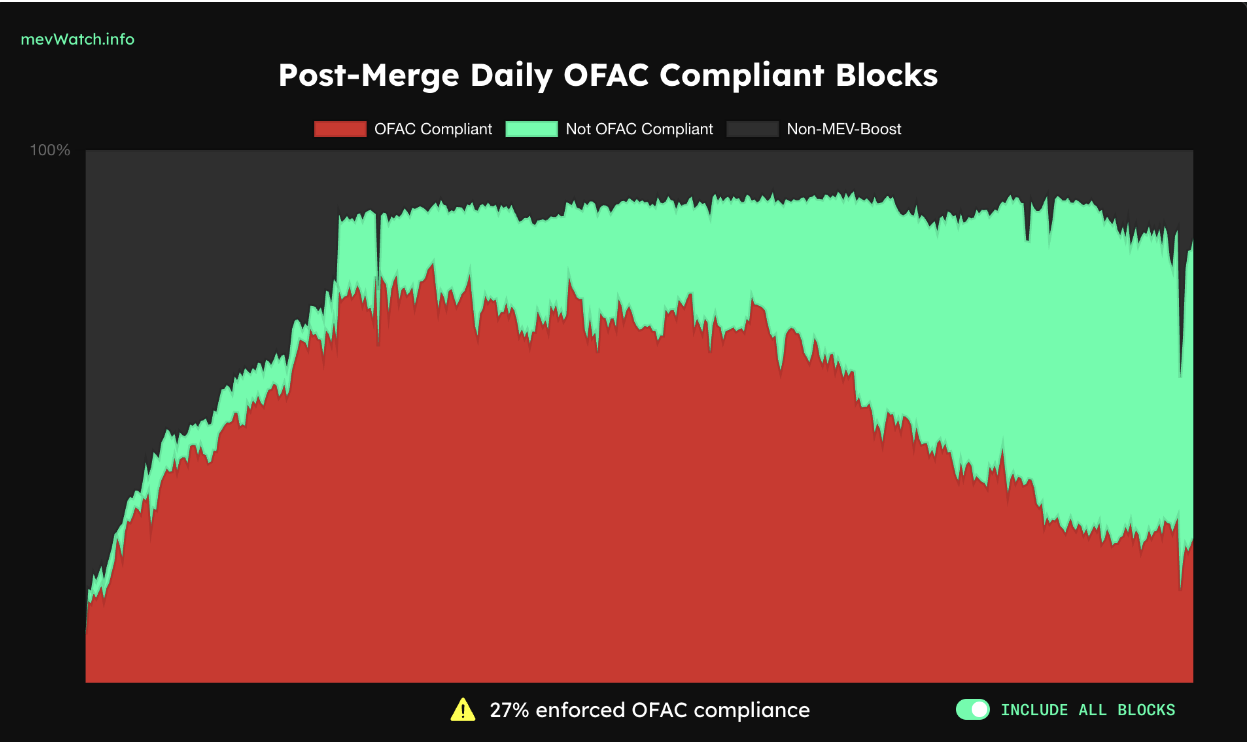
Percent of Ethereum blocks after the transition to Proof of Stake that do (Green) or do not (Red) contain sanctioned addresses. Other blocks that are undefined are colored gray.
Currently, there is 27% “enforced OFAC compliance”. Down from a high of 79% in November 2022. This trend has been lauded as meaning Ethereum is effectively “on the right track” when it comes to maintaining the basic value proposition of censorship resistance.
Contrary to what one might think, 79% censoring blocks does not mean 79% of sanctioned transactions are blocked and 27% censoring blocks does not mean 27% of sanctioned transactions are blocked. Studies have shown that even at relatively high levels of censoring blocks, sanctioned Tornado Cash transactions were still getting processed (3, 4). The main effect of censoring blocks has to do with the confirmation time for sanctioned transactions. In essence, the more censoring blocks, the longer the wait to get included in the blockchain.
A Clearer Picture of Censorship
So, does this mean that Ethereum, due to its decentralized nature and makeup of both compliant and non-compliant block producers, has effectively sloughed off the threat to its core value of censorship resistance? I would posit that no, it has not.
There is a simple reason for this that depends on one’s definition of censorship. If you define censorship as the technical ability to get a sanctioned transaction processed on Ethereum, then Ethereum is indeed censorship resistance. But if you define censorship as the ability for a censor to stop someone from taking an action that they otherwise would have, then Ethereum is not censorship resistant.
To examine if censorship is occurring under the latter, more broad, definition, we can look at Tornado Cash activity. Doing so, we see that Tornado Cash activity has largely dissipated. From a high of 775 unique addresses per week before Treasury’s sanctions, it has fallen to an average of ~75 unique addresses per week since the sanctions took place - a near 90% decline.
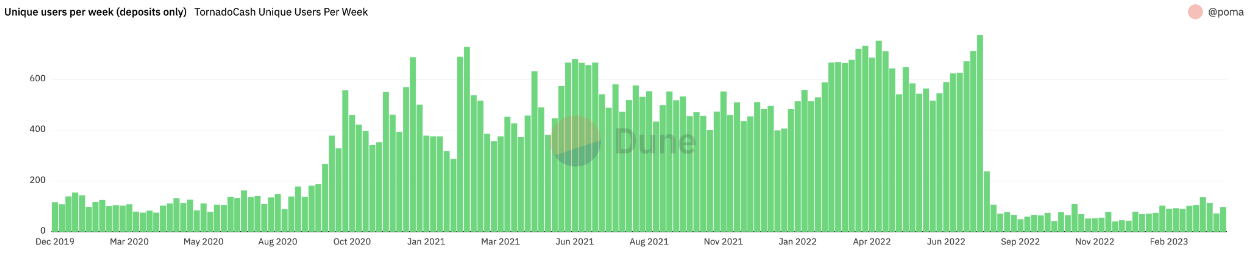
Unique active addresses using Tornado Cash per week. OFAC sanctions occur on August 8, 2022 coinciding with a large dropoff in activity.
Interestingly, about half of the ETH still remains in the Tornado Cash smart contracts after the sanctions. From anecdotal evidence, some of this may be due to law-abiding Tornado Cash users who do not want to withdraw their ETH due to the sanctions.
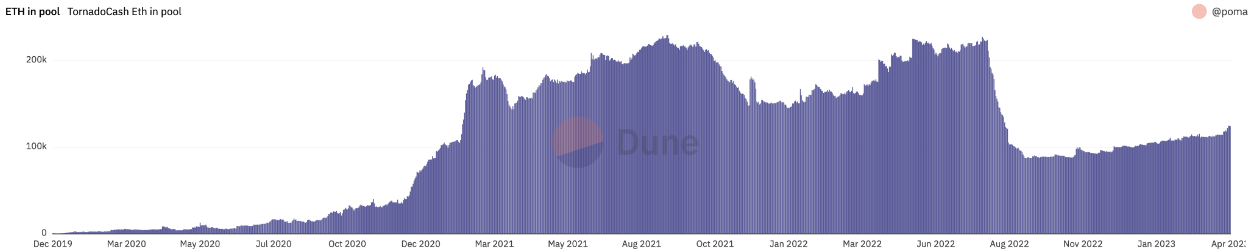
Number of ETH in Tornado Cash. OFAC sanctions coincide with a ~50% dropoff in early August 2022.
There are many complications to tracking Tornado Cash activity, including whether unique addresses interacting with the smart contracts are an accurate reflection of unique users (e.g., a single user may have many unique addresses under their control) and the fact that Tornado Cash has been deployed on numerous Ethereum-adjacent blockchains. Despite these complications, I think it is safe to say Tornado Cash activity has been effectively suppressed by the sanctions.
Many factors related to the sanctions may contribute to the suppression of Tornado Cash usage, including the shutting down of Tornado Cash’s Discord and website, the removal of its code base from Github (although subsequently re-published), the arrest (and still current imprisonment) of one its developers. However, none of these things technically prevent users of Ethereum from successfully using the still-live Tornado Cash smart contracts.
Instead, I wager (likely uncontroversially) that the number one reason for Tornado Cash’s decrease in usage is the effectiveness of the U.S. Treasury’s sanctions in preventing people from doing something they otherwise would be doing - in other words, the censorship is working. The threat of being punished for using Tornado Cash has censored Tornado Cash in a way the Ethereum blockchain could never do.
If a powerful actor were to ban a book, it does not make all copies of that book vanish. It is still theoretically possible to read that book despite the ban. That does not mean the ban is not working, it is a technicality. That is what some in Ethereum are celebrating - a technicality. The real censorship occurs because people are afraid to read the book or, in this case, use Tornado Cash.
Better Metrics
I do not think the focus on the technical possibility of using Tornado Cash is being done in bad faith. Instead, I think it is a reincarnation of Goodhart’s law and a lesson in being careful which metrics one uses. What other metrics could be used that might be more in line with the actual desires of censorship-resistance? It is hard to imagine using Tornado Cash activity as a good metric since that would incentive people to start advocating for something that is currently illegal in the US. However, I think a better metric can be borrowed from the non-blockchain world, namely, the percent of web traffic that is encrypted.
Numerous efforts have led to a larger and larger amount of web pages secured by HTTPS over time. It would be great if similar ideas could be applied to Ethereum and other blockchains to monitor the percent of encrypted transactions out of the total blockchain activity. There are numerous reasons why encrypted traffic would be a better measure than OFAC compliant blocks including: (i) we have seen even with high levels of OFAC compliant blocks, Tornado Cash transactions still get through, yet Tornado Cash usage has steeply declined, (ii) pushing for greater numbers of encrypted transactions will facilitate the safety and free expression of users, (iii) will normalize privacy on blockchains before their largely public-by-default nature becomes ossified, (iv) provide a necessary “safety in numbers” that is the basis of the privacy properties of encrypted transactions, (v) while some blockchain activity benefits from transparency (e.g., proof of reserves, activities of trusted authorities), most activity by individuals and businesses does not.
The good news is that encrypted blockchain activity can still be pursued without advocating for violation of the Tornado Cash sanctions. On Ethereum alone, new solutions such as Railgun and Privacy Pools are popping up that can give Ethereum blockchain users much needed privacy. (Note that I have not deeply researched these projects, yet).
Summing up,
- OFAC compliance is not a good metric for censorship-resistance on Ethereum since Tornado Cash activity is still being highly censored
- Censorship at the social level is more important than the technical level. (If a book is banned, still being able to obtain a copy of the book doesn’t mean the censorship isn’t working.)
- I would encourage those passionate about maintaining Ethereum’s core value proposition of censorship-resistance to incorporate other metrics of censorship-resistance, such as encrypted blockchain activity, to their efforts.
Closing thoughts
I do not mean to “make an example” out of Ethereum. I consider myself a member of the Ethereum community, I believe it is a vital component of a better future, and I believe many of the most important projects right now are on Ethereum, including public goods funding (e.g., Gitcoin) and Decentralized Science projects. I wrote this article because the Tornado Cash situation has given rise to a scenario where I think well-meaning enthusiasts are using an imperfect metric that misses out on the larger, more complicated story. And that this leads to a false sense of security that undercuts the larger mission of the crypto space.
As has been noted elsewhere, Bitcoin addresses are also on the Treasury sanctions list and all blockchains, to a greater or lesser extent, are susceptible to the type of censorship occurring with Tornado Cash.
Depending on the success of this article, I would be interested in writing a follow-up piece that examines how in the specific case of protocol level censorship, and perhaps social level censorship, the design of the Zcash blockchain offers certain advantages over transparent blockchains.
Disclosure
I hold several cryptocurrencies including ETH, ZEC, and ETH-based tokens.