One would think that Zeboot starts on Tuesday. But to me, it feels like it started long ago...
Zeboot Day 0
All new
One would think that Zeboot starts on Tuesday. But to me, it feels like it started long ago. I dare to say that it probably all began in 2019, where in August I joined ECC for a short time period to do a Zcash iOS SDK. Margaret (yes! That “Margaret”) told me that the team would be reuniting at the Denver office around the end of September. I already had vacations booked for the first part of the month and then the Denver trip fit like a glove. It was a coincidence, but others would call it destiny. In São Paulo, I kissed my girlfriend goodbye and we went apart. She flew back home and I took my flight to Denver.
I had never been to Denver but I knew my way around the US. First stop, the Apple Store. A regular MacBook Pro handles iOS development just fine. But not Zcash SDK development. Zcashd was frying my machine so I got this one I still carry with me. I had the same excitement as today, I was going to meet the team for the first time in a city I hadn’t been before. All new.
Shielded first
It all came back when I was sticking the new swag on the laptop lid. The Zebrad sticker next to the zcashd one. The AV club insignia and the ZAVAX bridge sticker.

In this very same machine, we had made history. The first shielded transaction from iOS to Android. I think I have the tx id somewhere, but not the keys of the wallet. You’ll have to imagine what the memo said.
The Denver trip was some sort of reboot. I did not know it until I saw the first day's sessions. ECC was preparing for a new era. New procedures, new structures. To me, it was all new.
Old new beginnings
I never knew if I found Zcash or if it was Zcash that really found me. So many things have passed since I committed my first line of code into Zcash’s codebase. Blossom, heartwood, canopy and the famous “NU5”, which set a new unprecedented kind of Zk-proofs out there. And “sandblasting”... So much can be said about it, and still it would feel as if it wasn’t enough. Anyone who went through those blocks, would never be the same as before. No Zcasher ever steps in the same river twice, for it's not the same river and it is not the same Zcasher- Zeraclitus said.
Still, here we are. On a plane (I can’t complain), restless to meet old and new friends, from a different role.
Zeboot Day 1
The day started with a workshop from ECC. The spirit of this workshop seemed to present ideas to the community members attending Zeboot with “an open mind” and “user focused”.
It started big:
“The work we will do today is the most important work of your life”
“A vision for Zcash” was a headline that resonated across the room. ECC’s new vision was to empower everyone with economic financial freedom.
The core principles that were stressed out were:
- Privacy
- Dignity
- Self-sovereignty
- Freedom
The ultimate goal would be getting Zcash to the point where obtaining financial privacy should be as easy as it is to close the curtains of your home.
ECC would focus on delivering products that drive adoption. And that started by figuring out one thing: What do people want?
Some hypothesis:
- Secure store of value
- Selective disclosure information
- Liquidity
- Security
- Compliance
Someone said:
“until we have user-friendly access to zec and private storage, nothing else matters”.
They defined storage in terms of:
- Self custody of shielded assets
- And legacy proof, meaning that you can have your relatives inherit your ZEC once you are gone without the need of getting help from others
What is Access then?
- Buy and sell ZEC on a phone
- On ramps
- DEX support
What could mission mean?
- Provide ZK proof of ______
- DeFi w/ ZEC
- Some really popular and straight forwards payment app w/ ZEC
- Custodian Service like “Casa for Bitcoin” but for ZEC
This is all good but… WE NEED TO SHIP
There was urgency in this phrase, because some points were brought up:
- ZEC <> BTC rate is going down. Meaning that constantly BTC is more chosen than ZEC
- Performance problems of last year broke the relationship the Zcash Devs had with their users.
- All time low address (transparent) usage while no new ZEC is coming to the shielded pools
- Regulatory pressure is building up, so getting the code out means that people will be able to pick it up and build it if Zcash orgs are somehow impeded to
- DEX access is urgent because CEXs could and eventually will be limited.
There’s a lot to do! But what should we, Zebooters focus on?
In this session all attendees were asked to gauge sentiment on what they put more effort into. There was a weighted ballot game that is not worth going into details about, but the results were interesting.
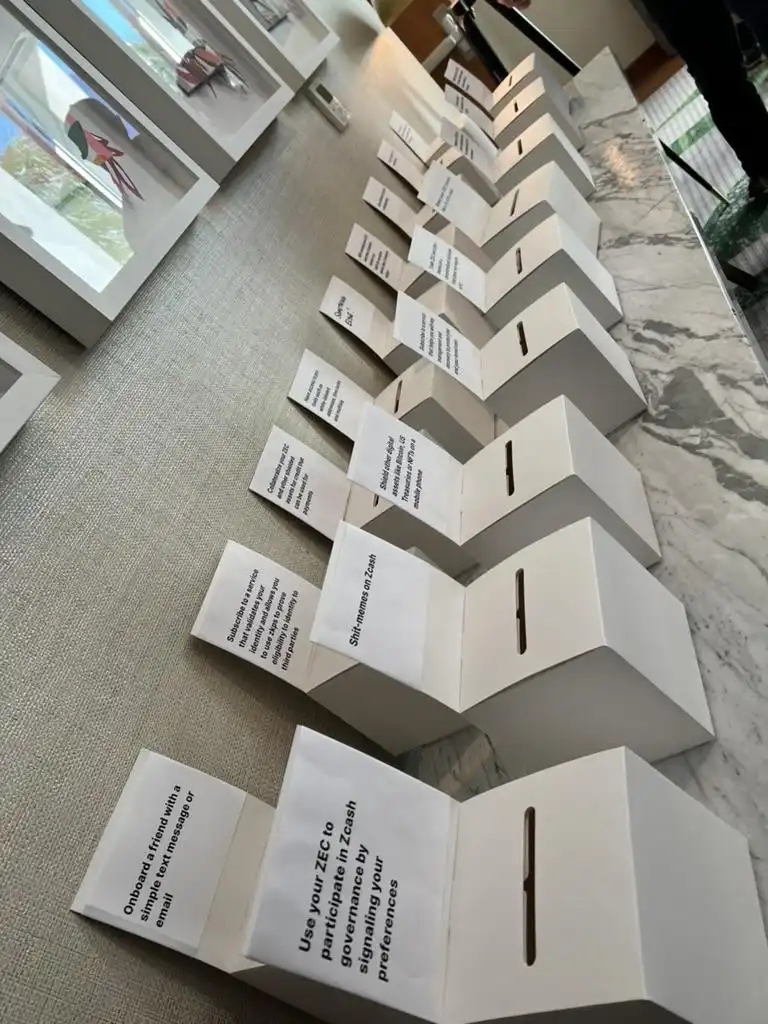
Among a dozen or more options most voted were: First “Venmo like” app and second “DEX”. It could be argued that there was a good deal of ECCers attending and voting and already developing a potentially seen as “venmo” app, so I would actually say that DEX would be a more legitimate number one. On the last place was “memecoins on Zec”. But the interesting part was the middle which was an open question: SOMETHING ELSE.
A lot of people wanted Something else from what ECC had proposed to them:
- Being able to spend ZEC in many places, meaning, having ways to actually SPEND ZEC without converting it into fiat or other fiat-like coins like USDT, DAI or USDC
- Highly related to the one above, a gift-card code system like Bitrefill but for ZEC.
- A system to distribute ZEC to builders more easily
- ZEC on other chains.
User engagement research
There’s an interesting thesis to debunk a popular crypto phrase. “We are not early, we are late”. What does this mean? That it has already happened! People needed borderless, censorship resistant, private payment and Zcash was not there for them. So for the case of Zcash, it can’t be said that we are “early”, in that sense “we are late” but we have the chance to turn that around and be there for every person that needs Zcash. .
We know by definition what Zcash is, but do we really know what Zcash means for its users? So the idea of building a "User adoption Engine” that can be started in order to bring more people on the ZEC wagon is in my view charming.
What would the “ideal” early adopter of Zcash look like? Probably we would be looking at users that:
- Have transacted in ZEC
- Used ZEC for payments
- Had barriers to spending ZEC in lot of places
- Would use ZEC for payments if there weren’t such barriers
- Highly recommend both transacting and hodling ZEC
What do numbers say? Those “ideal” users are a small fraction of the surveyed users. Not every early adopter has all of those characteristics, but a combination of a pair of them.
And what demographics were collected in this research?
Although It can be said that the USA is the home of Zcash, there are many other growing audiences that can’t be neglected.
Zcash’s reputation among its users:
ZEC is currently recovering from a very negative Net Promoter Score from previous years. This is a positive sign towards regaining the confidence of the community on the coin and its ecosystem.
From all kinds of ZEC users, there are some that promote ZEC more than others. We should focus on promoters of ZEC, because they are the ones that will carry the ZEC gospel across the globe.
The biggest barrier against adoption was identified as “no places to spend ZEC”, meaning that it would be relatively a no-brainer to recommend ZEC, but then once you have it, there’s not much you can do with it. Also, many users felt unhappy with wallets and confidence in them is really low.
At current prices, users appear to use ZEC as much as they can and would be very welcoming of solutions like Bitrefill to spend goods anonymously with Gift cards purchased with ZEC.
The key takeaway of this section of the day can be resumed in this quote.
“We just might have the people to make this work. There’s a greater group of people that are here for the right reasons and if we call them, they will respond”
Who is Zcash’s target user?
One of the afternoon sessions was all about you! Our beloved users! There are millions of users out there, every single one is a universe on its own. The Zeboot bunch was given some cues: What are the three kinds of Zcash users? What attributes do they have? How would you describe them? Are they enthusiasts, visionaries, pragmatists, followers or just out of the loop of the scene?
People split into groups to brainstorm about all of this and then gather together.
This is an assorted list of the answers that the groups debated:
- Zcash is for the De-banked, those who were actually banked and suddenly became unilaterally “ineligible” and denied access to their funds.
- Zcash is for merchants! Because they get all the properties of cash without the logistics of physical paper.
- Zcash is for those who can’t get a bank account or just won’t.
- GenZ’ers that look for consensual and private financial interactions but probably yet don’t know about ZEC
- People that need to exchange messages while transacting privately
- People who benefit from p2p models, such as artists, donations, ephemeral transactions (fair mechants, non-recurring purchases).
- Low-end cellphone users from non-developed countries.
- People that need to send and/or receive Cross-border payments
So thinking about all of these potential users, what shall the Zcash ecosystem focus on to make the most of the resources it has to reach users more effectively? What are the pains that those users are going through? What would be the best way to ease those pains?
Groups gathered again to come up with ways to actually reach out to those users they had envisioned with these questions in mind. And here are some of the points that came out:
- Zcash is a bit slow, it should be faster so that it can be used on over-the-counter kind of payments
It should provide a way to exchange messages alongside the p2p transactions that does not require a phone number. - It should be easier to get people to know and use (and therefore adopt) Zcash. A tool to onboard them all
- Text to onboard, some way to liberate a payment that can be collected afterwards by the recipient of some off-chain message (note: this is actually what liberated payments are)
- Merchants may not want to accept ZEC or any other form of crypto, but we could work around that by providing good services that can provide Gift cards, vouchers or any kind of prepaid credit card that Zcashers can redeem at retailers or online stores without needing to provide further details.
Zeboot Day 2
Rise and shine Zebooters! The second day of community workshops was going to be all about Protocol R&D.
After NU5 ECC’s engineering team had to focus on wallet problems and sandblasting, which postponed many of the plans they had for advancing the protocol towards Proof of Stake. There are many hypotheses on the effects of PoS on the Zcash ecosystem. Although it was pointed out that staking alone is not enough to revert the adoption trends, it could play a role in bringing users back to ZEC. The profile of Zcash miners changed substantially after ASICs took over the scene from GPU miners. Running validators and allowing stake delegation from mobile could be a way to bring those once avid Zcashers back.
Is PoS the only way forward for ZEC? Are there other alternatives that could actually drive adoption?
Of course, it was pointed out that there was a lot to do in the “use cases” front, regardless of the consensus mechanism. Continuing to build better wallet experiences, applications and developing other use cases for ZEC was something that shouldn’t be neglected. There are many things that could be explored: Programmability, DAOs, Meme-coins and education resources to attract new developers. Not letting perfect be the enemy of good, and focus on getting safe bridges to other chains and DEXs.
How will Zcash differentiate from other alternatives?
While Zcash’s mission remains unchanged and faithful to its core principles, how can Zcash be better at governance, reaching a worldwide audience? How many non-english speakers does Zcash have at the moment making decisions? From a tech-stack point of view, how can we improve the permissionless aspects of ZEC for a truly global audience?
These questions don’t have a single answer, but it can be the case that Proof of Stake can play a big role in every one of them.
What’s the point of Trailing finality in all of this?
Trailing finality means that anyone looking at a set of blocks at the trail of the blockchain, can have a set of properties that guarantees that the state represented by those blocks cannot be reverted. Unlike the assignment you finished pulling an all nighter in college, “block_final_FINAL.pdf” won’t cut it for a blockchain protocol. In order to make Zcash fast, reliable and interconnected with the rest of the DeFi ecosystem, we need assurance that our blocks are “final underscore FINAL in caps”, for real. That will let Zcash bridging, withdrawals and exchanges be faster with high levels of reliability and confidence.
WHEN PoS?
Maybe the most important question is not when, but how. Consensus mechanisms are not good or bad. They all have its benefits and drawbacks. Ultimately their goal is to make a bunch of computers agree on some state in a decentralized, byzantine fault tolerant and sybil resistant way. There’s not much point in switching from one mechanism to another if these properties are jeopardized along the way. ECC R&D engineers shared their vision on how they see this unrolling.
Meeting hybrid PoS.
If you’ve been at Arborist Calls you might have heard this before. The idea behind hybrid PoS is to gradually create a new kind of users (stakers) gradually over time and not in one day. We let Zcash rely on the security properties we all know from PoW while we roll out Proof of Stake.
During this transition users can stake ZEC and miners can mine ZEC. This should minimize disruption of the UX and allow a safe activation of the new consensus mechanism.
Some principles shared across the room were the need to make staking as private as possible. Today there’s a great deal of privacy provided to those who can mine a shielded coinbase. Staking should have privacy guarantees as well as auditability.
Crosslink, a stepping stone into a more modular Zcash.
PoW and PoS can’t be stitched together and just hit the “run” button on the Zcash nodes. Coordinating both supposes some deal of work. Crosslink is a layer over the consensus mechanisms that will allow connecting two ends to the same goal: finalizing a block into a blockchain. As presented by ECC R&D engineers, crosslink treats each one of the two consensus protocols as sub-protocols. Meaning that one sub protocol can be switched by another one. One of the sub-protocols will be the Zcash PoW protocol we know and the other will be the “new” PoS one. The fact that Crosslink allows to “switch” the subprotocols, is really important because this means that the PoS and PoW sides are not engraved in stone during this “transition”. They can be worked on, improved and updated as is has always been the case with the several “NUs” that Zcash has gone through. This will allow Zcash developers to keep evolving ZEC and introducing changes while maintaining all the safety properties of the current protocol.
Scratching the blackboard: What if ZEC was a rollup?
Someone warned “rollups increase throughput but don’t solve scalability because they are blockchains too”
This idea comes from the current landscape Zcash is immersed in. Zcash used to be THE zkp thing in crypto. That has changed and there are many competitors rising. Penumbra and Namada are two of them, but also Monero is evaluating moving away from ring signatures and embracing trustless ZKPs.
Takeaway: “No one is building rollups for privacy-centric protocols.”
Some ideas around this pivot were:
- Embrace Modularity, reject monolithic architecture
- Modern UX
- Interoperability
- Sources of new users:
- ZEC as gas token of a rollup, less pressure to sell ZEC
- Marketing opportunity
- Ability to have pre-confirmations and fast transactions
- These pre-confirmations could be shared across bridges and allow fast bridging of ZEC too
- Zcash would be the Data availability / L1 backing the rollups
- ZEC could build its own sequencer for more sovereignty
- Most sequencers are centralized, so bridging up decentralized privacy enabling sequencers could be disruptive
- ZEC as a gas token will increase liquidity and utility
- “Centralization on privacy coins has failed because there’s only one piece to attack, so privacy enabling technology inherently needs to be decentralized to be strong”
- Adopting other modular solutions for DA could help lower the amount of data needed to run a Zcash node.
Technical debt and obligations to the community
Note from ZWCD: What is tech debt? Tech Debt is a jargon term for the action of postponing maintenance work in favor of other work that is considered more meaningful to the project’s goals with the assumption that the postponed work won’t be a high risk for the project itself and that can be tabled for later. In my honest opinion, tech debt it’s usually mistakenly treated as “borrowing from granny”, when in fact its collecting dynamics and interest rates resemble more to borrowing from “day” or “shark” loaners where you never know when they will show up to your door asking for down payment.
Currently Zcash has a lot of tech debt and the teams have to start remediating that situation in order to be able to ship things fast and safely. Zcashd’s codebase represented a huge burden on the development teams when shipping new features. Sunsetting Zcashd would be a net positive for team velocity. Although Zebra is in a really good shape to occupy the void of retiring Zcashd, it lacks critical infrastructure and functionality that can’t be retired overnight, mostly the full node wallet and other tooling like regtest support.
There are many actors within the ecosystem that rely on this “old” infrastructure, so it would be interesting to gauge sentiment on what it would take for them to move on to Zebra and also to find ways to afford the cost of such maintenance if their specific use case can’t be served with the new infrastructure.
What about governance? Assessing community sentiment
After the tech debt debate the afternoon shifted to governance, community sentiment and the future of ZEC. How are we doing on governance in comparison with others?
The general sentiment was that it could be improved.
Where does community sentiment come from? There are many sources: Forums, ZCAP, Surveys, Github Issues, Z-Twitter, ZecHub, Ambassadors, Free2z, ZIP process.
The facilitator of this discussion proposed certain catalysts for change:
- Halving and Dev Fund expiring
- Inadequate funding for ECC and ZF
- US Gov pushing for Infrastructure as a Service to be KYC’d
- Hypothesis: The question is not if privacy enabling projects will be censored by regulators or not, it will most likely happen. The question is WHEN
- Is this a crisis or an Opportunity?
We need to gauge sentiment from the community because there are tough decisions to be made.
How to assess community sentiment?
- Coin holder voting
- On-chain governance (a long term opportunity)
- Remove controls on community speech
How to mitigate all this regulatory risk?
- Move Zcash orgs away from US
- Prioritize Anonymous participation on governance, grants and potential future dev funds
Opinions on this:
- “miners and validators run the consensus nodes and they ultimately support what’s being developed”
- “US policy should be fought back regardless of the jurisdiction of the Zcash orgs being changed. Every other country just copy what US regulators do either by submission or incapability to do something better”
Brainstorming ideas:
- Destroy the trademark agreement in favor of something else or nothing else.
- Move out of US jurisdiction
- Established a distributed global “Zenate” with 5 to 7 distributed organizations / community members to reduce liabilities
- Create a different distribution of funds for
- Protocol
- Network support
- Speculative funding of arbitrary projects
The idea of regulators probably coming after privacy enabling projects like ours created a sense of urgency in the room. People started to get inspired and to express their calls to action:
“We need to put ZEC into the hands of everyone because if Zcash orgs are shut down tomorrow, people would not know it existed when they needed”
“Individuals could be coerced into infiltrating our movement and plant backdoors, and even if we could fight back adversaries with our processes, it would be possibly not enough”
“We should approach bitcoin developers (again) and ask them to include ZkProofs”
“What if most people walked away from the trademark agreement?”
Funding models the present and the future
Two ideas were the main motives around funding models. Mostly everyone put their hopes on the community deciding what would be the best path forward when ZIP-1014 comes to its end.
“The current dev fund sets pervasive incentives because the orgs receive money for four years regardless of what they do”
“Some funding has to be guaranteed in order to secure the network, then orgs could ask for more funds”
Zeboot Day 3
Rain down on me
As ECCers met and wrapped their fourth day of meet ups, I packed my stuff, went for a walk and grabbed something to eat. The smell of Petrichor in the air anticipated the rain that started to pour over this dry landscape some minutes after. I couldn’t avoid thinking that if it weren't for the ride back to LA that the wallet folks offered me, I’d be soaking in the middle of some bus stop in the middle of the desert. Since they got my back, I could focus on other stuff.
The space (in)between
I must admit that I was afraid of Zeboot either being too clingy over the past or too far-fetched into “the future”. And I’m happy to say that it was neither. It is my hope that these humble diaries can illustrate the amount of work and preparation that was put together to acknowledge the past and present state of Zcash and its community, and set a new vision for the near future.
Zeboot had some journeys packed with workshops and presentations, but there was a lot happening on the sidelines too. Lunch breaks, ad-hoc gatherings and meetings that went for long hours into the night. Those conversations were not logged into these diaries. They will remain as private as the memos on our blockchain. What I can surely disclose is that I left Zeboot with the impression that it was not much about what ECC had to announce. It was about ECC opening up to the community and the different actors of the Zcash ecosystem, listening to what they had to say and including that feedback into their vision for the months ahead.
Of course, there is a great deal of optimism in these last sentences. Our present is rough and the challenges ahead do not seem to be any softer. My optimism lies in the fact that the community was asking for changes and that’s what I mostly noticed during Zeboot: changes being made. Only time will tell if they were “the right ones” or not, but I have the feeling that these changes are the first of many.
Closing thoughts and a call to action
Years ago, Zcash was a nobel, groundbreaking piece of technology built on the foundation of a revolutionary unstoppable decentralized machine, which was Bitcoin. Today, the landscape has changed completely. As more and more Trad-fi investors lean to it, Bitcoin does not seem to be the thing that would debunk Wall St. anymore. Neither Zcash is the only ZKP capable crypto out there. There’s one thing that to me, remains invariant. As traditional finance is learning to coexist with DeFi while surrounding it with its regulations, the need for Privacy, self-sovereignty and financial freedom grows larger everyday.
It may not be at the pace we Zcashers would expect, but people will eventually start to realize that those ads conveniently matching 100% their private conversations and search engine queries are not a mere coincidence but a product of espionage and illegal trade of their private information. Every day, someone’s bank account is closed for no apparent reason other than unfounded suspicions from some “compliance department”. Every other day, an existing online service is KYC’d: a new form of “paywall” that only accepts your privacy as a means-of-exchange. Privacy advocates, don’t let this bring you down. It also means that each day, hundreds of potential privacy-geeks like you “are born”. In every KYC pop-up there will be users that will hopelessly submit to it out of necessity. But many others will silently choose not to.
The main thing I could conclude from Zeboot, is that to drive Zcash adoption, ZEC has to be there for those silent privacy minded users. Delivering a great experience to them is the key to expanding Zcash’s horizons.
There is no single path to achieve that. Every region has its own particularities and needs. **Only you know how ZEC can help your community. **

A few days ago, the Zcash Foundation announced ZconV with the motive to “open doors for inclusive and widespread participation from our global community”. That seems a great venue to start having these conversations.
I’ll wrap this diaries with a quote from day 1:
“We just might have the people to make this work. There’s a greater group of people that are here for the right reasons and if we call them, they will respond”
See you around!