
We all live under a government, a system of public power that shapes our lives and “takes care" of the quality of our schools and the safety of our streets. But this system often feels like a confusing, distant machine. Who decides what?
Why does a local traffic problem sometimes get tangled in national politics, and why, in some cases, can't your city just fix it? It's easy to feel like you're just a spectator.
So, how is this power actually organized, and what does that structure really mean for us as citizens?
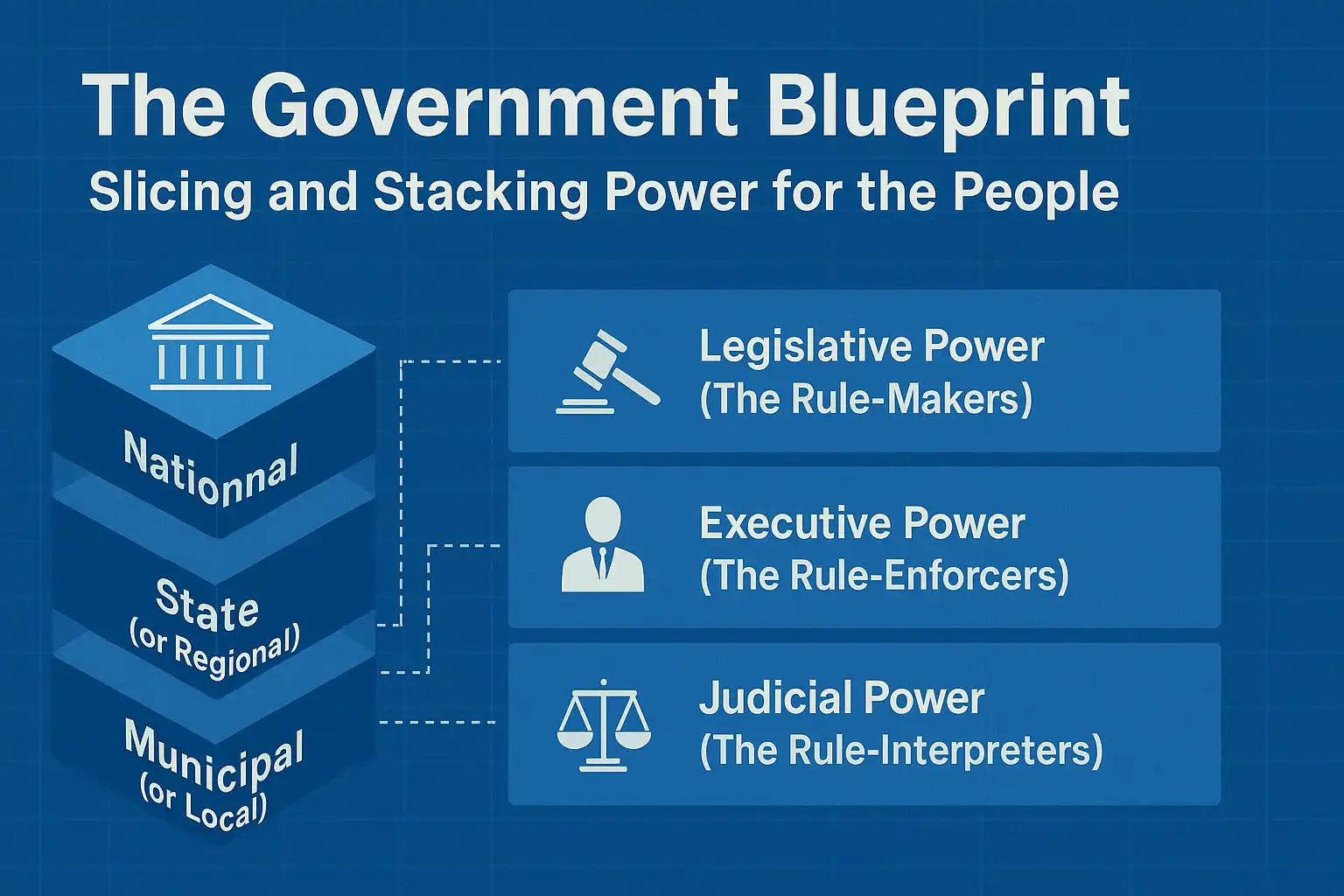
The answer lies in a two-dimensional blueprint. Public power is simultaneously sliced horizontally (into branches like legislative and executive power) and stacked vertically (into national, state, and local levels). This intricate design, as explored by Allan R. Brewer-Carías, is the very foundation of a modern democratic state, determining everything from who paves your street to how your rights are protected.
Let's break down together.
The Vertical Stack: From the Capital to Your Community
First, power is stacked in layers.
This is the vertical distribution of power, which defines a country's territorial structure. In a federal system, this creates distinct, autonomous levels of government, each with its own role and legal identity:
- National Level: This is the top layer, responsible for the big picture-things like national defense, international treaties, and major economic policy.
- State or Regional Level: This middle layer has its own government (like a Governor and State Assembly) with the power to manage its own affairs, public services, and finances within its territory.
- Municipal or Local Level: This is the foundation, the government closest to the people. It's considered the "primary political unit" and handles the core issues of local life.
This vertical stack is what makes decentralization possible. It’s not just about delegating tasks; it’s about giving each level real autonomy to govern itself, elect its own leaders, manage its budget, and create local laws, bringing decision-making closer to home
Decentralization.
It’s a powerful concept that moves authority away from a single central point and brings it closer to the communities it serves. Brewer-Carías emphasizes that this is not just an administrative convenience; it is a political-territorial decentralization that grants each level genuine autonomy. This autonomy includes the power to elect their own leaders, pass local laws (ordinances), and—crucially—raise and spend their own money through local taxes.
The Horizontal Slice: A System of Checks, Balances and Creative Tension
Now, within each of those vertical layers, power is sliced horizontally. This is the classic separation of powers we're all familiar with, designed to keep any one branch from becoming too powerful:
- Legislative Power (The Rule-Makers) ⛏️
- Executive Power (The Rule-Enforcers) ✅
- Judicial Power (The Rule-Interpreters) 👩⚖️
However, Brewer-Carías points out that these branches aren't in separate, sealed-off rooms. They constantly interact, collaborate, and even interfere with one another. The Executive proposes a national budget, which the Legislature must approve; the Judiciary can review laws passed by the Legislature.
It’s a dynamic system of checks and balances.
Brewer-Carías also points out that modern states have evolved beyond this simple trilogy by creating organs with functional autonomy. Think of an independent Comptroller General who audits the government's finances or a national Electoral Council that oversees elections. These "referees" operate outside the direct control of the main three branches, adding yet another vital layer of checks and balances to the system.
The Blueprint's Guarantees: Your Shield Against Overreach
So, why should you care about this complex blueprint? Because every slice and every layer is designed to uphold the principle of legality and protect you, the citizen 🧑🤝🧑. This structure ensures that no government body—from the President down to a local council—is above the law.
This has powerful, real-world implications, especially when it comes to your wallet and your rights:
- Fair Taxation and Structured Public Finance: The vertical stack dictates who has the power to tax and for what purpose. National governments handle major taxes, while municipalities manage local ones. This division is meant to ensure that each level of government has the resources to meet its responsibilities to its citizens. The Constitution ensures the system is just, progressive, and respects your ability to pay.
- Protection from Confiscation Taxation: This is a crucial guarantee. Because the government's power is limited by your constitutional rights (like the right to property and equality), a tax can't be so excessive that it becomes "confiscatory". A tax that is unreasonable or absorbs an unfair portion of your income or assets would violate this principle and could be challenged in court.
- A Single Voice on the World Stage: This blueprint also clarifies who speaks for the nation. While decentralization gives states and cities autonomy on local issues, international relations —signing treaties, appointing ambassadors, and representing the country globally—are handled exclusively by the national government. This ensures the country speaks with one clear and unified voice on the world stage.

Why This Blueprint Still Matters Today
The power puzzle isn't just an abstract theory; it's a multi-layered, interconnected blueprint for a functioning democracy. This blueprint of vertical and horizontal checks is what allows for a balance between a strong, unified nation and vibrant, autonomous local communities.
The vertical stack ensures government is close and responsive to local communities, while the horizontal slice prevents the concentration of power in any single hand.
Understanding this blueprint empowers us all to know who to hold accountable, to demand a government that is not just powerful but principled, and to actively participate in shaping the communities we call home.
Modern Challenges to the Balance of Power

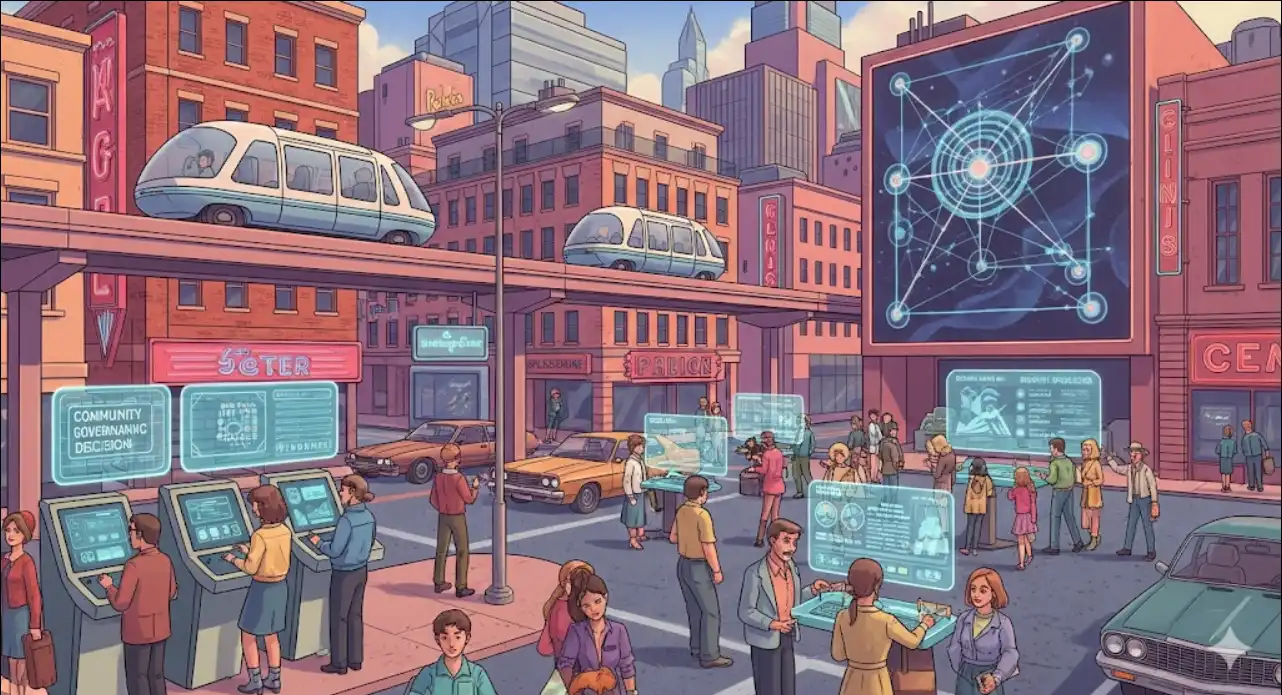
But this blueprint isn't a static drawing; it's a living document that constantly adapts to real-world challenges. Think about the natural tug-of-war between national and local power. Have you ever noticed how in a crisis, everyone looks to the central government for decisive action, but when things are calm, people demand more local control? This push and pull isn't a flaw in the system—it's the very heartbeat of a dynamic democracy, always seeking the right balance. This classic framework also faces new tests in our digital age.
While technology can empower local communities like never before, it also gives central governments unprecedented tools for control and surveillance, and we're all living through the experiment of how the internet is reshaping this balance. In this often polarized environment, the role of independent "referees"—like electoral commissions and audit offices—becomes more crucial than ever. They are the guardians of the rules, and their strength and independence are often the best measure of a country's democratic health.
References
- Brewer-Carías, A. R. (1996). El poder público: Nacional, estadal y municipal (Tomo II de Instituciones políticas y constitucionales, 3rd ed.). Editorial Jurídica Venezolana; Universidad Católica del Táchira.
NOTES
The concepts and framework discussed in this post are drawn from Allan R. Brewer-Carías's analysis of the Venezuelan legal and political system as structured by its 1961 Constitution. While the principles of power distribution are universal, the specific application and details reflect that particular legal and historical context.
This is part of a series of articles I’m writing as I prepare for my Master’s in Public Administration. Throughout this journey, I’ll be sharing key lessons and insights I gain along the way—so follow along!
If you have any comments, ideas, or would like to add your perspective, you’re more than welcome to join the discussion—let’s learn together!
If you find these articles useful, you’re welcome to support my work with a contribution to the following ZEC address:
u10d5d9kathwqfy5675h45nl6asrywewtprnp4e7gsdu2tsge9h42t8tg83juzllr70uygplt76t3t7z0dprl5mfn6jfhahxrld63r9jwzup264wc3dhpy8z8acxukzjekh2szx9juysmylcsftr0p33pm8kmj085qsy300z3uzu4f78v3