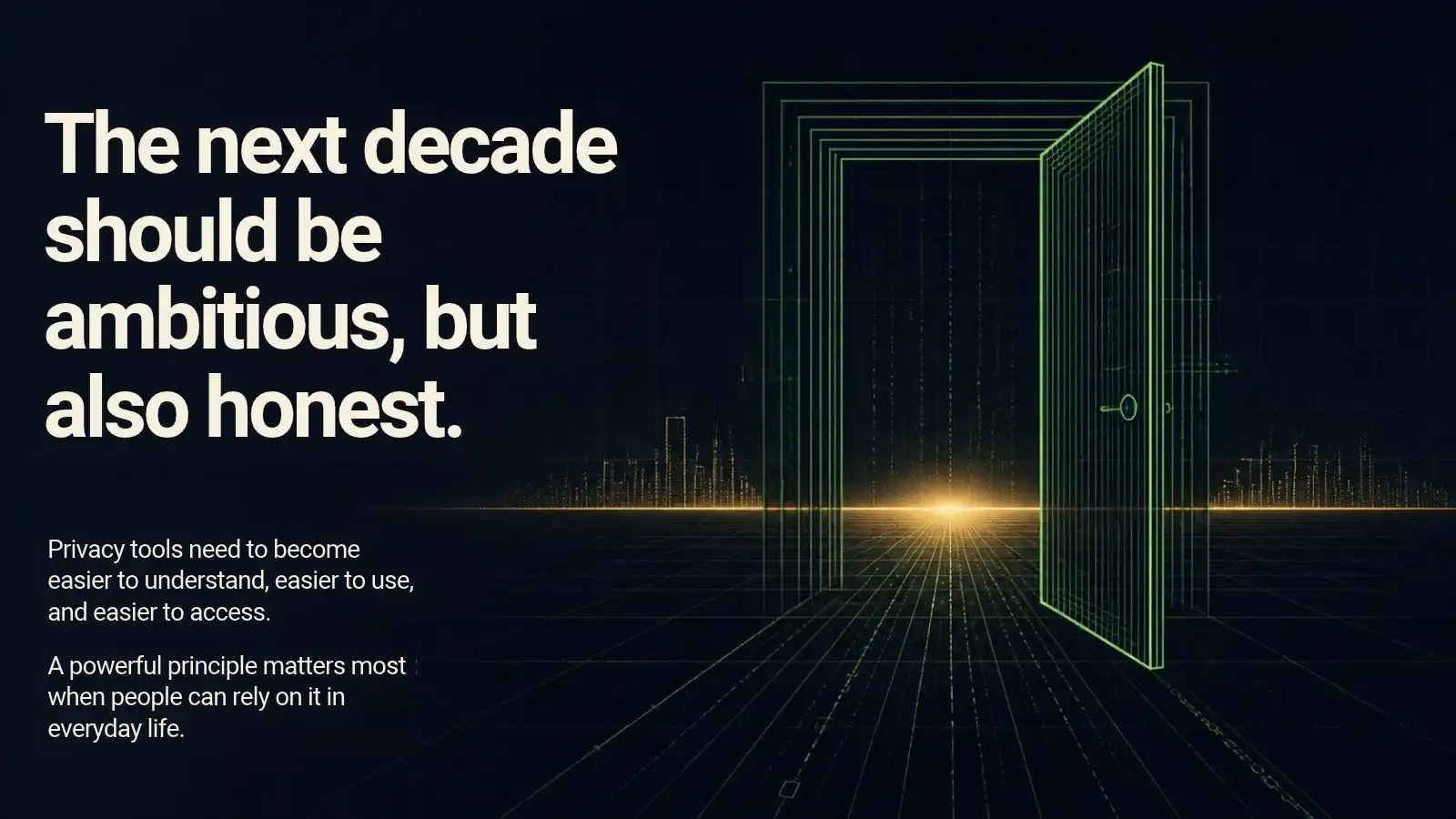
The next decade should be ambitious, but also honest.
Privacy is often discussed as a principle, a right, or a line we should defend. But a principle matters most when people can rely on it in ordinary life—not only when they have time, expertise, or unusual patience.
That is the challenge ahead for privacy tools. They need to become easier to understand, easier to use, and easier to access. This is not a retreat from ambition. It is how ambition becomes useful: by meeting people where their lives actually are.
Privacy Is About Control, Not Concealment
Privacy is not about having something to hide. It is about retaining control over the parts of life that make choice meaningful: your personal decisions, your relationships, your livelihood, and your ability to participate in the world on your own terms.
That control can be quiet and ordinary. It can mean deciding what to share with a service, what to keep within a relationship, or how much of your financial life should be exposed to people and systems that do not need to know everything about you.
The language of secrecy can make privacy sound suspicious. The language of control is more accurate. We all need room to think, change, connect, work, and make mistakes without every part of that process becoming permanently visible or available for judgment.
Key idea: Privacy gives people room to make choices without surrendering more of themselves than the situation requires.
A Principle Matters When People Can Use It
A right that is difficult to understand can feel distant. A safeguard that is difficult to use can become something people work around, postpone, or quietly give up on.
That gap between principle and practice is where privacy work must become more grounded. People should not need to decode specialist language to understand what they are choosing. They should not have to navigate unnecessary complexity to make a reasonable decision about their own information or financial life.
The standard should be simple without being simplistic. Good privacy tools can respect the complexity of the world while giving people a clear path through it. They can explain what matters, make choices visible, and help users act without making confidence a prerequisite for participation.
Clear enough to understand — People can see what a choice means before they make it.
**Simple enough to use **— The path to a decision does not depend on specialist knowledge.
Available enough to matter — Privacy is not reserved for people with spare time, money, or technical fluency.
Ambition Needs an Honest Measure
Ambition is necessary. Privacy deserves better tools, clearer choices, and a larger place in everyday life. It deserves builders and institutions willing to imagine systems that treat people as participants rather than as sources of data or risk.
But ambition without honesty can become a promise people cannot use. It can focus on what is possible in theory while overlooking the friction of a busy day, the uncertainty of a first-time user, or the barriers created by cost, language, confidence, and access.
Honest attention to accessibility is not a lesser goal. It is a test of whether the goal is real. If privacy is meant to protect people, then the experience of seeking that protection has to respect their limited time, their different circumstances, and their need for plain answers.
The next decade should be ambitious, but also honest. That means asking not only what privacy can become, but who can benefit from it now—and what must change so that more people can.
Financial Dignity Belongs in the Conversation
Financial privacy is part of personal dignity because money is tied to choices, relationships, work, and belonging. People need room to manage their lives without feeling that every decision must be explained to an audience they did not choose.
This does not mean pretending that responsibility and trust are unimportant. It means recognizing that accountability does not require unlimited exposure. A healthier approach makes room for both: people can meet legitimate obligations while keeping control over information that is personal, sensitive, or unrelated to the matter at hand.
For free2Z readers, this is a practical as well as principled question. What would it look like for privacy and financial tools to be understandable at the moment someone needs them? What would change if access were designed as part of the experience rather than treated as an afterthought?
The answers may not arrive all at once. They can begin with smaller acts of clarity: better explanations, more deliberate choices, and a willingness to notice where everyday systems ask too much from the people using them.
Privacy becomes meaningful through practice. It grows when people can understand their options, make informed decisions, and expect the tools around them to respect their agency.
If you care about privacy and financial dignity, start with one practical question: what information are you being asked to share, who needs it, and what choice do you have? Look for explanations you can understand. Ask for clearer ones when you cannot find them. Support tools, communities, and standards that make privacy more accessible rather than more mysterious.
The goal is not a perfect life without exposure or uncertainty. It is a more balanced one—where people can participate, earn, connect, and choose without giving up control by default. That is an ambitious future. It is also an honest one.