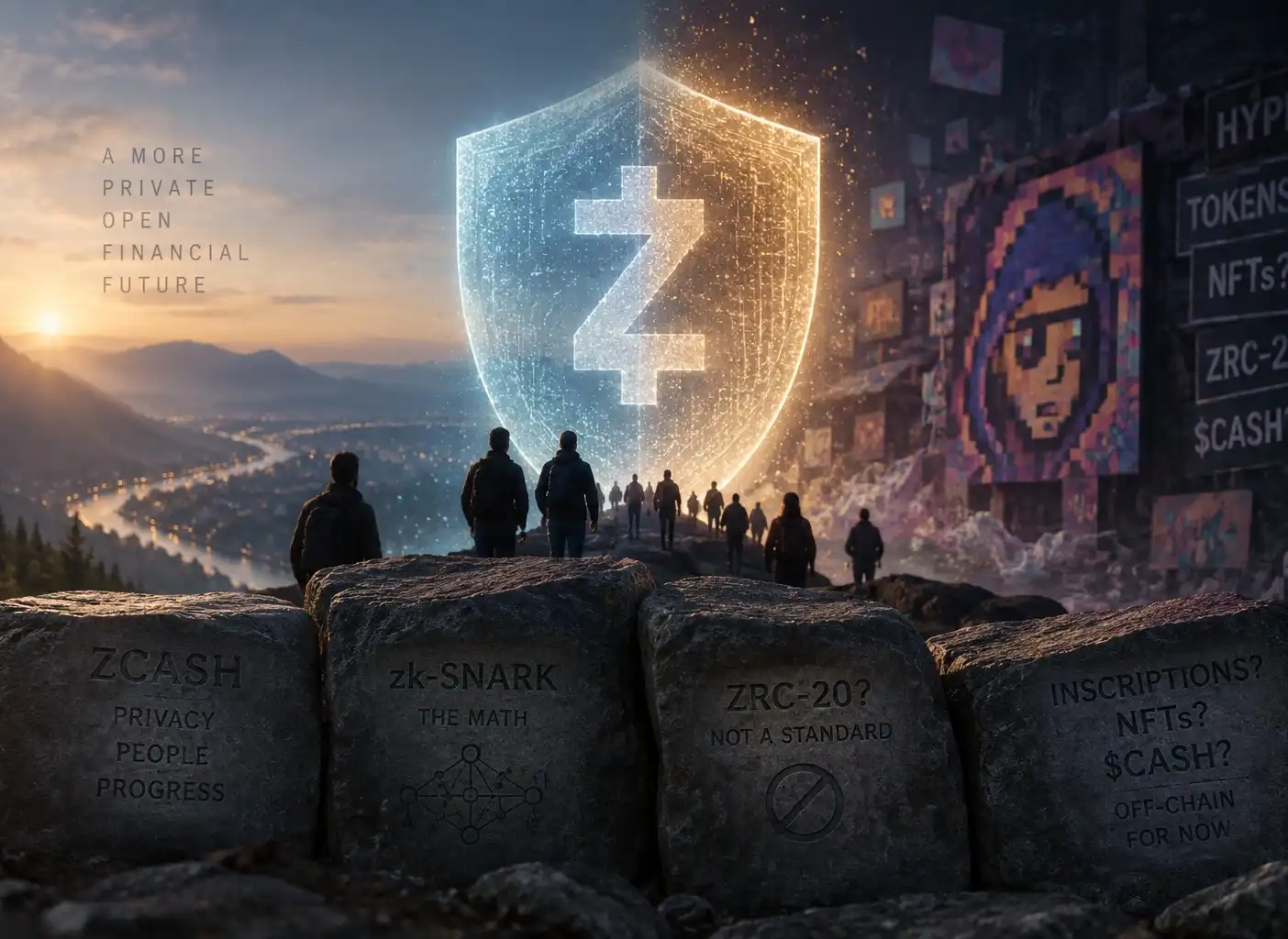

A plain-English guide. As of September 22, 2026.
Zcash is having its busiest few weeks in years. Record volume, a shielded NFT auction that raised eight figures, a "token standard" that the Zcash Foundation says it never heard of, and a flood of new accounts telling you what it all means. Several different things are being blurred together. Here they are, one at a time.
TL;DR
- Zcash itself is doing well. More ZEC is shielded, and a bigger share of transactions are shielded, than a year ago. That part is real.
- "zk-SNARK" is the cryptography. "zkSNARKs" is an NFT project. Same name, unrelated things.
- "ZRC-20" is not a Zcash standard. It's a name at least four unrelated groups are using, for incompatible systems. Zcash and the Zcash Foundation have both said so publicly.
- Zcash has no native tokens or NFTs on mainnet today. The real proposal, Zcash Shielded Assets (ZSA), is testnet-only and isn't in the November upgrade.
- Anything sold today as a Zcash "token" or "NFT" is off-chain bookkeeping. Some company's software reads data out of normal ZEC transactions and decides who owns what. If that software goes away, so does your balance.
- Get your information from long-standing sources, not accounts that showed up this month. List at the bottom.
1. The real news: Zcash usage is way up
- Messari/Blockworks report that last week Zcash settled over $23 billion in transfer volume. That's the highest since 2021 and the second-highest week ever.
- About 29% of all ZEC (~4.9M ZEC) now sits in shielded pools, up from 23% a year ago. About 62% of daily transactions are shielded, up from 22% (zecstats).
- In July, the network activated Ironwood (NU6.3), a new, formally verified shielded pool. It replaced Orchard after Taylor Hornby of Shielded Labs found a soundness bug in Orchard in late May. The bug was patched within days, and developers found no evidence it was ever exploited (The Block).
Read the volume number carefully. It's measured in dollars, and ZEC went from about $400 at the end of June to about $1,500 now. Price alone multiplies dollar volume by almost 4×. Also, shielded amounts are encrypted by design, so any on-chain volume figure is built from what's visible. Use it to see which way things are moving, not as an exact total.
Why so many new wallets? Much of the new shielded activity comes directly from the zkSNARKs NFT auction and its marketplace (section 2). Both require a shielded Zcash address to take part, and a lot of bidders arrived from other chains through NEAR Intents. That very likely means thousands of people who had never used Zcash set up shielded wallets. That's a good result for Zcash, whatever you think of the NFTs.
2. zk-SNARK (the math) vs. zkSNARKs (the NFTs)
zk-SNARK is the zero-knowledge proof system Zcash has used since 2016. It proves a transaction is valid without revealing the sender, the receiver or the amount. It's the reason Zcash exists.
zkSNARKs (the product) is a collection of 10,000 pixel-art "shielded identities." It trades on a marketplace called Zilkroad. The name borrows credibility from the cryptography, but the project has no connection to the people who built it.
What happened:
- The auction. A 48-hour sealed-bid auction drew 16,971 bids. 8,000 pieces cleared at 1.5 ZEC each (12,000 ZEC, about $17.5M). Losing bidders were refunded about 13,309 ZEC. Another 2,000 pieces were not auctioned; they were reportedly held for the team, early members and a treasury (CryptoBriefing, KuCoin). More than $19M of the bids came from other chains through Aurora/NEAR Intents (crypto.news).
- The allegations. On-chain investigator ZachXBT called it an eight-figure money grab. He says the team kept a 10% allocation plus a 5% royalty, and that none of the promised governance, community-access tools or partners have shipped (PANews, Cryptonomist). The team is pseudonymous. These are allegations, not findings.
- The market since. On Zilkroad today, the cheapest zkSNARK is listed at about 0.51 ZEC, roughly a third of the 1.5 ZEC auction price.
- What you actually own. Zilkroad describes itself as a "non-custodial index" and says "the chain is the record." But Zcash has no native NFT type on mainnet (see section 5). Your purchase is a normal shielded ZEC payment with a memo, and Zilkroad's software maps that payment to your shielded address and a portrait number. One independent write-up calls these holdings database entries, not on-chain assets (onchaindiary). Either way, ownership depends on how one project's software reads private transactions. We couldn't find a public spec that would let anyone else check it independently.
3. Inscriptions: tokens and NFTs written into public transactions
The inscriptions craze was copied from Bitcoin (Ordinals, BRC-20). You write a small blob of data, often JSON like {"p":"zrc-20","op":"mint","tick":"ABCD","amt":"1000"}, into an ordinary transaction. An indexer, a program run by some project, reads the chain in order and adds up who owns what.
On Zcash this is being done by Zecscriptions, Zerdinals/ZRunes, zcash.ink, Zord/Zatoshi and others. What you need to know:
- They only work on transparent (public) addresses. Every indexer has to be able to read the data, so it can't be encrypted. Zecscriptions' own docs say so, and zcash.ink says that "shielding funds breaks inscription continuity." That makes these Zcash assets without Zcash's privacy. Sender, receiver and amount are all public.
- Your balance exists only as long as the indexer agrees it does. The chain stores the raw data. What those bytes mean is decided by whichever indexer you trust, and different projects use different rules. If the indexer shuts down, the tokens still exist in the raw data, but nothing shows them as a balance anymore.
- It's easy to lose them by accident. Inscriptions live on small transparent outputs. A normal wallet can spend that output as ordinary ZEC, and the token goes with it. Zecscriptions and Zerdinals both warn about this.
- zcash.ink says it plainly: "Inscriptions are experimental collectibles with no intrinsic value."
This isn't fraud. It's a working hobby protocol. Just don't confuse it with Zcash.
4. "ZRC-20" is not a Zcash token standard
The name sounds like Ethereum's ERC-20, which is the point. ERC-20 is an actual standard that Ethereum's protocol and wallets support. "ZRC-20" is just a label, and it's being used for at least four incompatible things:
- The JSON inscription format used by Zecscriptions (transparent)
- Zord/Zatoshi's format, using 80-byte OP_RETURN outputs (transparent)
- The token list on Zerdinals/ZRunes (transparent)
- $CASH's "ZRC-20" (docs.zrc20.io), described below
- And separately, ZetaChain already uses "ZRC-20" for its own tokens on another chain.
About $CASH, which BSCN promoted as a ZRC-20 token on Zcash mainnet, with a 21M supply and a launch set for September 23. Its draft spec takes a different approach: token operations go into encrypted memos in shielded transactions, all sent to a single "protocol address" whose viewing key is published. Your funding wallet stays hidden. But anyone with that key can read every deploy, mint and transfer, so the token ledger itself is public by design. The spec doesn't say who controls that address. It's marked "unaffiliated with the Electric Coin Company or the Zcash Foundation," and it lists unsolved problems, including ticker squatting and how to trade without a trusted middleman.
What the Zcash side said (September 21):
- The Zcash Foundation: "We have no prior knowledge of 'ZRC-20' or the $CASH token. This is a private project, not an official Zcash token standard or protocol feature. Please do your own research before interacting with any token."
- The official Zcash account said ZRC-20 is not a protocol standard, that Shielded Assets are still experimental and only live on testnet, and that ZEC is the asset secured by network consensus (CoinGabbar, Crypto Times).
5. The real thing: Zcash Shielded Assets (ZSA)
ZSA (ZIP 226 / ZIP 227) is the actual proposal for native Zcash tokens. Custom assets would live inside the shielded pool with the same privacy as ZEC, hiding sender, receiver, amount and even which asset it is. It has been in development since 2021, was audited in 2025, and has had a public testnet since August 2026.
It is not on mainnet, and it's not in NU7. NU7 is the upgrade targeted for November 5, and its announced scope is 25-second blocks, turning off old v4 transactions, and the Network Sustainability Mechanism. Developers stated that "new transaction formats are not part of this upgrade" (The Coin Republic).
So if anyone tells you they're selling a native, private Zcash token or NFT today, they're wrong or they're hoping you won't check.
Cheat sheet
| You hear | What it actually is | Private? | Zcash protocol? |
|---|---|---|---|
| ZEC | The native coin | Yes, when shielded | Yes |
| zk-SNARK | Zcash's core cryptography | — | Yes |
| zkSNARKs (NFT) | Pixel-art collection, tracked by Zilkroad's index | Payments shielded; ownership record depends on the project | No |
| Inscriptions / Zerdinals / Zecscriptions | Data in public transactions, read by indexers | No | No |
| "ZRC-20" | A borrowed name for several unrelated indexer schemes | Varies (mostly no) | No |
| $CASH | A "ZRC-20" token with a published viewing key | Wallet hidden, ledger public | No |
| ZSA | The real native token proposal | Yes | Proposed; testnet only |
Before you buy anything "on Zcash"
- Is it ZEC? If not, it isn't secured by Zcash consensus.
- Who runs the indexer, and what happens if they stop?
- Is it actually private? Inscriptions aren't. A published viewing key isn't.
- Is the team named, and what did they ship last time?
- Did you hear about it from an account that's more than a month old?
Where to get information you can trust
Many of the loudest accounts right now are new, own the tokens they're promoting, or both. Check claims against sources that were here before the rally:
- Zcash Foundation: zfnd.org · @ZcashFoundation
- Zcash: z.cash · @Zcash
- Zcash Community Forum: forum.zcashcommunity.com. Core developers post here.
- ZIPs: zips.z.cash. If something is a Zcash standard, it's listed here.
- ZecHub: zechub.wiki, community education and a weekly digest
- Shielded Labs: shieldedlabs.net
- Free2Z: free2z.cash
Zcash's privacy is the product. Anything that asks you to give it up in exchange for a ticker symbol should have to explain why.
Sources: Zecscriptions docs · zcash.ink · Zord · Zerdinals/ZRunes docs · docs.zrc20.io · Zilkroad · crypto.news on ZF · crypto.news on NU7 · QEDIT ZSA Hub · Messari on X · KuCoin Q3 review. Nothing here is financial advice.