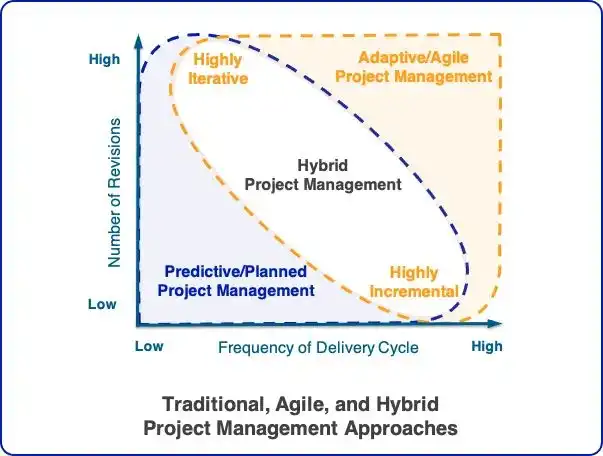
Agile or traditional? If you are weighing up the pros and cons of both project management methods, there is a good alternative. Work with both methods by using hybrid project management.
Hybrid methodologies are often used in situations where a single, pure approach is not sufficient to meet the needs of the project, or where the project requires a mix of predictability and flexibility.
Waterfall and Agile are often depicted as rivals: an old-guard project management methodology competing with a nimble newcomer. At its heart, the difference between them comes down to predictability versus adaptability. Waterfall strives for predictable outcomes by predetermining features at the outset and deeming projects complete only once those features are fully implemented.** Agile** promises adaptability, delivering a **minimum viable product (MVP) **and then iteratively releasing new features and collecting user feedback to guide the path of improvements.
When using structured planning, the main problems come from the lack of room to improve the final result, since the reviewing part comes late in the process. It can only be done in the end. So, it is hard to find all of the working problems or develop innovations like that.
And with an agile approach, projects might lack concrete goals and planning and can end up depending too much on how the different parts involved are flowing. That can translate into delays in the calendar plan.
With Hybrid Project Management, tasks are optimized to have the pros of the chosen planning and mitigate all the disadvantages of using a single one. For the Project Manager, the focus becomes finding the way to arrange the project in a way in which the long-term goals are set nicely and do not create obstacles for the short-term tasks.
There are many benefits of combining the **Waterfall **and Agile project management methodologies. Some of them are as follows:
Suitable for a Variety of Projects: It is flexible and can easily be applied to almost any team size. This makes it an ideal choice for a wide range of projects.
Planning can be Done in Detail: With the help of the hybrid project management model, businesses can plan better. All the plans can be made in detail, along with the cost estimation for each sprint. Breaking the project into sprints allows for a smooth review process. Not only this, but sprints also help to predict how quickly the goals will be achieved.
Division of Responsibilities: It maps the project right from the initiation to the completion. It also mentions in detail the entire scope of the project while also allocating the responsibilities as to who is involved in each of the steps. This ensures a smooth monitoring process.
Flexibility: The hybrid project management methodology incorporates the adaptability of Agile. This helps to ensure that the projects are flexible enough to include changes that might come mid-way.