The purpose of this paper is to illustrate how the Difference Identity for Cosine can be used.
Let us start here:
cos(A−B)=cos(A)cos(B)+sin(A)sin(B)
As a quick corollary notice that,
sin(A+B)=cos[(90°−(A+B)]=cos[(90°−A)−B]=cos(90°−A)cos(B)+sin(90°−A)sin(B)=sin(A)cos(B)+cos(A)sin(B)
where lines (1) and (4) follow since
sin(θ)=cos(90°−θ)
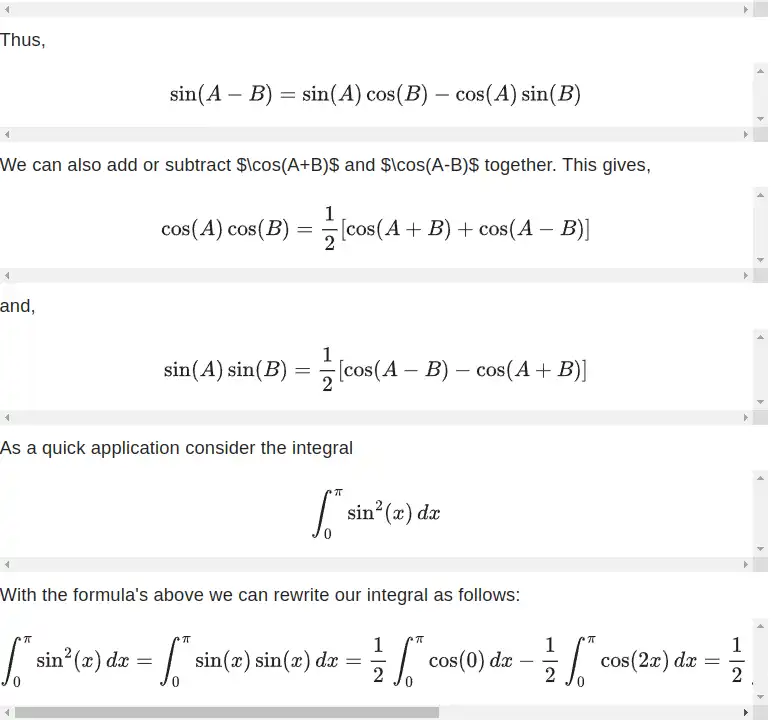
Thus,
sin(A−B)=sin(A)cos(B)−cos(A)sin(B)
We can also add or subtract $\cos(A+B)$ and $\cos(A-B)$ together. This gives,
cos(A)cos(B)=21[cos(A+B)+cos(A−B)]
and,
sin(A)sin(B)=21[cos(A−B)−cos(A+B)]
As a quick application consider the integral
∫0πsin2(x)dx
With the formula's above we can rewrite our integral
as follows:
∫0πsin2(x)dx=∫0πsin(x)sin(x)dx=21∫0πcos(0)dx−21∫0πcos(2x)dx=21∫0πdx−41∫0πcos(u)du=2π−41[sin(π)−sin(0)]=2π