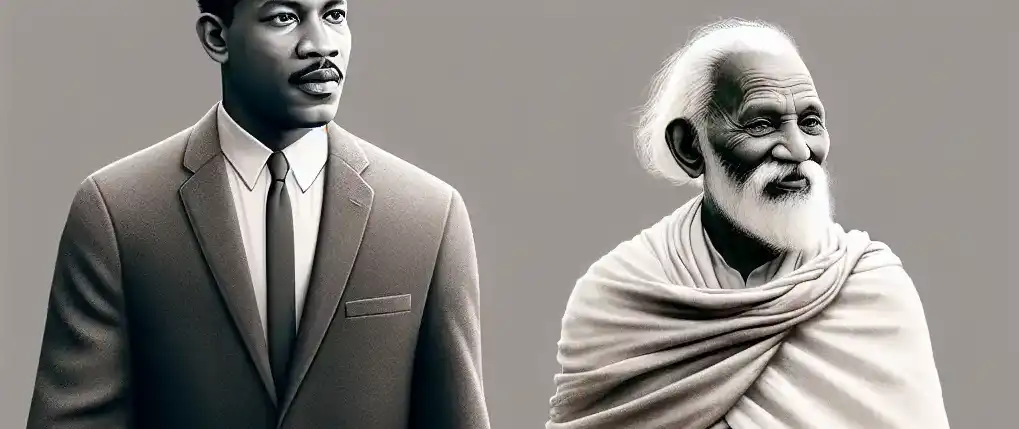

Today is Dr. Martin Luther King Jr's birthday. Dr. King was perhaps the most prolific and famous leader in US History to apply Mahatma Gandhi's principles of nonviolence to drive social change. Gandhi's philosophy of nonviolent resistance,described in the concepts of "Satyagraha" and "Ahimsa," profoundly shaped Martin Luther King Jr.'s approach to the Civil Rights Movement in the US. While Gandhi originally developed these strategies during the Indian independence movement against British colonial rule, King found them to be potent tools in the struggle against racial segregation and discrimination in America.
King first became acquainted with the works of Gandhi during his time as a seminary student Crozer Theological Seminary in 1948. A lecture by Dr. Mordecai W. Johnson, who had visited India, introduced King to Gandhi's philosophy of nonviolent resistance. This lecture, coupled with King's subsequent study of Gandhi's works, including "The Story of My Experiments with Truth," played a pivotal role in shaping King's adoption of nonviolent methods in his fight for civil rights. King's interest in studying Gandhi's methods culminated with a trip to India in 1959. This trip in February and March of 1959 was a turning point in his life and in shaping his philosophy of nonviolence. Organized by the Gandhi Memorial Trust and the American Friends Service Committee, the trip was an opportunity for King and his wife, Coretta Scott King, to immerse themselves in Gandhi's legacy.
While in India, King got deeper insights into integrating nonviolent principles in governance by meeting with Prime Minister Jawaharlal Nehru, a close associate of Gandhi during the indepence movement. King's speeches to Indian audiences helped refine his articulation of the Civil Rights Movement in the context of nonviolent principles.
Additionally, firsthand exposure to India's caste system and other social challenges broadened King's perspective on how nonviolence could address various forms of societal injustice.
King's adoption and adaptation of Gandhi's principles not only shaped the American Civil Rights Movement but also demonstrated the universal relevance and power of nonviolent resistance in the global struggle for justice and human rights.