Structure of atoms
What are atoms
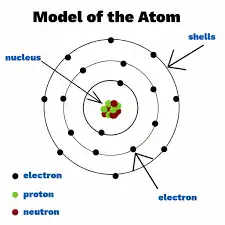
Atoms are the building blocks of all matter in the universe. They are made up of three basic particles, protons, neutrons, and electrons. Each atom has its own unique characteristics, such as its atomic number, chemical symbol, and atomic weight. Understanding these characteristics is essential to understanding the behavior of atoms and molecules.
Atomic numbers chemical symbols and atomic weight
Every atom has a unique atomic number, which is the number of protons in the nucleus of the atom. This number is also used to identify the element. Each element also has a chemical symbol, which is a one- or two-letter abbreviation of the element's name. If the abbreviation has one letter it's capitalized and if it has two letters than only the first letter is capitalized to avoid confusion. The atomic weight of an atom is the number of protons and neutrons in the nucleus. This number is typically expressed in atomic mass units (amu).
Protons
Protons are positively-charged particles located in the nucleus of an atom. They have a mass of 1 amu and are responsible for most of the atom's mass. Protons also determine the element's atomic number.
Neutrons
Neutrons are neutral particles located in the nucleus of an atom. They have a mass of 1 amu and are responsible for most of the atom's mass. Neutrons help to stabilize the nucleus and prevent the protons from repelling each other.
Electrons valence electrons and ions
Electrons
An electron is a subatomic particle, symbol e− or β−, which carries a negative electric charge. Fundamentally important, it is the lightest particle in the universe with a definite rest mass. Electrons contribute greatly to the atom's mass, but they account for the size of the atom since they occupy a lot of space in the atom. Electrons play a crucial role in many physical phenomena, like electricity, magnetism, chemistry, and thermal conductivity, and they also participate in gravitational, electromagnetic and weak interactions. The coalesce in a "cloud" outside the nucleus
Valence electrons
Valence electrons are the electrons located in an atom's outermost shell. They play a key role in chemical reactions and bond formation as they are the electrons that interact with other atoms. The number of valence electrons in an atom of a representative element determines many of the element's chemical properties, including its valence, or the ability to bond with other elements. In general, if the outer shell of the atom is full, it is stable and unlikely to engage in chemical reactions. On the other hand, if the outer shell is not full, it is prone to exchanging electrons with other atoms to achieve stability, thus it readily reacts chemically to form compounds.
Ions
Ions are atoms or molecules that have gained or lost one or more of their valence electrons, giving them a net positive or negative electrical charge. Ions participate in chemical reactions and are essential in nature for many bodily functions such as the transfer of nutrients in the digestive system. They are produced by ionizing radiation, in large amounts by natural phenomena such as lightning or volcanic activity, and are essential components of plasma. The two main types of ions are cations (positively charged) and anions (negatively charged).
Quarks and gluons
Quarks
Quarks are elementary particles that are fundamental constituents of matter. They are unique because they carry a fractional electric charge, whereas most other particles carry an integer charge. There are six types, or 'flavors', of quarks known - up, down, charm, strange, top and bottom. Up and down quarks make up protons and neutrons, which are found in the nucleus of an atom. Quarks never exist alone in nature, they are always found in combinations to form other particles. For example, a proton is made of two up quarks and one down quark. This principle is known as confinement. If something exerts force to try to seperate them thew will use the energy from that force to create a new quark to bond to. The study of quarks and the interactions between them through the strong force, is a fundamental aspect of particle physics.
gluons
Gluons are elementary particles that serve as the exchange particles for the strong force between quarks, analogous to the role of photons in the electromagnetic force between two charged particles. Gluons are uniquely characterized by their color charge, a property associated with the strong interaction, and have the ability to interact with other gluons since they themselves carry this color charge. They bind quarks together, forming the nucleons (protons and neutrons) which in turn form atoms, thus making gluons a fundamental building block of the universe. Unlike many other force carrying particles, like photons, gluons do not exist in free state and can only be indirectly observed in high-energy physics experiments or cosmic ray interactions. They play a significant role in quantum chromodynamics (QCD), the study of the strong interaction.
Conclusion
Atoms are the building blocks of all matter in the universe. They are made up of three basic particles, protons, neutrons, and electrons. Each atom has its own unique characteristics, such as its atomic number, chemical symbol, and atomic weight. Understanding these characteristics is essential to understanding the behavior of atoms and molecules.