
Xia dynasty palace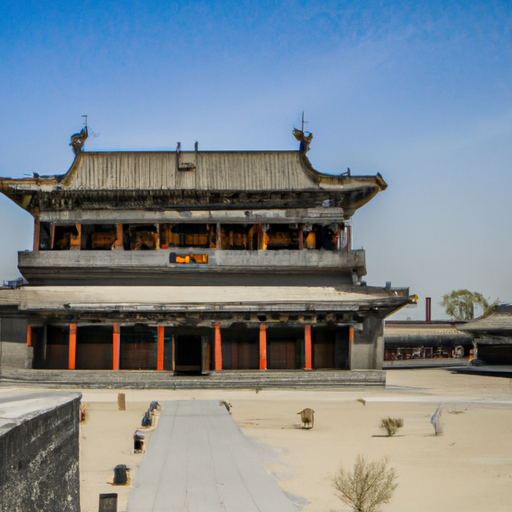
Overview of Chinese History
Chinese history is incredibly long and complex, spanning over four millennia and encompassing a variety of dynasties, cultures, and religions. The earliest known Chinese civilization dates back to the Xia dynasty, which existed between the 21st and 17th centuries BC. During this period, China was divided into many small states, and the Xia was the first dynasty to unify them.
The Shang dynasty followed the Xia and was the first to use written records. During this period, the Chinese developed a writing system and a system of bronze metallurgy. The Zhou dynasty followed the Shang and was a period of great philosophical and cultural development, including the development of Confucianism and Daoism.

The Qin dynasty unified China and established the first imperial dynasty. During this period, the Great Wall of China was built and Confucianism became the official state ideology. The Han dynasty followed the Qin and was a period of great economic and cultural prosperity. It was during this period that the Silk Road was established, connecting China to the Middle East and Europe.
The Sui, Tang, and Song dynasties followed the Han, and during this period, China saw great advances in the arts, literature, and science. The Ming dynasty followed the Song and was a period of great maritime exploration, including the voyages of Zheng He. The Qing dynasty followed the Ming and was a period of great expansion and consolidation of Chinese power.
The Republic of China was established in 1912, ending the imperial era and ushering in a period of political and social turmoil. The People's Republic of China was established in 1949, and this period saw great economic and social progress, including the establishment of the One-Child Policy and the opening up of the Chinese economy to the world.
Yes, it would be incredibly naive to summarize recent Chinese history in such a way without mentioning the famines and authoritarianism that have also been a part of the country's history. Although there have been periods of great economic and social progress, it is important to acknowledge the darker aspects of China's past and present in order to gain a full understanding of the country's history.

Under Mao, logistics failures could lead to disastrous consequences. For example, in the late 1950s, China's Great Leap Forward was intended to modernize the country's agriculture and industry, but it led to a massive famine that killed tens of millions of people. One of the main causes of the famine was the failure of the logistical system to provide enough food to the people. The government had set unrealistic goals for agricultural production, which led to a breakdown in the distribution of food from the farms to the people. This meant that people in the cities, especially in the coastal areas, were unable to get enough food, including rice. The government's attempts to increase production by collectivizing farms and encouraging people to produce more food only exacerbated the problem, as the logistical system was not able to keep up with the increased demand. As a result, many people were left without enough food to survive, leading to widespread starvation and death.
and government interference?
The Great Chinese Famine (1959-1961): This famine was caused by a combination of natural disasters and a disastrous policy of collectivization and forced grain procurement by the Chinese Communist Party.
The Bengal Famine of 1943: This famine was caused by a combination of drought, war-time disruption of trade, and the British government's policy of exporting large amounts of food from India while millions of Indians were starving.
The Ethiopian Famine of 1984-1985: This famine was caused by a combination of drought, government mismanagement of resources, and a civil war that disrupted food production and distribution.
The North Korean Famine (1994-1998): This famine was caused by a combination of natural disasters, economic mismanagement, and the government's refusal to accept outside aid.
The Sahel Famine of 1972-1974: This famine was caused by a combination of drought, government mismanagement of resources, and the disruption of trade due to the Nigerian Civil War.