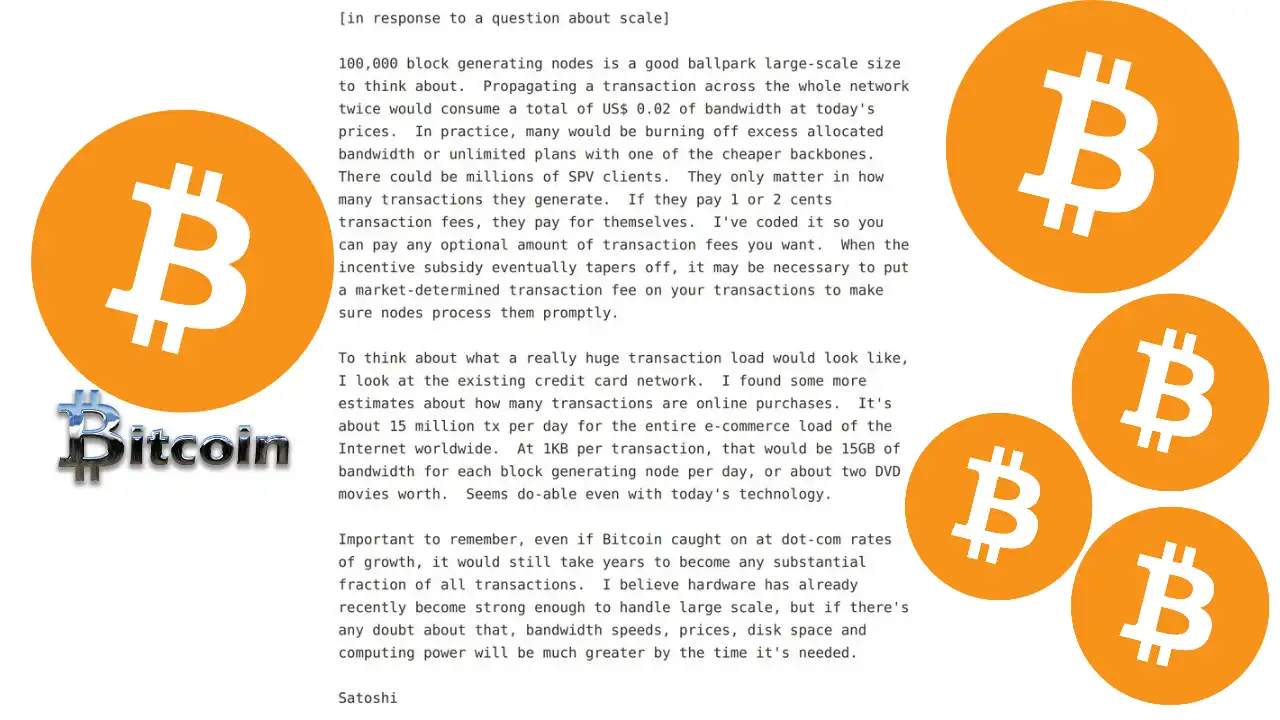

In a new set of emails released in the case against claims that Craig Wright is Satoshi, some of them reveal significant plans that the Bitcoin creator had for the currency, now considered an asset.
Satoshi knew in 2009 that, in order to keep Bitcoin practical and keep up with the market, it would need to have at least 100,000 nodes to operate on a larger and higher scale. This could also ensure that network fees are lower and affordable, giving users the means to choose how much they are willing to pay for their transactions to go through.
Users would have flexibility to choose transaction fees, and miners would have the right to accept or reject them in a more decentralized manner, opening a well-configured and inclusive market. At the time, Satoshi knew that Bitcoin was just in the beginning and would take time for the currency to be widely adopted, and that was fine; it wasn't in competition with anyone.
But he had a plan to scale Bitcoin and make it a global currency for the world, even surpassing the daily transactions of Visa, the global payment provider conglomerate. For that, it would need improvements in hardware, internet speed, and computing power. Satoshi was far ahead in his thoughts and already planned to scale Bitcoin because he believed in the technology and its potential.
He knew that Bitcoin's growth would happen gradually, and with that, more improvements would be made to keep the technology running smoothly. Nakamoto's plan was always meant to make Bitcoin inclusive and attract more people to the ecosystem, where they could pay lower fees, be their own bank, and use their money whenever they wanted.

The emails prove that Satoshi's intentions were clear and that Bitcoin could scale better than Visa, being inclusive with cost-effective transactions where users could pay fewer fees to make it a global currency. But, almost 15 years later, this is not happening in the market, and do you know why? Because some people hijacked the Bitcoin narrative.
The simple act of reading, sharing, and providing a meaningful tip for the creator's content encourages them to write more and enhance the quality for the community and their readers. Contribute to building a circular economic ecosystem by appreciating the author's content.