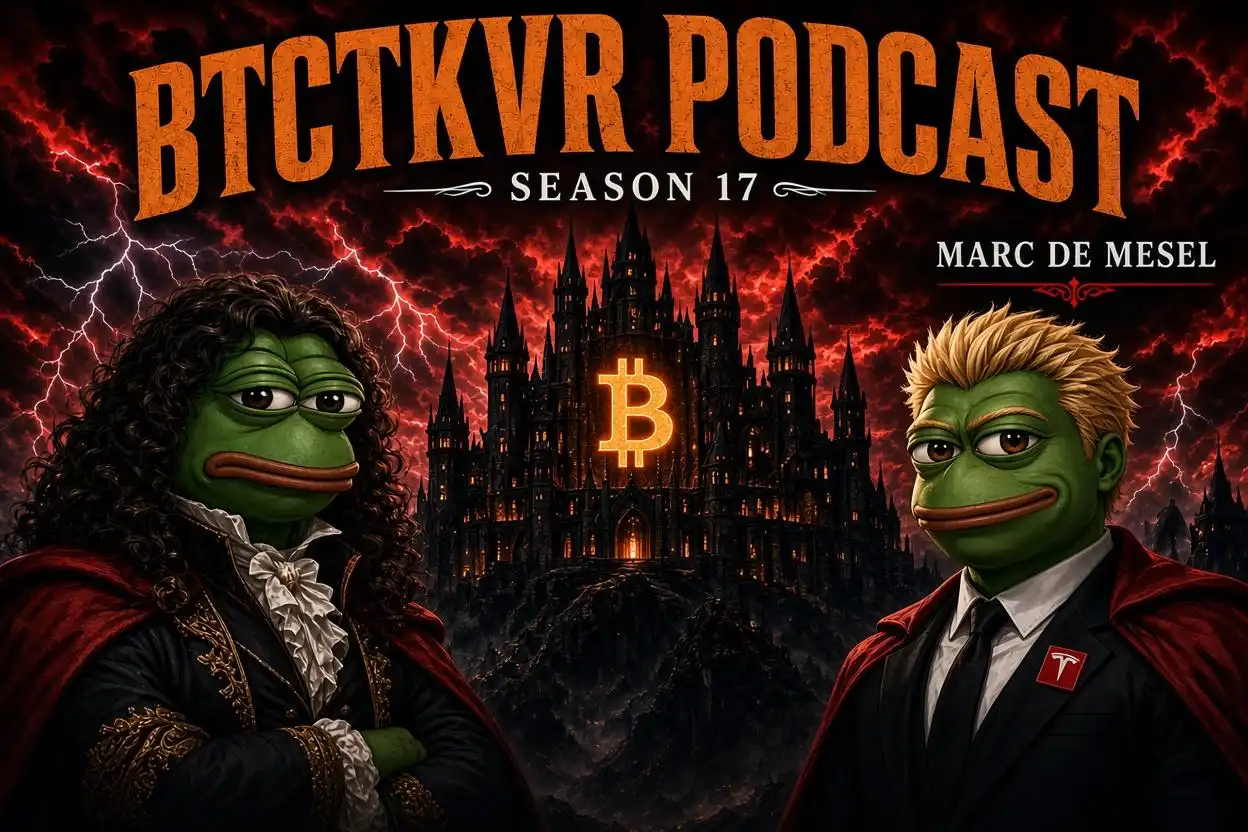

Marc De Mesel gave a superb interview on the Bitcoin Takeover Podcast and opened up about his investments, life and much more. The all interview took more than 4 hours and I needed time to put it together but finally all is here. I hope you can dive in and read about Marc's life as investor or learn more about his polygamy lifestyle.
The Bitcoin Takeover Podcast was hosted by Vlad and in his episode 44 from season 17 had Marc on stage.
Marc is an early Bitcoin and Tesla investor, long-time Bitcoin Cash supporter and funder of many projects on the ecosystem. He was nicknamed "the Guardian Angel of Bitcoin Cash" and recently he started to invest in privacy coins. Besides his investments Marc is also known for his polygamous lifestyle and large mixed-race family.
The conversation is unusually candid in the Bitcoin Takeover Podcast: Marc dissects his biggest financial mistakes in detail, explains his current portfolio logic, and discusses personal life with the same directness he applies to markets.
The defining trade: Selling BTC for BCH in 2017
In August 2017, while many holders kept both coins or sold the free Bitcoin Cash, Marc did the inverse. He sold BTC to buy more Bitcoin Cash on the futures market before the fork. At the time Bitcoin Cash was trading at roughly 0.1–0.2 BTC (around $300 while BTC was ~$3,000). He expected a flippening-value migrating to the big-block chain because a currency needs cheap, usable transactions.
Nine years later Bitcoin Cash still trades around $300 while BTC went from $3,000 to ~$80,000. Marc openly runs the inflation math:
- at 7–8–10% real inflation over a decade, Bitcoin Cash would need to be $600–800 just to preserve purchasing power.
At $300 it has lost significant real value, plus the massive opportunity cost. At his peak he held ~20× more Bitcoin Cash than today; much was liquidated in the 2022 bear market (where he chose to sell Bitcoin Cash rather than Ethereum during margin calls). The year cost him ~93% of his total portfolio.
Besides all that Marc still holds a small Bitcoin Cash position (recently increased via DeFi loan from ~4% to ~6% of portfolio) because the risk/reward at current prices justifies a modest bet and because the personal regret of being at an all-time low of coins if the improbable happens would be high. He distinguishes conviction (arguments you can articulate) from stubbornness (love without evidence).
From investor to benefactor: Funding Bitcoin Cash development
Marc De Mesel shifted from a passive Bitcoin Cash holder to active funder around the 2020 Infrastructure Funding Plan (IFP) proposed by Amaury Séchet (Bitcoin ABC). He views a treasury/dev-funding model as smart in principle (Dash pioneered it; Zcash has a version; it solves crypto’s lack of a business model). His objection was the implementation: funds went to an address controlled by Amaury, who decided spending. That clashed with Bitcoin’s voluntary-contribution tradition.
The community rejected it and developed Flipstarter (non-custodial crowdfunding where funds only move when a goal is met). Marc funded developers who stayed with the main Bitcoin Cash chain. He sees the IFP episode and the earlier BSV split as two fractures that permanently weakened the project by removing irreplaceable talent and fragmenting the brand.
Why Bitcoin Cash failed (according to De Mesel)
The main causes Marc cites are:
Death by a thousand splits: Miners were supposed to vote with hash power and the community stay together (Satoshi-style). Instead every major disagreement produced a hard fork (BSV 2018, eCash/ABC 2020, etc.). Each split shrank the community and damaged the brand.
Merchant-adoption mistake: Years spent chasing brick-and-mortar merchants were largely wasted. The economics never worked; that energy should have gone into making the chain more useful (smart contracts, CashFusion privacy, developer tooling).
Launch differentiation was weaker than marketed. With SegWit, post-SegWit BTC already had effective capacity closer to 4 MB, so BCH’s 8 MB was closer to a 2× advantage than the orders-of-magnitude improvement claimed. The fork was more political than technical at the outset.
He still believes Bitcoin Cash was the best big-block version of Bitcoin and that unexpected turns remain possible, but acknowledges the war was lost.
Broader crypto views
“Hijacking Bitcoin” / store-of-value narrative: Marc agrees with the framing that Bitcoin was shifted from peer-to-peer electronic cash to a store-of-value/collectible. Goalposts moved from “use it” to “never sell” to “borrow against it.”
Michael Saylor / MicroStrategy: Critiques the leveraged approach. Saylor did not build the position the way Bezos or Musk built wealth; a leveraged treasury works only while price rises. Weak hands at scale create a trapdoor. References Saylor’s 2000 dot-com losses as precedent.
Stablecoins: Sees them as a free-market form of CBDC, especially useful in the Global South.
Network effects & dominance: Bitcoin dominance fell from ~90% to ~50%. Expects further decline—either slowly via altcoin outperformance in a bull market or more abruptly if leveraged structures are forced to sell in a bear market.
Early history: First bought Bitcoin at $13 on Bitcoin-24 (2012 era). Also early into Litecoin, Peercoin, etc. Sold some positions too early (including relative to Roger Ver). Biggest wrong assumption across the space: how slowly real adoption would arrive.
Privacy as crypto’s last unique selling point: Transparent ledgers vs. traditional bank privacy. Privacy coins are today’s equivalent of Bitcoin at $1—obviously important, still legally gray, and priced as if the future will never arrive.
Privacy-coin basket (risk mitigation)
Having learned from earlier single-horse bets (e.g., NXT over Ethereum), De Mesel now buys a diversified privacy basket rather than one winner:
Monero (XMR) – strongest adoption.
Zcash (ZEC) – best privacy technology according to experts he trusts (despite dual transparent/shielded design). He has sell orders above the market after its ~40× run because “waking up wishing you had bought more” is a classic top signal for him.
Zano – heavily influenced by conversations with Roger Ver (whom he visited while Ver was under house arrest).
Smaller positions in Firo, Pirate Chain (ARRR), and a separate allocation to Dash (for its treasury model more than pure privacy).
In the interview, Vlad corrects an outdated claim about low shielded Zcash usage: shielded supply has risen substantially (helped by better wallets and DeFi integrations). Marc De Mesel takes the correction gracefully.
Tesla, portfolio philosophy and “HolyGrailPortfolio”
Marc bought Tesla in 2019 (after years of sideways action and peak anti-Musk sentiment) with a large allocation. In his original thesis: cheap EVs.
Updated thesis: robotaxis plus humanoid robots. He notes Chinese EV makers have already won the “own a car” segment and holds positions such as Xpeng (cheap valuations + high growth). Uses put options on certain equities/indexes as crash insurance.
Marc's goal: ~20% CAGR after inflation via high-conviction, relatively uncorrelated bets rather than conventional “safe” assets (indexes, bonds, real estate), which he views as the real risk. The 2022 93% drawdown taught him that extreme concentration in one volatile asset is a mistake you only make a few times.
Personal life: Polygamy, family, Kenya
The final third of the interview leaves markets. Marc discusses:
- Transition from monogamy to polygamy and his current multi-girlfriend arrangement.
- Seven children (stated longer-term goal of many more).
- Years living in Kenya, large bank transfers to girlfriends that led to false accusations of money laundering, court cases, and tabloid attention.
- Living arrangements, family structure, old-school fatherhood style, and trust across cultures.
- Dating evolution: from online profiles to cold approach; selection logic that deliberately mirrors his investment style (diversify, watch red flags, avoid over-concentration).
He frames much of it in portfolio terms. Vlad pushes back on reducing relationships to a financial ledger. Marc takes disagreement calmly throughout.
Marc closing advice
The altcoin bull market has barely started and sentiment remains cold. Crypto is still undervalued on a long-term trend basis. Biggest market mistakes:
- Selling too early, and being so certain that you sell everything.
- Size positions to the pain of regret as well as probability.
Marc still keeps a modest Bitcoin Cash overweight relative to pure risk/reward because of his personal history.
In the episode Marc was extremely open, self-critical, and consistent. He treats financial and personal decisions with the same first-principles, high-conviction, diversified-but-concentrated approach. The Bitcoin Takeover episode is valuable both as a primary-source account of the block-size wars from the big-block/investor-funder side and as a window into an unconventional life lived according to the same principles.
This article covers the major arcs, key numbers, arguments, and personal elements about the Bitcoin Takeover Podcast which can help to understand Marc investment lessons, privacy thesis, lifestyle and much more. Below, you can watch the full episode.
Support My Work
If you found this article useful, you can support my independent writing and research with BCH or ZEC. Every contribution helps me keep researching, writing and building in this space.