
💡 Fact of the Week
Running your own Zcash node means you don’t have to trust someone else’s infrastructure to determine what is valid.
A full node independently checks transactions and blocks against Zcash’s consensus rules, while also helping relay them across the peer-to-peer network.
📩 In today’s edition
⚡ ZODL Slipstream Brings Faster Syncing to Zodl
• ZODL introduced Slipstream, its open-source sync engine for significantly faster wallet restores and syncing.
🪞 Mirrors: A Zcash Update
• Josh discussed leadership and staying focused on Zcash’s mission, alongside the latest updates on Zodl Wallet, Coinholder Polling, and Zcash Core.
🛠️ ZF Engineering Update — July 27 to August 9
• Following Ironwood activation, the Zcash Foundation shipped Zebra 6.2.3, improving connectivity, syncing, mining infrastructure, and network reliability.
🗳️ Coinholder Grant Review Begins With $9M Requested Across 37 Proposals
• The latest Coinholder-Directed Grants round entered review, with 37 proposals requesting a combined $9.01 million ahead of the September 17 poll.
🔍 **Viewing Keys: Privacy With Selective Visibility
**• Zcash viewing keys provide read-only access to shielded activity without allowing funds to be spent, giving users selective visibility while keeping control of their ZEC.
ZODL Slipstream Brings Faster Syncing to Zodl
ZODL introduced Slipstream, its new open-source synchronization engine designed to significantly reduce the time users spend waiting for Zodl to restore and sync their wallets.
A sync engine downloads blockchain data and privately scans it to identify transactions associated with a user’s keys. This process is particularly important for shielded Zcash transactions, where wallet activity cannot simply be looked up through a public address.
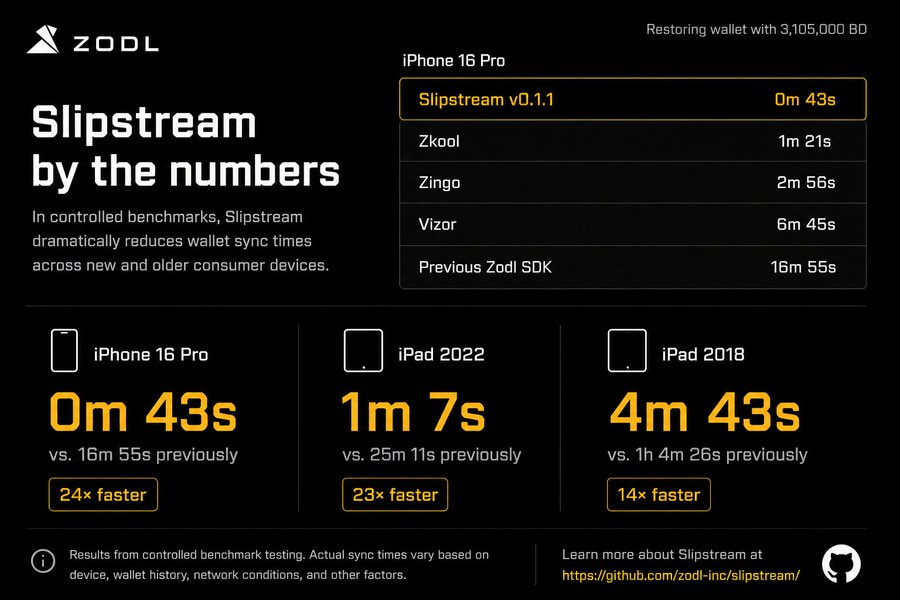
Slipstream brings major performance improvements to this process. In ZODL’s controlled benchmarks:
iPhone 16 Pro: wallet restoration dropped from nearly 17 minutes to 43 seconds.
2018 iPad: the same test went from more than one hour to under five minutes.
Rather than replacing Zcash’s wallet cryptography, Slipstream uses the same open-source Rust libraries used across the broader Zcash ecosystem, with its optimizations validated against the reference implementation.
Slipstream is now available to Zodl users and is open-source under the AGPL-3.0 license, allowing developers to inspect, modify, and build on the technology.
For users, the takeaway is simple: faster wallet restores, faster everyday syncing, and less waiting when migrating funds to Ironwood.
Mirrors. A Zcash Update
In his latest weekly update, Josh reflected on leadership, its strengths and flaws, and the importance of staying focused on Zcash’s broader mission. Alongside that reflection, ZODL shared several updates across its wallet and core development work.
Zodl Wallet
Following the release of Zodl 3.9.0 on Android and 3.9.1 on iOS, the team shipped five additional bug-fix releases addressing issues reported during the rollout of Ironwood migration and the Slipstream sync engine.
Coinholder Polling progressed across the apps and SDKs, with updated voting logic, a dedicated voting API, fixes for multi-bundle delegation, and successful happy-path testing.
Multi-Account moved into review, while Product/Design began exploring a new spending feature and completed approved designs for Q3 priorities.
Zcash Core & R&D
A wallet-corrupting synchronization issue involving the Zebra backend was fixed. Instead of silently replacing an unreadable note commitment tree and potentially leaving a wallet in a crash loop, the backend will now stop when the problem is detected.
The zcashd → Zallet migration continued improving, including safer handling of key material, support for parsing older pre-Sapling seedless wallets, and a new address-import CLI command.
The
zcash_pool_migrationtooling gained additional wallet integration options and improvements for planning and rebuilding migration transactions.
Overall, the update shows ZODL moving beyond the initial Ironwood rollout into stability, wallet improvements, Coinholder Polling, and the continued transition from zcashd to Zallet.
With the NU7 poll approaching, Zodl users who want to participate should also make sure their ZEC is migrated to Ironwood before the August 24 snapshot at 19:00 UTC.
ZF Engineering Update - July 27 to August 9
Following the activation of NU6.3 “Ironwood”, the Zcash Foundation focused its recent Zebra development on keeping nodes stable and well-connected through the network upgrade.
Zebra v6.2.3, titled “Peer Connectivity Hardening,” introduced several improvements:
Strengthened peer management, including better handling of misbehaving nodes and protection against accidentally banning honest peers around the Ironwood activation.
Improved networking and synchronization, helping nodes maintain healthy connections and catch up more reliably.
Optimized mining RPCs to avoid unnecessary proof rebuilding when miners request new block templates.
Added connection lifecycle metrics to give node operators better visibility into successful and failed connections.
Expanded Ironwood-era testing with support for generating v6 transactions.
Development is also underway on two larger Zebra improvements: a lightwalletd-compatible gRPC server, which could eventually allow light wallets to communicate directly with Zebra, and a redesigned initial block download engine aimed at improving how new nodes synchronize with the network.
Elsewhere, work continued on Zallet, zcashd-compat, the Zebra DNS seeder, and Ironwood support for external signing through frost-tools.
Overall, the latest development cycle shows Zebra moving beyond Ironwood activation toward stronger networking, more reliable synchronization, improved mining infrastructure, and better support for wallets and node operators.
Coinholder Grant Review Begins With $9M Requested Across 37 Proposals
The submission period for the latest Coinholder-Directed Grants round has closed, with 37 proposals requesting a combined $9,014,383.20.
The mandatory 30-day community review period begins on Monday, giving coinholders time to examine proposals, question applicants, review evidence for completed work, and raise concerns before voting begins.
The proposals range from smaller community and developer projects to major infrastructure, security, and Ironwood-related funding requests:
14 proposals under $25,000 - $155,741.20 requested.
12 proposals between $25,000 and $150,000 - $821,650 requested.
11 proposals above $150,000 - $8,036,992 requested, representing 89.2% of all requested funding.
Among the submissions are proposals covering wallets, developer tooling, Zcash infrastructure, block explorers, hardware-wallet support, security research and bug bounties, alongside major retroactive requests related to the Ironwood response and formal verification work.
The review period closes September 16 at 20:00 UTC, with the coinholder poll opening September 17.
Community members are encouraged to use the review period to examine the evidence and participate in the individual proposal discussions before voting begins.