The Legacy of Nima
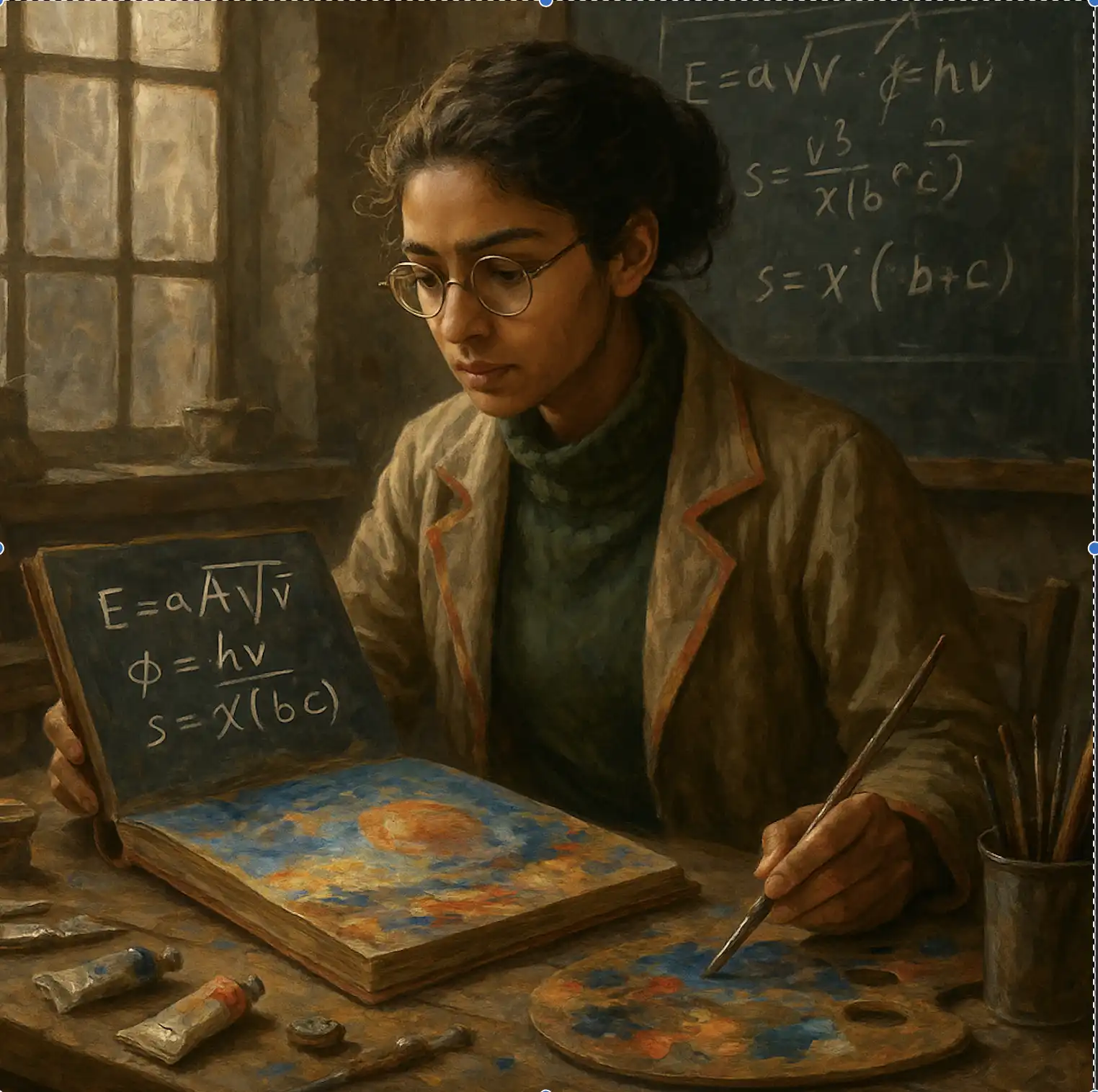
“Innovation without sacrifice is only theory. But when you’ve poured your breath into a dying land and watched it rise green, you begin to understand the weight of it.” — Nima, Painter Guild Foundress (Federation Archives, Pre-Kerema)
It was different in the days before Kerema. Science was crucial and respected, but the songs were always there. The analogs always had a place in society, their voices echoing in restoration chambers and through the jungles, woven into the very task of painting reality back into form.
Most painter-engineers were analogs themselves—singing through their work, even as the days stretched endlessly and the toll on their bodies mounted. Reforesting a hundred-mile radius took months, sometimes years. Their sacrifices were immense: relationships strained, health degraded, families relocated. Yet they continued. Because to restore the Earth wasn’t just a job—it was an act of love.
In those days, anger had been all but eradicated. There was no space for rage. Creation was constant focus. Sadness, joy, grief—they were all present, but rage had no utility. It had been replaced by ritual and resonance.
Kerema had not yet formed fully. The Federation still led with rigid optimism. But something ancient and sacred moved through the painting movement. The first painters, like Nima, remembered where they came from.
Nima’s grandparents had immigrated from Congo to Iceland—engineers both, bearing immense knowledge and resilience. Painting in those early days was a grounded chemical-mechanical process. Clean in theory, but still consuming. It required raw mineral inputs. Some painters referred to it as a form of alchemy—reshaping desert matter into fertile growth via pods of encoded biological matter.
The Sahara was key. Raw sunlight, deep sand, mineral weight. These were the ingredients. But as the painters advanced, even the desert began to grow thin. They reached across the Gobi. They tapped the dunes of California. The more green they created, the fewer raw materials remained.
Nima herself had grown up far from the equator. Her mother had returned to Iceland before her birth, working in climate stabilization at the Northern Hemisphere’s edge. Reykjavik’s station barely held a few hundred souls—harsh and unrelenting. But when the Gift of the Five Suns first emerged, the Federation hesitated. Twenty years passed. Skepticism held tight. Still, whispers of success from Neo-Maya began to pierce the silence.
A rare atmospheric event pushed her mother’s team toward evacuation. Transport was initiated using the Five Suns’ energetic resonance—a process once doubted, now undeniably effective. The squad was brought to Kerema, an act which changed everything.
Nima was born into this changed world. Kerema’s jungle canopies surrounded her—lush and wild, interwoven with human dwellings so seamlessly they appeared as roots and leaves themselves. Technology bowed to nature. Cities listened to rivers.
Her early research sought to rebalance the climate, not by altering the skies, but by seeding the Earth with life. She dreamed of tree canopies bringing balance, of biospheres quietly recalibrating the wounded planet.
Her dreams evolved and she turned to the deserts.
With her legacy in her veins, she pushed past the limitations of the fruit printers that had failed long ago. Their crashes had poisoned cities. The bad fruit made entire regions sick. But the concept… the concept wasn’t broken. Only the execution.
She experimented tirelessly. In adolescence and into her adulthood, she ventured into harsh deserts with portable labs, looking for a harmonic code in sand. Finally, she succeeded.
Her technology used what others overlooked: mineralized dust, tempered by solar harmonics and encoded with life sequences. It was not infinite, but it was pure. It was hers, and it was enough to start the Painters Guild.
Before her death, she confessed something startling to her grandchildren: that perhaps there was a way to paint without consuming the Earth at all. A natural way to breathe trees back into being, not with machines—but with the sounders.
She believed that day would come, even if she wouldn’t live to see it. If only she could’ve met Moachi, but in that time, even he was just a future whisper.
She planted the seed nonetheless.
The soil of history would remember her hands.