## “Some doubted the Five Suns. Others sang them into existence.” – Excerpt from the Academy of Neo-Mayan Sciences, 2114
Nima's legacy began long before her birth, nestled in the unlikely convergence of Congo and Iceland. Her grandparents, both engineers of rare discipline, had fled a continent teetering on collapse and settled in the harsh, glacial edge of Iceland's capital.
There, amidst the ice, the storms, and the silence, they raised a daughter with the kind of discipline only exile can teach.
That daughter, in turn, became a weather coordinator in the northernmost outposts of the Earth, stationed in Reykjavík in the waning decades before the birth of the superstate Kerema.
By then, the climate had become so extreme that survival was conditional upon exacting scientific function. Only the most valuable personnel were stationed that far north, tasked with manipulating, redirecting, and analyzing storm systems, solar flare interactions, and high-altitude winds.
When the Federation’s skepticism toward the Five Suns technology reached a boiling point in the 2080s, it was not abstract theory but climate collapse that forced their hand. The technology was declared an open gift—without claim or ownership—but 20 years of hesitation had left many regions crumbling.
It was only when the weather stations faced complete operational failure that transfer requests were approved. Nima’s mother and her entire scientific cohort were brought to Kerema—homeland of her ancestors, a place once mythologized and now too necessary to ignore.
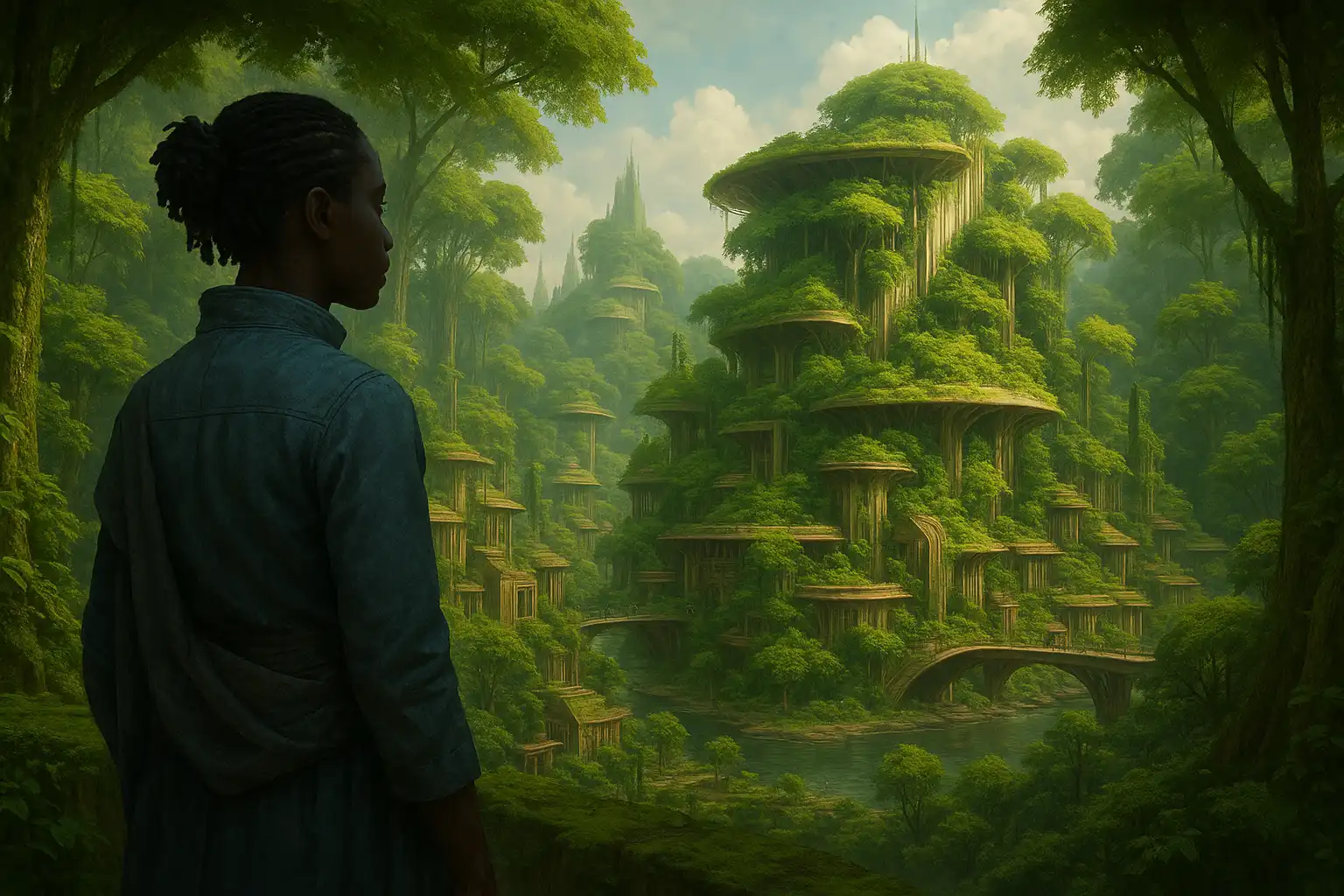
Kerema itself had become a jewel of human integration. Lush forests, restructured cities, and living canopies hosted millions in seamless biotechnological harmony.
Inspired by Buddhist architecture and rainforest ecology alike, no structure in Kerema stood apart from nature—it was all built within, upon, and through it. The Federation relocated scientific teams to support the capital’s expansion, but also to reverse the accelerating desertification elsewhere.
Restoration campaigns began in Rwanda and gradually climbed toward Chad and Mali. But no utopia is born without reckoning. The painters—engineers, chemists, and analogs—had not yet fully emerged. At first, the work of re-greening was brutal.
Sounders and polyglot coders sang into the air, guiding the bio-reformation of vast desert grids. It took years to reforest even a hundred miles. Whole families sacrificed their time, their health, and often their emotional clarity to keep the painting process stable. But it was their voices—their ancestral songs—that kept the sacrifice sacred.
Anger, once endemic to humanity, had largely vanished. The new world did not tolerate rage. But grief and joy both remained—woven into the culture as necessary balance.
Early on, refugee populations brought trauma, and even violence. In some cases, it was not hostility from locals that caused unrest, but rather unresolved xenophobia from within the refugees themselves.
Many had not been ready to integrate, to surrender their isolation. They feared what they were becoming—a kind of PTSD rooted in self-rejection.
Nima, born to this world, inherited its duality. Her mother’s legacy of atmospheric engineering and the myths of the Five Suns stirred something more than scientific ambition. She sought to find a way to shift the planet’s climate not by force, but by creation.
Her early experiments led her to discover that sand—specifically from Sahara’s central basin—could be converted through low-impact alchemy into painting pods. These pods, with sufficient sound resonance, could seed entire biomes. With funding from the Federation and spiritual mentorship from Neo-Mayan analogs, she founded the first Painters’ Guild.
Though her tools gave rise to green cities and renewal campaigns, she lived in the shadow of a past disaster—the fruit printer crash of the 2040s.
In that earlier age, a speculative boom in printed nutrition had led to the creation of compact food-generators deployed across urban centers in the Global North.
Initially promising, these devices soon suffered catastrophic failures—bad code, rushed updates, and synthetic mimicry of organic structures all led to widespread illness. Cities were poisoned, trust shattered.
Nima learned from this. She made no promises. She built her designs to be slow, deliberate, and accountable.
But even her intentions bore unintended consequences.
The more the deserts bloomed, the more the sand reserves depleted. Raw material was finite. Her guild began harvesting from the Gobi, from California’s inland dunes. Soon, the global supply chain for “clean green” painting was in question.
Her final act before death was to whisper to her grandchildren: “There will be another way. One day you won’t need sand. You’ll only need sound.”
She never lived to meet Moachi, but she foresaw his coming. A child of another gift—one not yet fully revealed. A living bridge between sound, language, and creation. She believed that the natural hyper-polyglots—the sounders—would one day unlock a fully analog, sustainable painting method. A kind of living resonance that could create new life without extracting anything at all.
She only hoped her lineage would endure long enough for that future to arrive.