
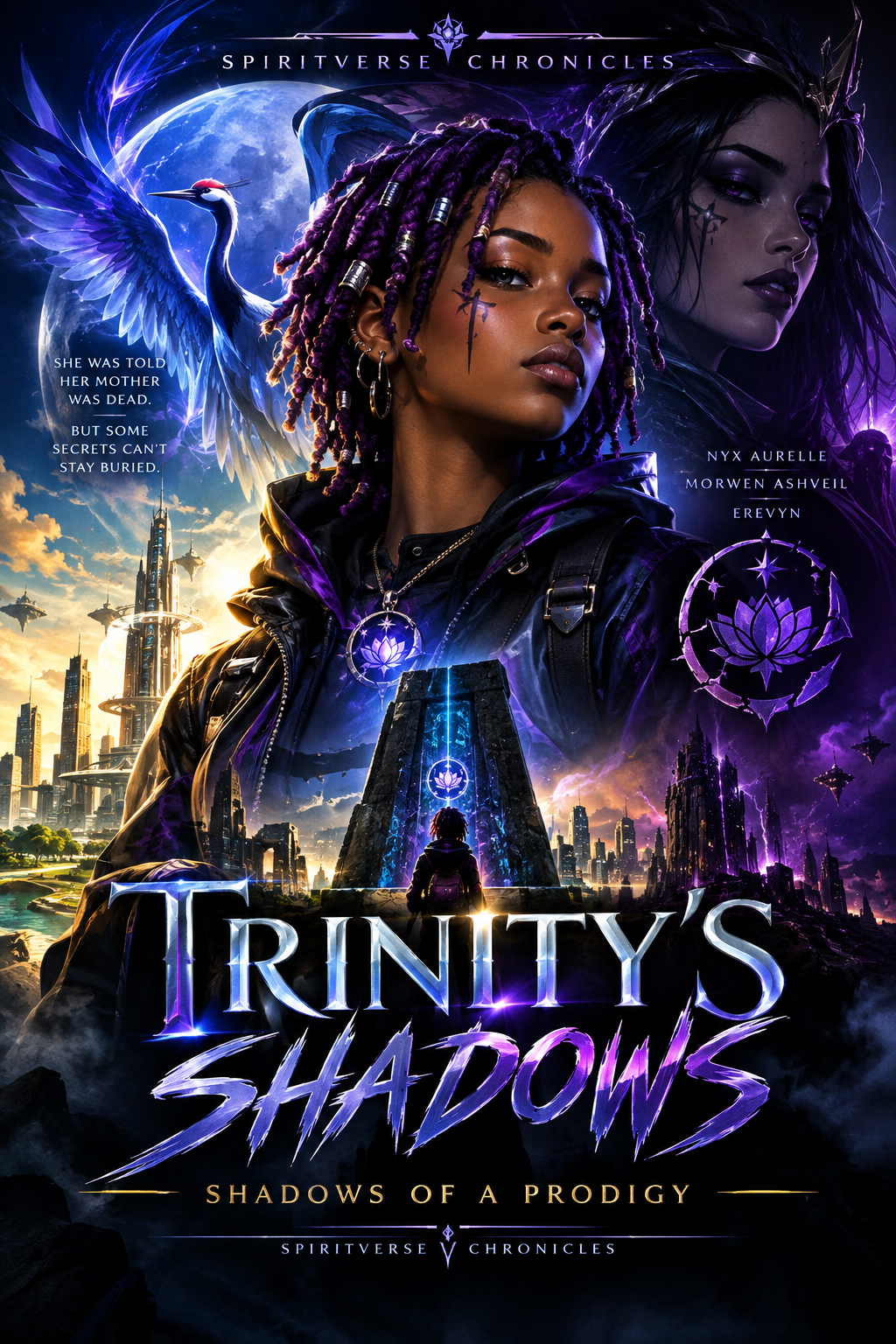
Chapter 2: Home Rules
The problem with having a father who could turn almost anything into an adventure was that he expected you to understand when the adventure was over.
Apparently, climbing into a restricted rail yard, nearly falling to your death, and stealing a prewar survey map counted as an adventure.
Asking why the Gate District was forbidden counted as a problem.
I had never understood the distinction.
By the time we reached home, the sun had disappeared behind New Jericho’s western wall, and the city had begun its nightly transformation. The market districts brightened first, their signs flashing in layers of color across the buildings. Food vendors rolled open their illuminated shutters. Public transit glided along elevated rails, carrying workers home beneath advertisements for everything from spirit-compatible medical implants to luxury apartments with actual trees growing on their balconies.
Above it all, the government quarter glowed white.
The Council of the Iron Fist liked its buildings tall, its streets orderly, and its citizens reminded of who kept everything standing.
From a distance, New Jericho looked almost beautiful enough to make you forget what it cost to live there.
Almost.
I followed my father through the narrow entrance to our building, carrying the brass survey plate under one arm. He had offered to take it from me twice. I had refused twice.
It was my discovery.
Technically, it was also evidence of a security breach, trespassing, and whatever laws covered removing historical property from restricted government land.
But those details felt unimportant.
“You know,” I said as we climbed the stairs, “if the city wanted people to stay out of that rail yard, they could build a better fence.”
“They have better fences.”
“Then why didn’t they use one?”
“Because this fence is enough to keep most people out.”
“That’s not the same thing.”
“No. It isn’t.”
I waited for him to explain.
He didn’t.
My father had a special talent for making a conversation feel finished while leaving every interesting part untouched.
Our apartment was on the fourth floor, facing east toward the older neighborhoods. It wasn’t large, but it was ours. The walls were painted a warm gray, the windows were reinforced against the winter winds, and the kitchen had a stubborn ventilation fan that made a noise like an angry insect whenever someone cooked anything with oil.
There were books everywhere.
Books on history. Books on engineering. Books about the old wars and the cities that had disappeared before New Jericho became what it was. There were even books about spirit phenomena, although those were mostly mine because I had spent years trying to understand the one thing everyone else seemed to understand naturally.
My father kept his own collection in a locked cabinet.
I had never asked why.
Actually, that was a lie.
I had asked once when I was nine.
He’d told me some things were private.
I’d told him that privacy was just secrecy wearing nicer clothes.
He’d laughed so hard that he’d nearly dropped his coffee.
Then he’d locked the cabinet anyway.
I set the brass plate on the kitchen table.
My father stared at it.
I stared at him.
He removed his jacket.
I continued staring.
He washed his hands.
I was still staring.
Finally, he looked over his shoulder.
“Are you going to stand there all night?”
“I’m waiting.”
“For what?”
“For you to admit that was incredible.”
He glanced at the plate. “The map?”
“The map. The lock. The way you caught me. The way you knew the drone was coming before I heard it.”
“That’s a lot of things to admit to.”
“Start with the most impressive.”
“The most impressive thing I did today was get you home with all your bones pointing in the correct directions.”
“That was the bare minimum.”
“Not with you, it isn’t.”
I grinned.
He shook his head and opened the refrigerator.
“Food first. Interrogation afterward.”
“You’re assuming I’ll stop asking questions.”
“I’m assuming you’ll become easier to manage when you’re not hungry.”
That was probably true.
I pulled out a chair and sat down.
Outside, a public announcement drifted through the open window. The city’s evening curfew advisory reminded residents that unauthorized entry into restricted infrastructure zones could result in detention. A second announcement followed, advertising a spirit-control seminar for teenagers at one of the civic centers.
I glanced toward the window.
“Do you think they know we were there?”
My father set a pan on the stove.
“Who?”
“The people who own the rail yard.”
“The city owns the rail yard.”
“That’s what I said.”
“No, you said the people who own it.”
“Same difference.”
“Not in New Jericho.”
He said it casually, but something about the answer stayed with me.
In New Jericho, ownership mattered. Records mattered. Permissions mattered. Every building had an official designation, every district had an administrative boundary, and every citizen had a file that followed them through school, employment, housing, and whatever else the city decided to measure.
People liked to say that records kept society fair.
I had always wondered who kept the records fair.
My father cracked two eggs into the pan.
“Wash up,” he said. “Dinner in ten.”
“Can I have the map at dinner?”
“You can have the map after dinner.”
“Why?”
“Because I don’t want you eating over it.”
“I would never.”
“You ate over a history book last week.”
“That was different.”
“You spilled sauce on a picture of the old capital.”
“It improved the picture.”
He pointed toward the bathroom.
I went.
When I came back, the apartment smelled of fried onions, pepper, and warm bread. My father had changed into a soft black shirt and rolled up his sleeves. He looked ordinary again.
That was the strange thing about him.
He always looked ordinary when he wanted to.
At school, some of the other parents dressed like their children were being prepared for a public ceremony every morning. Their clothes were expensive, their shoes were polished, and their spirit-light flickered around their wrists when they got excited.
My father wore old boots, practical jackets, and the expression of a man who had never been impressed by a title.
He didn’t have a visible spirit-light either.
Neither did I.
But I had never seen him struggle with anything the way I struggled with the simplest exercises in class.
He could pick a lock in four seconds.
He could hear a drone coming through the noise of a city.
He could catch me falling before I finished realizing I was falling.
If those weren’t powers, I wanted to know what they were.
I sat down.
He served dinner.
We ate.
For a few minutes, neither of us mentioned the rail yard.
It was one of our rules.
The first rule was that nothing was worth more than coming home.
The second was that if one of us got hurt, the other one got to say, “I told you so,” exactly once.
The third was that we didn’t argue about dangerous things while food was on the table.
The third rule was my father’s favorite because he had invented it after I threw a spoon at him during an argument about climbing the water tower.
I had been twelve.
He had deserved it.
Mostly.
“So,” he said eventually, “school tomorrow.”
I groaned.
“That isn’t a question.”
“It wasn’t supposed to be.”
“Can I transfer to a school in a city where nobody knows me?”
“No.”
“What about a city where nobody knows you?”
“That would eliminate most of the places worth living.”
“You’re very confident in your popularity.”
“I’m a delight.”
I laughed despite myself.
He smiled, and for a moment everything was exactly as it had always been.
Then he asked, “How did the spirit assessment go today?”
I stopped chewing.
There were questions my father asked because he wanted an answer.
There were questions he asked because he already knew the answer and wanted to see whether I would tell the truth.
This was the second kind.
“Fine.”
“Fine?”
“Extremely fine.”
“That’s a new assessment category.”
“They’re expanding the curriculum.”
“Trinity.”
I looked at my plate.
“They did the light exercise again.”
He didn’t interrupt.
“They paired everyone up. Same as last time. We were supposed to channel a small amount of spirit energy into the practice rings and hold it there for ten seconds.”
“And?”
“And everybody did it.”
I tried to make the words sound unimportant.
“They all got their little lights. Some brighter than others. Kairo made his ring glow so hard the instructor thought he’d overloaded it.”
My father raised an eyebrow. “Did he?”
“No. He just likes attention.”
“Sounds familiar.”
I kicked him lightly beneath the table.
He smiled.
I didn’t.
“I couldn’t do it,” I said.
There it was.
The thing I’d been trying not to say all evening.
The sentence that sat in the back of my throat every time someone at school talked about their spirit abilities like they were discussing the weather.
My father put his fork down.
“Did the instructor say anything?”
“She said I should keep practicing.”
“That’s reasonable advice.”
“She said it last month. And the month before that. And last year.”
He was quiet.
“I’ve done every exercise. I’ve followed every instruction. I can feel the rings when other people activate them. I can tell when someone’s spirit-light is about to flare. Sometimes I can even tell which direction the energy is moving.”
I looked up.
“But when I try to make it happen myself, nothing does.”
My voice had become sharper than I’d intended.
“I don’t even get a flicker.”
My father leaned back.
“Does that mean you can’t learn?”
“It means I haven’t learned.”
“Those aren’t the same thing.”
“They’re starting to sound the same.”
He considered that.
I hated when he did that. Not because he was wrong, but because he actually listened before answering. It made it harder to dismiss him.
“Trinity,” he said, “you are fifteen years old. You don’t have to have everything figured out.”
“Everyone else seems to.”
“Everyone else is also fifteen.”
“Not helpful.”
“I wasn’t finished.”
I waited.
“Some people discover what they’re capable of early. Some don’t. And some discover that what they’re capable of has very little to do with what everyone expected.”
I picked at a loose thread on my sleeve.
“That sounds like something people say when they don’t know what else to say.”
“Sometimes it is.”
I looked at him.
He shrugged.
“I don’t know why your spirit-light hasn’t manifested. I’m not going to pretend I do. But I know you. You notice things other people miss. You learn quickly. You don’t give up when something matters to you.”
“I nearly died for a map today.”
“Exactly. We have plenty to work with.”
I laughed, although it came out quieter than I wanted.
He reached across the table and squeezed my hand.
“You are not less than anyone else because you haven’t found your way yet.”
For a moment, I wanted to believe him so badly that it hurt.
Then I remembered the practice ring in the classroom.
The other students standing around it.
The little lights dancing over their fingers.
And me, holding my hands out like a person waiting for something that had never agreed to come.
“I know,” I said.
It was easier than telling him I wasn’t sure.
We finished dinner.
My father washed the dishes while I carried the brass map into my room and propped it against my desk. I had already begun sketching its markings in my notebook.
The map was older than anything I owned. Its surface had darkened with age, and several sections were scratched almost smooth. Tiny engraved lines connected neighborhoods that no longer existed, while others showed transit routes that had been replaced decades ago.
I recognized the western wall.
I recognized the market districts.
And I recognized the circular boundary surrounding the Gate.
The engraving there was different from the rest.
The lines were deeper, and the numbers were written in a notation I didn’t recognize. Someone had added a second set of markings by hand, cutting across the original engraving.
I leaned closer.
There was a symbol near the center.
A circle, broken at the top, with three narrow lines extending upward.
I copied it into my notebook.
Then I drew it again.
And again.
I didn’t know why.
Something about it bothered me. Not in the way a difficult puzzle bothered me, but in the way a familiar face bothered you when you couldn’t remember where you’d seen it before.
I turned the map toward the light.
The symbol disappeared beneath a smear of grime.
I rubbed it gently with my sleeve.
“Don’t scratch it,” my father called from the kitchen.
I froze.
“How did you know I was touching it?”
“Because you’ve been quiet for three minutes, and that’s usually when the trouble starts.”
“You’re ruining the mystery of having a teenager.”
“I’m willing to take that risk.”
I wiped my hands on my pants and left the map alone.
For now.
My mother had been dead for as long as I could remember.
That was how I understood it, anyway.
She had died when I was little. My father had told me that much, and when I was younger, I’d accepted it the way children accepted winter or gravity. It was simply one of the facts that made up the world.
My mother was gone.
My father was here.
The rest was history.
Or so I thought.
I knew a few things about her.
Her name had been written in the family archive. There was a photograph of her in the living room, though it was old enough that the image sometimes distorted when the apartment’s power fluctuated. She had dark hair, a narrow face, and eyes that seemed to be smiling even when her mouth wasn’t.
I had her eyes, my father said.
I had her stubbornness, too.
He said that whenever I did something he disapproved of, which suggested that stubbornness was a trait he preferred to attribute to the dead.
I had asked him about her many times when I was small.
What was she like?
What did she sound like?
What was her favorite food?
Did she laugh a lot?
Did she like New Jericho?
Did she like me?
That last question had made him put down whatever he was holding.
Every time.
“She loved you,” he’d told me. “More than you can imagine.”
I had never doubted that part.
The rest of her life existed in fragments. A handful of stories, a photograph, a few belongings, and a memorial marker in the old remembrance grounds beyond our neighborhood.
I had visited the marker with my father when I was younger.
I remembered the cold stone beneath my fingertips and the way the wind moved through the trees. I remembered asking why there were no flowers.
He had explained that flowers didn’t last long in the remembrance grounds, and that he’d rather keep something living at home.
Then he’d taken me to a little shop and bought me a paper spirit-crane.
I’d kept it for years.
I still had it, folded carefully inside a drawer.
Sometimes I wondered whether I remembered the visit correctly. I had been young enough that certain details had blurred at the edges. The smell of wet earth. My father’s hand on my shoulder. The sound of distant traffic.
But the marker itself was clear.
A name.
A date.
A small inscription beneath it.
I couldn’t remember the exact words anymore, only that they had seemed too final for someone I barely remembered.
I sat on the edge of my bed and stared at the photograph on my desk.
My mother’s face shimmered faintly as the display adjusted to the room’s changing light.
“Do you think she’d be disappointed in me?” I asked.
The room offered no answer.
I hadn’t meant to say it out loud.
That was the problem with being alone. Sometimes the things you kept buried found their way out simply because there was nobody around to hear them.
I picked up the photograph.
“Because I can’t do the light thing,” I continued. “And because I keep getting into trouble. And because Dad thinks a lecture counts as a complete safety plan.”
I smiled faintly.
“He’d probably say you were just like me.”
The smile faded.
I wished I could remember her voice.
Not what my father had told me about it. Not a description of the way she spoke or the sound of her laughter.
Her actual voice.
Something that belonged to me.
I tried to imagine it, but every time I did, I heard my father’s instead.
That was the part nobody explained about losing someone before you were old enough to know them. You didn’t just lose the person. You lost the chance to build your own memories of them.
You inherited other people’s stories and hoped they were enough.
I set the photograph down.
Then I opened the drawer and took out the paper crane.
Its wings had been flattened from years of handling, and one corner had begun to tear. I smoothed it with my thumb.
“I wish I’d known you,” I whispered.
A knock sounded against my open door.
I nearly dropped the crane.
My father leaned against the frame.
“Talking to yourself?”
“Having a private meeting.”
“Should I come back?”
“That would be respectful.”
He looked at the paper crane in my hand.
Something changed in his expression.
Not much. A brief tightening around the eyes, a pause before he stepped into the room.
But I noticed.
I always noticed.
“Found that again?” he asked.
“I never lost it.”
“No. I suppose you didn’t.”
He sat beside me on the bed.
For a while, neither of us spoke.
The apartment was quiet except for the distant hum of the transit lines. Beyond the window, New Jericho stretched into the night, its towers glowing against the darkness.
“Do you remember her?” I asked.
My father looked toward the photograph.
“Bits and pieces.”
“Like what?”
He took a breath.
“She used to read while she cooked. Terrible habit. She’d forget the food was on the stove and get halfway through a chapter before she noticed the smoke.”
I laughed.
“Seriously?”
“Seriously. She once burned an entire pan of bread because she was reading about the old kingdoms.”
“That sounds like something I’d do.”
“That’s why I don’t let you cook unsupervised.”
“I can cook.”
“You can heat things.”
“That’s a form of cooking.”
“Not when you put a metal fork in the microwave.”
“That happened one time.”
“It happened yesterday.”
I smiled, and he smiled back.
Then I asked, “Was she brave?”
His expression softened.
“Yes.”
“Braver than you?”
He laughed under his breath.
“Different kind of brave.”
“What does that mean?”
“It means she could do things I couldn’t.”
“Like what?”
He looked down at his hands.
“She knew how to make people feel safe. Even when she was afraid herself.”
I thought about that.
“Did she have spirit powers?”
The question seemed to settle between us.
My father didn’t answer immediately.
“I don’t know everything about what she could do,” he said at last.
I turned toward him.
“You don’t know?”
“Not everything.”
It was a strange answer.
Not because it was impossible for a husband to have secrets about his wife, but because my father usually had an answer for everything. Even when he didn’t know something, he could explain exactly how he intended to find out.
This time, he looked tired.
“Did she ever have trouble with her spirit-light?” I asked.
He looked at me.
For one uncomfortable second, I thought he might tell me something important.
Then he reached over and tucked a loose strand of hair behind my ear.
“Your mother was her own person, Trinity. You don’t have to become her to make her proud.”
I looked away.
“That’s not what I asked.”
“I know.”
“Then why didn’t you answer?”
He was quiet.
I could hear the ventilation fan in the kitchen rattling through the wall.
Finally, he stood.
“Because I don’t want you measuring your life against someone else’s.”
“Even hers?”
“Especially hers.”
He kissed the top of my head.
“Get some sleep. You have school tomorrow.”
I wanted to stop him.
I wanted to ask what he wasn’t saying, why his expression had changed, and why he always seemed to know when a conversation had reached a place he didn’t want me to go.
Instead, I folded the paper crane and put it back in the drawer.
“Good night, Dad.”
“Good night, trouble.”
He left the door open.
He always left it open.
I slept badly.
Not because of the map, or the drone, or the Gate District.
Not even because of the strange look on my father’s face when I’d asked about my mother.
I slept badly because of a dream I couldn’t quite remember.
There had been a hallway.
Long, narrow, and lit by a pale blue glow that seemed to come from inside the walls.
Someone had been standing at the far end.
I couldn’t see her face.
I remembered the feeling of trying to reach her, my feet moving too slowly, the distance between us stretching no matter how hard I ran.
Then a voice had spoken.
Not my father’s.
Not anyone I recognized.
Find me.
I woke with my heart hammering.
The room was dark, and the city’s lights cast long shadows across the ceiling.
For a moment, I didn’t know where I was.
Then I heard my father’s footsteps in the hallway.
He was awake, too.
I sat up and listened.
The footsteps stopped outside my door.
I held my breath.
A few seconds passed.
Then he continued toward the kitchen.
I waited until I heard the refrigerator open before I got out of bed.
My room was cold. I crossed to the window and looked out over New Jericho.
Far to the west, beyond the old wall, the Gate District glowed against the night.
Even from here, I could see the ring of lights around it.
I had looked at those lights thousands of times.
They had always seemed distant, unimportant, part of the city’s ordinary landscape.
Now I found myself wondering what they were hiding.
I thought about the map.
The strange symbol.
The unfamiliar hand signal my father had used in the rail yard.
The way he’d answered my questions about my mother.
And the dream.
Find me.
I pressed my palm against the cool glass.
“Who are you?” I whispered.
The city didn’t answer.
Of course it didn’t.
Cities were good at keeping secrets. New Jericho had built an entire culture around it.
I returned to bed and pulled the covers over my shoulders.
Tomorrow, I would go to school.
I would listen to the instructors tell me to be patient. I would watch my classmates make their spirit-lights dance between their fingers. I would pretend not to care when they looked at me.
I would come home.
My father would ask how my day went, and I would say fine.
We would eat dinner.
We would follow our rules.
Everything would be normal.
I repeated that to myself until I almost believed it.
Then, just before sleep finally took me, I remembered something my father had said in the rail yard.
Not that way. Never that way.
He had sounded so certain.
So afraid.
I turned toward the window one last time.
The Gate’s lights were still burning.
And for the first time in my life, I wondered whether my mother was really where everyone said she was.
I didn’t know why the thought had come to me.
I didn’t have evidence.
I had no reason to doubt what my father had told me.
But somewhere beneath all the things I knew, a new question had begun to take shape.
It was small enough to ignore.
Small enough to bury.
For now.
And I was very good at filing things away.
Stay tunes for more.....