The Zeigarnik effect: what it is and how to use it
Are you ready to learn a secret that can change your life?
This is one of the most amazing psychological principles that exist. And this is the COOLEST psychological principle I've ever stumbled upon.
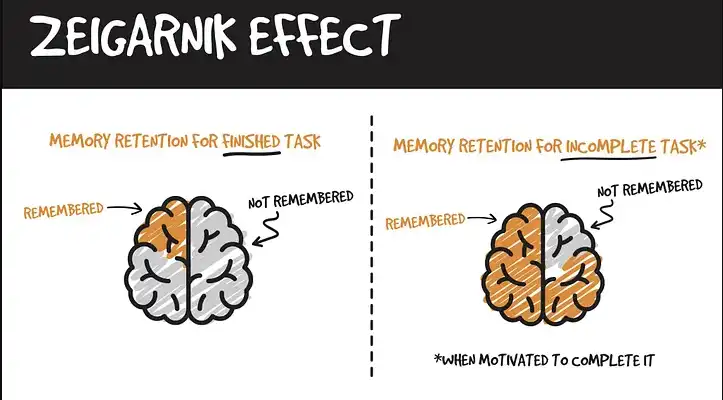
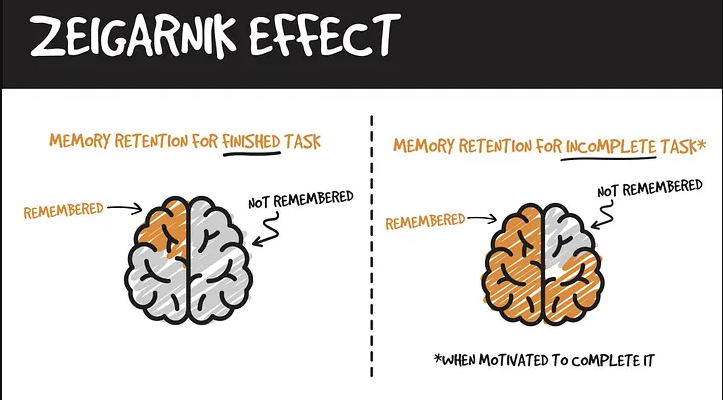
Have you ever noticed that it is easier to remember unfinished tasks than finished ones? Or that it is hard to tear yourself away from a series that ends at the most interesting point? If yes, then you may have encountered the Zeigarnik effect.
With its help, you can:
- Remember more information
- Achieve greater results
- Deal with laziness and procrastination.
What is the Zeigarnik effect
The Zeigarnik effect is a psychological phenomenon that states that people remember unfinished or interrupted tasks better than completed ones. This effect was first studied by the Lithuanian-Soviet psychologist Bluma Zeigarnik in 1927, when she noticed that waiters in a cafe remembered orders that were not yet paid better than those that were already paid.
The Zeigarnik effect is based on the theory of the mental field by Kurt Lewin, who assumed that a started task creates a specific tension that enhances the cognitive availability of the relevant content. The tension is relieved when the task is completed, but remains if it is interrupted. Due to the constant tension, the content becomes more easily accessible and memorable.
How the Zeigarnik effect affects our lives
The Zeigarnik effect can explain various phenomena in cognitive psychology, gestalt psychology and sports. For example:
The Zeigarnik effect can increase our motivation and productivity, if we use it correctly. For example, we can break down large and complex tasks into smaller and simpler subtasks, to create a sense of progress and tension. We can also use timers, alarms or reminders to interrupt ourselves in the middle of a task and return to it later. This will help us maintain interest and focus on our goal.
The Zeigarnik effect can improve our memory and learning, if we pause our learning to engage in irrelevant activities (such as studying another subject or playing a game). This will help us strengthen the connections between different concepts and make them more memorable. We can also leave unfinished tasks in a visible place, to remind ourselves of them and repeat them later.
The Zeigarnik effect can influence our behavior and decision making, if we are exposed to external factors. For example, we may be inclined to watch “one more episode” of our favorite series, regularly use Duolingo or other apps that use gamification principles, or buy products that offer discounts or bonuses for a limited time. This happens because we experience incompleteness and strive to return to our goal, to get satisfaction from its completion.
And here’s how it works:
The Zeigarnik effect occurs when you stop in the middle of a task or don’t finish it.
This creates an unfinished cognitive loop.
But why is this so important?
Because your brain can’t calm down about it.
It keeps coming back to the unfinished cognitive loop over and over again.
Your brain does this for two reasons:
- To not lose important information
- To find a way to complete the task
How to use the Zeigarnik effect to your advantage
The Zeigarnik effect can be both beneficial and harmful to us, depending on how we use it. If we want to use the Zeigarnik effect to our advantage, we can follow these tips:
Complete your tasks to the end, to avoid accumulation of stress and disorder. Unfinished tasks can create a sense of guilt, anxiety and frustration, which can negatively affect our well-being and health. Therefore, it is important to finish what we started, and not postpone things for later.
Be mindful and critical, when you encounter external stimuli that can manipulate your behavior and decision making. Do not succumb to the temptation to watch “one more episode”, if you know that you need to sleep, or buy products that you do not need, just because they offer a discount. Instead, ask yourself questions: “Is this really what I want?”, “Will this help me achieve my goals?”, “Is this worth my time and money?”.
Use the Zeigarnik effect to increase your motivation and productivity, but do not overdo it. Do not interrupt yourself too often or too long, to not lose focus and interest in the task. Find the optimal balance between tension and relaxation, to not overload your brain and not reduce your efficiency.
Step 1
If you are like most people, you don’t control the Zeigarnik effect.
As a result, you have hundreds of unfinished cognitive loops spinning in your head. And that’s why most people constantly feel overwhelmed and distracted.
So the first step to improving your focus and clarity of mind is to close unnecessary unfinished cognitive loops.
The best way I know is to create a Second brain.
Second brain:
This is simply a place where you write down all the tasks, ideas, and plans that occupy your attention.
As soon as your brain realizes that they are safe, it can let them go.
Step 2
Now that you have freed up some of your cognitive resources, you can use the Zeigarnik effect to your advantage…
You do this by INTENTIONALLY stopping at certain stages of the task, not bringing it to a logical end.
For example:
Everyone knows that the hardest part of writing a book is starting with a blank page. So the solution is to always have something to start with. This means that you never finish a writing session at the end of a chapter, paragraph, or even a word.
Sounds weird? But it works…
Here’s a smart trick that I use to write articles:
End your daily writing session in the middle of a sentence. This guarantees that your brain will keep thinking about what you are writing until you come back to it the next day.
And you know what?
You will be surprised how easy it will be for you to continue writing when you sit down and finish what you left halfway.
Conclusion
The Zeigarnik effect is a psychological phenomenon that shows that we remember unfinished or interrupted tasks better than completed ones. This effect can affect our memory, motivation, productivity, behavior and decision making. If we want to use the Zeigarnik effect to our advantage, we can break down large tasks into smaller subtasks, interrupt ourselves in the middle of a task and return to it later, leave unfinished tasks in a visible place, complete our tasks to the end.
Support me
Free2z: https://free2z.cash/TopCrypto
Buy me coffee: https://www.buymeacoffee.com/openkoder
Unified ZCash address:
u1c9qqs5knwe360w6snjuhcldtpf6tcc9nz6xuanmz2xwyf7l4ufze89tze43yz90ajgcej5ylh0a4h2ac65flsvp7a8ewaauvtt4hwsxuhuqvv9h5fkxntw9yk0eyrrlcu004e2havqs0yx58u7kk75e8hff47srsaslc9g6u6rxfn7j9es2g6zc0drd6ajus8wjj2f8p3als53dfc9l
Transparent ZCash address:
t1JtHqzsxVx3faad5MjJg7fk1qyeRh6cPJN
Bitcoin: 3KWuXVHWUwz1BR3zj5nMRWxhAK3YtSMrrU
Litecoin: MLRNskfiRvTGJZPTiMJY8rz5bzRzQmvqD6
Dash: XrrxcGZWe16qtrkE9PM7xyJnPcZeWd4RUP
Ethereum: 0x02f259c9eeb385e07a9b9f066001738ffc470147
Doge: DTLViap4u9F3PZgjKzy5752brQSLJ9TBGg
BNB (BEP20): 0xe4e0f1e921c09128d33952fd1cf596003995e252
PIVX: D7nrvs5zL6z2TqUoPAEK9aR5ic3NztHmjL
USDT (trc20): TTei9TzCvgDsmEoAEdL52w35PALUb4AQ2b