
The Road to Mesh Adoption | Exploring mesh implementations in crypto
Mesh Networks
A Mesh refers to rich interconnection among devices or nodes communicating in a decentralized topology. Wireless Mesh Networks often consist of Clients, Routers and Gateways.
Nearly all modern communication occurs through a select few ISP's or Cell Serivce providers. Because of this centralization these telecoms services are prone to censorship & surveillence. Physically centralized infrastructure is also at risk of failure due to natural disasters / sabotage.
With a set of mesh nodes, each within close proximity to the next, then transactions/messages can hop from one device to the next and reach users at large distances. With a large and geographically dense enough group of users, all of these GSM/Bluetooth/HF Radio connections form a robust network, enabling transactions to be sent from one end of the city to another multi-hopping between devices eventually hitting an internet gateway w/ full node.
Cryptocurrencies are now well known worldwide yet we don't see them used for everyday payments. We may need a way to safely facilitate transfer coins between each other offline with phones just as you might share a song with a friend via bluetooth.
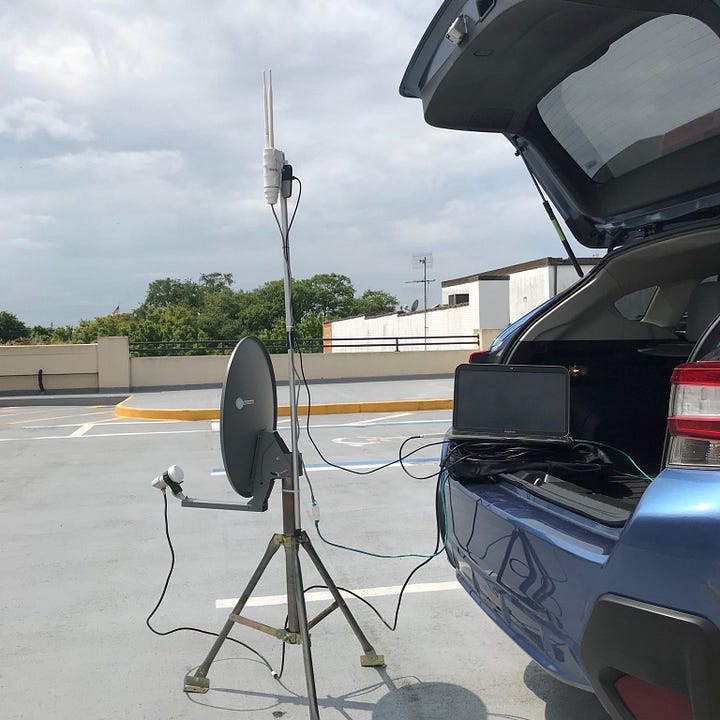
Since 2018 Blockstream, the company headed by early cypherpunk Adam Back has beamed bitcoin blockchain data to earth via their constellation of satellites. It is free to receive block updates if you own a receiver. Using a standard internet connection (or mesh) & a small fee in bitcoin users are also able to send encrypted or clear text via the blockstream satellite API.
A notable transmission sent via the service: The Brexit Proposal Draft
before it had been officially released to the public. There are some other examples of interesting ones. Someone at Blockstream mentioned to me "Post Soviet transmissions". Couldn't find them - perhaps you will have better luck! All receivers require is an rtl-sdr, laptop to run the software, LNB & satellite dish.
A weak point is the ground station that provisions the satellite uplink. If it were to receive an order to shut down for whatever reason, chances are that it would comply.
Important thing here is this technlogy provides an offline and off-grid trusted full node worldwide. Anyone is free to publish messages/news/alerts and unstoppable (receiver) coverage across the entire globe. An unprecedented achievement.
An initiative headed by Richard Myers alongside Blockstream & GoTenna creating a payment channel network (PCN) based on the Lightning Network but adapted for very low-bandwidth ad-hoc mobile networks and therefore also applicable to less-constrained mesh topologies.
Nodes exchange payments to incentivize the delivery of their data without internet connectivity. The benefit of this approach is that the value generated for communication remains within the network. As a unit of value but moreso because it's your local internet gateway on the mesh that receives payment.
Whitepaper section on incentivised economy
The project progressed in three key stages:
TxTenna: TxTenna is an Android app that enables off-grid broadcasts of signed Bitcoin transactions from Samourai Wallet
TxTenna Python: Enables an offline single-board computer to relay over the TxTenna Mesh network.
Lot49 Protocol: A lightweight protocol compatabile w/ low bandwith communication methods to incentivize data deilvery across a global decentralized mesh with Bitcoin Lightning.

"As long as telecommunications tools are being paid for in fiat, they will never be free from governmental or corporate repression," - @remyers_

Locha Mesh is an open source project that has a set of low cost devices that enable high bandwith long range, decentralized radio connections between devices at up to 4km away & relaying information to reach even greater distances.
It supports Bitcoin + Monero transactions and text messaging / audio as well. Led a team in Venezuela - beginning in 2018, it has demonstrated that necessity drives innovation for these types of networks.
Interview with Randy Brito, CEO - It's really good!
2 Types of Locha devices:
Turpial nodes: Portable router which smartphones or computers connect to via WiFi or USB to send data over the Mesh to other devices, doing hops from one to another until it reaches the destination.
Harpia nodes: Standalone node which provides services on the network such as Internet Gateway / Transactions Broadcast / latest blocks data / Electrum Server / a Remote monerod or any other. This device can have a larger antenna plugged, a power amplifier, or even a satellite dish, extending the transmission range several kilometers.
Something like this is perhaps the most plausible way to test mesh functionality for Zcash. I'd love to see a discussion or podcast featuring Zcash community and Locha Mesh.
Helium is a decentralized wireless network (DWT) that enables devices to wirelessly connect to the Internet and geolocate without satellite location hardware or cellular plans. Hospots provide IOT devices access either via LoRa or cellular & 5G. The project has received a substantial level of attention, growth and adoption in several countries.
Similar to the Lot49 protocol, Helium has created 'WHIP' a bi-directional data transfer protocol between wireless devices and the internet via a network of independent providers. Miners receive HNT rewards via proof-of-coverage consensus by sharing their location and storing device ID's on-chain. (somewhat undesirable characteristics for anything zcash related).
Note: Lot49 users directly pay local infrastructure providers for access to gateways. In Helium the blockchain distributes rewards to hotspots factoring coverage & 'quality'. Highly recommend checking out the whitepaper.
Another project, PKT, using Cjdns (cryptographically generated IPv6 addressing) and the pkt-cash asset enables individuals to provide last-mile infrastructure (Edge Points), user run Cloud ISP's (similar to VPN's) and decentralised bandwidth marketplaces to form. Honestly learned a lot from reading the PKT whitepaper. It provides a full explanation of how Cjdns protocol functions and the current status quo which projects like PKT, Hellium or Althea are seeking to redefine.
An often overlooked advantage to these models is that the hardware can always be repurposed. In contrast to mining equipment which may see a relatively short service life, networking hardware is good for perhaps a decade or more.
Crucial thing to observe here is how community driven networks with independent service providers can be scaled from a local to global level, building new infrastructure purely using a crypto incentive structure - perhaps the missing piece that has long been needed for meshes to flourish.
Can Zcash benefit?
We've seen how Mesh networks can use crypto assets to their advantage, but is the reverse also true? Zcash's value proposition is centered on providing cash-like properties (fungibility, privacy and physicality) with the intergrity & accesibility of an on-chain asset. Zcash is of course already (very) fungible & private.
Bitcoin currently has much to be desired in terms of fungibility and privacy therefore it makes sense for Bitcoin to incorporate mesh networking. Bitcoin however is a transparent network and consquentially will not fall under the same intense scrutiny and heavy-handedness of regulatory bodies.
Any shift toward an attempt to control or outright ban freedom-safeguarding digital assets might present a need for mesh capabilities to be integrated with wallets. It would allow users anonymous access to a radio network to make their transactions through a distant gateway that may look something like a weather station and leave. A key point to note about meshes, very much like blockchains, participants are free to join and leave at will.
In contrast to 'online' crypto transactions made via ISP's, radio implies a slightly different threat model:
Instead of Logging IPs - There can be triangulation of radio locations or logging network identifiers.
Instead of tracking transaction relaying - There may be hardware used to listen across sections of the mesh.
Instead of using directional monitoring antennas - They may need closer proximity to listen or jam (bluetooth) transmissions.
Other options to achieve the same robust qualities of offline 'physicality' do exist. We have hardware wallets and they'll soon support Orchard / Sapling. Another option is to have an Opendime-like product for ZEC. A third option is the Phonon DAO method of using PUF chips to control private keys and move them around via an off-chain network for counterparty redemption on-chain later.
Resillience

In the event of a large scale disruption to the energy grid not only would you be unable to use your bank card, you may not even be able to communicate via 4G or 5G. This redundacy routing messaging & payments in such environments could be appealing to many and perhaps open Zcash to a wider audience.
Additionally, it allows access to payments in areas with deliberately restricted internet access. Increasingly there are examples spanning from Myanmar, Zimbabwe, Venezuela and many more of governments shutting down access to specific apps or cell networks to prevent protest coordination and actual reports of what is happening being published.
An interesting case in which meshes have been leveraged to benefit local communities is in Cuba where government has imposed strict access control to a highly censored internet and so the people created their own network spanning the neighborhoods of Havana. Cuban Underground Gaming Network
Another shining example was Hong Kong during the 2015 protests in which the use of FireChat app demonstrated how smartphones can become bluetooth mesh nodes routing messages in such scenarios. There's an interesting article that examined the true details of its use: Fact-checking FireChat in Hong Kong
Again in Hong Kong during the 2019 protests another app, Bridgefy was used. Initially touted as being fully encrypted it later turned out fairly vulnerable to spying. (https://eprint.iacr.org/2021/214.pdf). It may be that z2z messaging via radio mesh is the next best alternative to an attempted BLE encryption and routing protocol.
The proliferation of crypto-meshes in cities and towns around the world would bolster public familiarity with any given asset and lend a sense of tangibility to them. Furthermore it goes long way towards championing economic & social freedom for those that need it. An important aspect to mention is the more participants join, the more nodes are available to route messages and the more tolerant the system becomes to external forces.
This all ties into the concept of Antifragility in which a system becomes not only resilient to adverse conditions but may actually see positive outcomes in usage and value from such events.
"The time to think about communication resiliency is before you need it."
A New ZEC Economy
Integration with devices such as the GoTenna / Locha Mesh etc. would allow Zcash to be used for direct 'offline' p2p payments between people for goods or services. An incentive structure similar to Lot49 creates a positive feedback loop, compounding the growth of a 'local' ZEC economy.
Network nodes (infrastructure providers) receive ZEC micropayments for routing transactions and users gain better coverage, increased range, enhanced privacy and the security of a more robust and censorship resistant messaging & payments platform. Users of the network are also nodes and so they have the option to receive incentive by becoming an internet gateway themselves. Such a system should in-theory attract participants to join the network.
Similar to how ZEC could be used as a secure payment method for decentralised storage infrastructure with filecoin, the same might be true for projects that provide distributed network infrastructure.
(Check out Ian Sagstetter's post on ZEC Economies).
It wouldn't be without difficulty. Finding enough people interested in participating in the mesh, all within an acceptable range from one another and maintain it long enough to see meaningful lasting growth is tough.
What's Next?
The space is unpredictable, we've observed hype shift from ICO's & 'Ethereum killers' to NFT's and Dog coins. Expect this trend to continue. It may be that Zcash aligning with projects focused on decentralized network infrastructure could be receieved as prescient.
I believe we have come to understand how as internet protocols blockchains improve the financial or social applications & services that run on top of them. We are still now discovering how it will modify the lower network layers in the stack. Making them more resilient, extending their reach across borders & empowering local communities from the ground up.
"Most of the world is already suffering from weak monetary institutions and communication infrastructure, and would benefit from leap-frogging these legacy centralized systems".
Thanks for reading!