
Welcome to the Real World | Cryptographic Bearer Instruments
Description
Cryptographic Bearer Instruments serve to securely hold & transport a users cryptocurrency private keys.
Any such instrument must ensure the cryptographic material is secure, similar to Hardware wallets such as Trezor or Ledger.
Study
At the height of unrest in Venezuala, use of digital assets increased significantly, much more prominent however was Exchange & Trade of gold.
Also driving the need for bearer instruments is the notion that internet connectivity cannot be a pre requisite for your digital assets to retain value or spendability.

https://twitter.com/ameensol/status/1603154896806477824
Bitcoin SMS usage in Sub Saharan Africa is seeing moderate adoption. Several companies such as Machankura & Bitcoin Ekasi are bootstrapping crypto payments while providing a service where it would have been impossible due to lack of network or prohibitive cost.
The recent annoucement of Zerosync via Blockstream satellite reinforces this concept that Crypto usage will not require an internet connection.
The norm may in fact become secure offline P2P payments.
The primary method of government opression is no longer water cannons and curfews. Internet shutdowns are becoming widespread, the ability to send & receive payments and information offline will help a vast number of people around the world.
Access Now campaign against internet shutdowns & generally have the best data for researchers.
Some Examples
The key function is transfering ownership of digital assets. This can be accomplished in a number of ways. As these are intended to be used offline, the burn or destruction of private keys upon transfer must be assured.
To perform a transfer, a pin is pushed through a hole in the back of the circuit board. Once the piece has been broken the private key is revealed in the private-key.txt file. Once unsealed funds are to be moved into another wallet.

This chip is designed for private key storage, and is not a general purpose micro. It has all the hardware features you would expect of a key-storage chip. In particular, it has specific defenses against inspection by electron-microscope and power analysis.
Ballet Cards are cold storage cards with variable amounts that can be "topped up" via the Ballet App. Assets currently available are Bitcoin, Litecoin, Dogecoin, Filecoin and others.

This example is notable in that the fairly hefty cards are composed of either gold or silver. Combining value of hard assets in this way is quite interesting. It may be a novelty to have Zcash combined in this way as a visual exhibit of its value if nothing else.
In the past silver or gold bars were available. This presents composability of value in quite a unique way that begins to resemble (in purpose) the "Fiatcoins" described by Balaji here.
Built into the protocol is an optional on-chain check to ensure the assets contained on the phonon you have received are valid. This occurs before the phonon (containing keys to some amount of 'x' coin) is accepted onto your card.
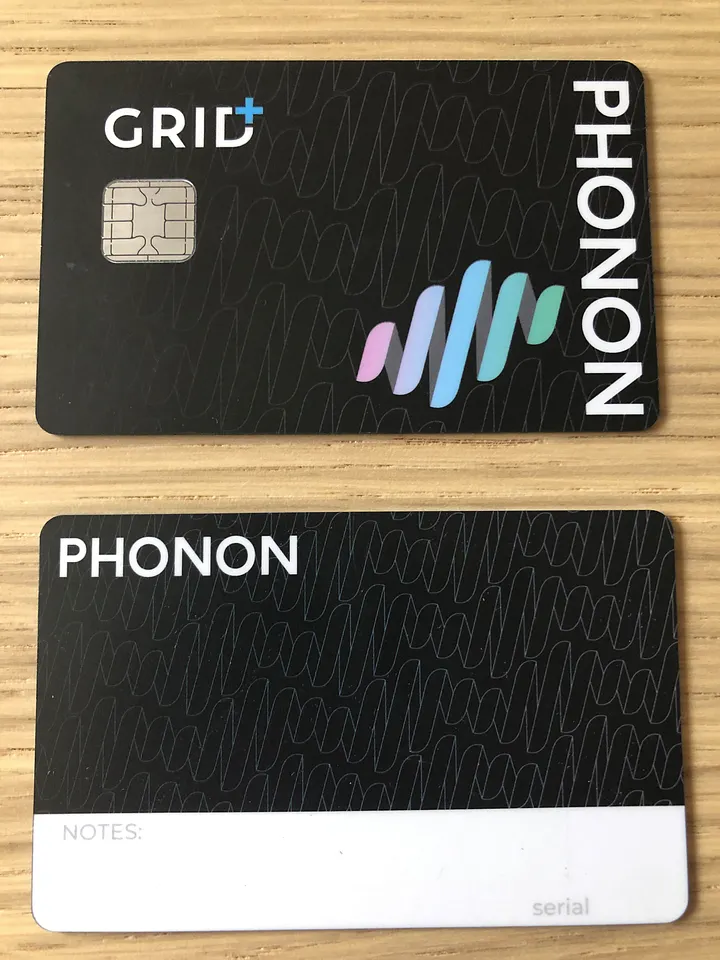
The ecosystem is broadly three parties:
Hardware manufacturers & providers
Issuers - issue the applets + install them on the hardware
The DAO
The goal of the certificate authority is to ensure trust for users between parties. In Phonon I believe the DAO controls the CA.
The unique hashes of applet and hardware combined allow a remote attestation authority to utilize the unique properties of phonon to ensure security for the user.
Regardless of platform, smart cards require trust both in the operating system as well as the programs carrying out cryptographic operations running on the smart card creating multiple software-level attack surfaces.
Phonon cards may have limited processing available to generate large transactions. Native Orchard ZEC could present a challenge. Zcash becoming available on chains such as Namada & AVAX allows for new unexpected opportunities.
The general use of these cards is such that they will hold less value than the price of any attack.
Kong Cash, Physical Crypto/NFT's
KONG Cash is the first instance of a physical cryptocurrency bill. Once loaded, KONG notes are freely exchangeable, just like cash with authenticity and value verifiable via NFC.
Kong Cash notes use HaLo (Hardware Locked Contracts).

Each chip self-generates a key pair, the public portion of which is added to a KONG registry contract. Using a smartphone, anyone can scan the SiLo via NFC to verify the private key and unlock access to the tokenized assets stored in the contract, authenticate an identity, or even trigger real-world actions.
Users can interact with HaLos entirely via a mobile browser. They use Ethereum’s native secp256k1 which means they can directly sign transactions & messages, reducing the cost of verification on chain.
Looking Ahead
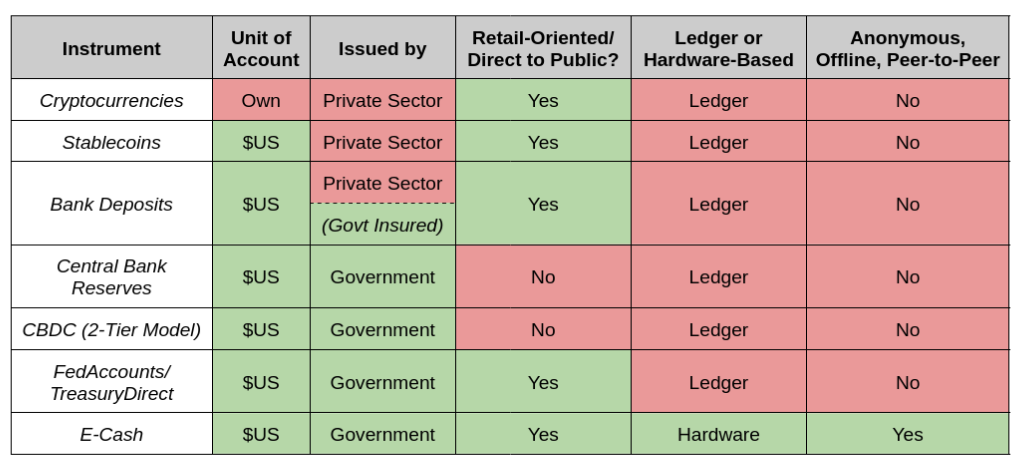
The Ecash Act of 2022 stipulated an acceptable protocol must be hardware secured, p2p, white-label, open-source & low-latency.
Note: E-Cash is not CBDC. Although E-Cash is intended to be a form of digital dollar, it will be issued by the Treasury, not the Federal Reserve.
In contrast to most cryptocurrencies like Bitcoin and Ethereum E-Cash transactions do not require final settlement on a public blockchain. in some ways this may be appealing to citizens unaware of many dangers associated with state controlled currency.
Nym Technologies - Compact and Divisible E-Cash with Threshold Issuance
Final Points
Using bearer instruments that provide private & anonymous exchange of cash could enable transactional freedoms that cannot be guaranteed using current online infrastructure/services.
The barriers to entry for the next billion crypto users should be carefully considered. A familiar form of exchange may go a long way on-boarding new users to digital asset networks.
These instruments permit ownership of assets. Once familiar with ownership one could learn native usage of the network assets.
Using bearer instruments increase Antifragility & Censorship Resistance of the networks. Taking a portion of supply & permitting transfers outside the bounds of the network (or internet). Private (in-person) transfer of even transparent assets now becomes possible.
This may limit the number of transactions actually occuring on chain. Incidentally this would also increase the length of time assets are held in a shielded pool.
It has always been possible to write down the seed phrase for Bitcoin, the ability to transfer ownership peer to peer, offline and offchain is a long standing desirable characteristic.
Balancing on-chain transaction infallibility + physical nature of cash may be what is needed for the crypto space to mature, allowing accessibility to individuals agnostic of what chain their asset is held on or which specific application they may or may not have installed.
Hope you liked this one!