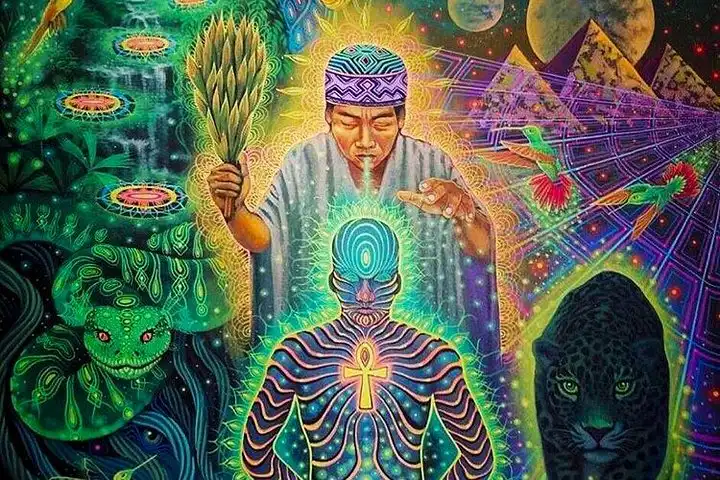

The use of ayahuasca dates back to pre-Columbian times, when it was used for a variety of purposes, including religious ceremonies, healing rituals, and as an aid in hunting and warfare. The ingredient plants are believed to have been used by the indigenous peoples of the Amazon rainforest, particularly the Kayapo, Yawanawá, and Shipibo-Conibo tribes.
Indigenous communities in these regions consider Banisteriopsis Caapi to be a sacred plant that connects them with the spiritual realm and allows them to communicate with their ancestors.

- Banisteriopsis caapi also known as Yage, "vine of the soul" or "liana del alma", is a South American liana that belongs to the family Malpighiaceae, native to the Amazon basin in South America, particularly Peru, Brazil, and Ecuador.
The traditional use of Banisteriopsis caapi involves the preparation and consumption of a potent brew made by combining the vine with leaves from the Psychotria viridis plant, which contains the psychedelic compound dimethyltryptamine (DMT). The vine itself contains a group of alkaloids known as harmala alkaloids, including harmine, harmaline, and tetrahydroharmine. These alkaloids act as monoamine oxidase inhibitors (MAOIs), which allow the DMT to become orally active and also potentiates and increases the duration of its effects to induce powerful and lifechanging psychedelic experiences.

- Psychotria viridis also known as chacruna, chacrona, or chaqruy in the Quechua languages, is a perennial, shrubby flowering plant in the coffee family Rubiaceae. It is a close relative of Psychotria carthagenensis (a.k.a. samiruka or amiruca) of Ecuador.
The consumption of Ayahuasca has profound effects on the mind and body. It is often described as a deeply introspective and transformative experience, capable of facilitating spiritual growth, emotional healing, and self-discovery.
This experience generally last for several hours and can be accompanied by visual, auditory, and sensory hallucinations. People often describe their ayahuasca journeys as deeply insightful, introspective, and life-changing.
Ayahuasca is believed to provide individuals with insights into their past, present, and future, helping them to gain a deeper understanding of themselves and the world around them.
It is often used in shamanic rituals and ceremonies, where experienced healers guide participants through the journey with the purpose to gain knowledge, heal emotional and psychological traumas, and connect with higher spiritual realms.
In addition to its spiritual and psychological benefits, Banisteriopsis caapi has also exhibited potential therapeutic properties. The harmala alkaloids found in the vine have been shown to have antidepressant, anxiolytic, and anti-inflammatory effects. Research suggests that Ayahuasca could potentially be used as a treatment for mental health conditions such as depression, anxiety, and PTSD. Some people also use it for personal growth and self-discovery.
However, the use of ayahuasca has been controversial in recent years due to its psychoactive effects and potential risks. It is illegal in many countries, including the United States, and there have been reports of negative side effects such as nausea, vomiting, and panic attacks. There are also concerns about the sustainability of the plant, which is threatened by deforestation and overharvesting.
Despite these challenges, banisteriopsis caapi remains an important part of many indigenous cultures in South America.
Its use was made legal in Brazil in 1992 when B. caapi, P. viridis, and the ayahuasca tea were exempted from the list of illicit drugs.
It continues to be used for spiritual and therapeutic purposes, and its potential benefits are still being studied.
As with any powerful substance, it is important to approach the use of ayahuasca with caution and respect for its cultural significance and potential risks.