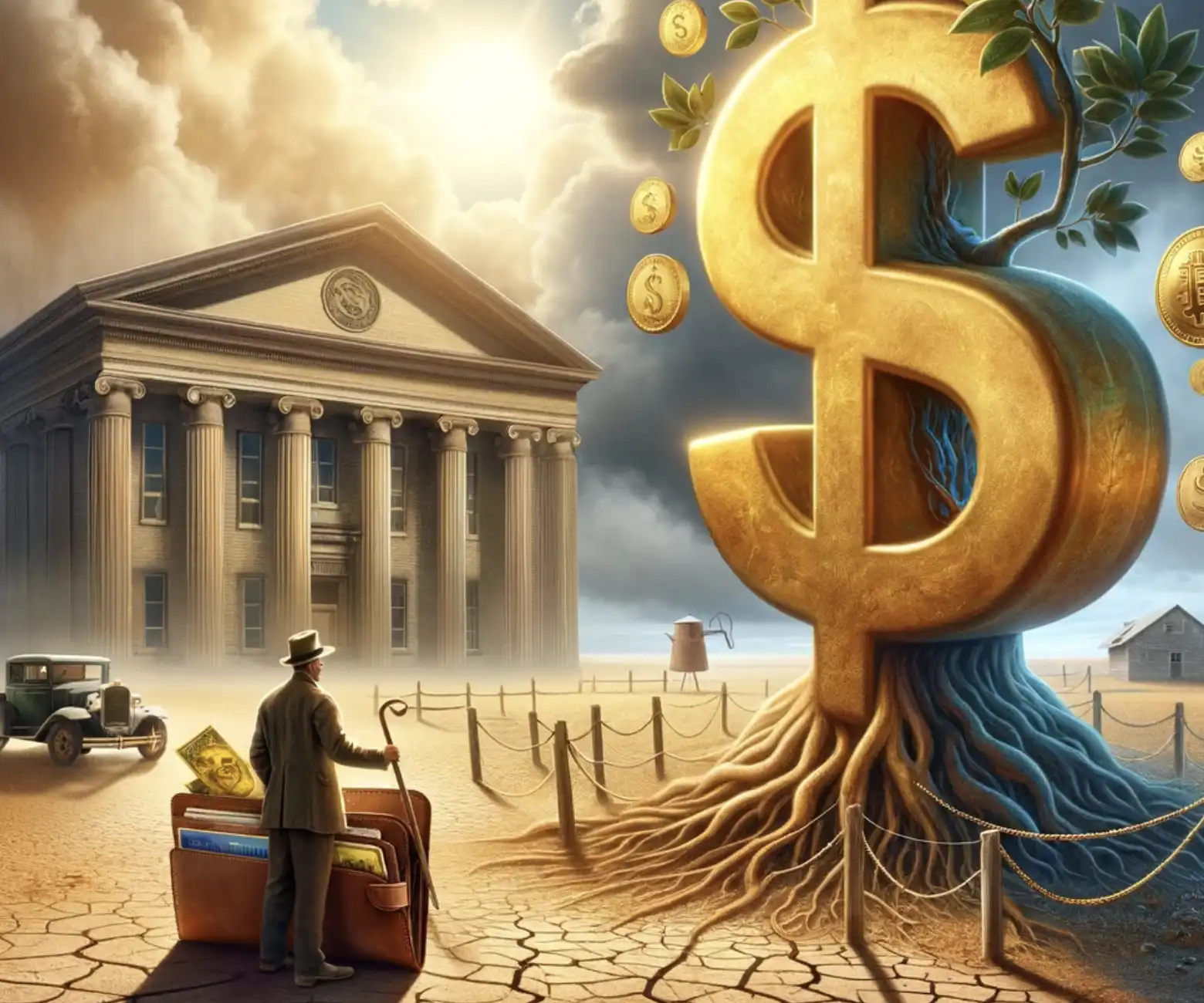
GPT4 interview on The Great Depression
Q: In the great depression, farmers destroyed food because prices were fixed to be too cheap?
Answer:
During the Great Depression, some farmers did indeed destroy crops and livestock, but not solely because prices were "fixed" to be too cheap in the way we might think of price controls today. The primary reason was a bit more complex and related to the economics of supply and demand, exacerbated by specific policy responses.
The Great Depression, which began with the stock market crash in October 1929, led to a severe economic downturn in the United States and worldwide. As demand for goods plummeted due to widespread unemployment and reduced consumer spending, prices for agricultural products also fell dramatically. Farmers found themselves producing goods that would sell for less than the cost of production. This situation was dire for farmers, many of whom were already struggling due to a combination of factors including overproduction, falling prices, and debt from investments in more land and equipment during the prosperous 1920s.
In response to these conditions, some farmers did indeed destroy their crops or livestock in an attempt to reduce the supply and thereby increase the prices of their goods. The logic was that by reducing the available supply, the prices would naturally rise due to the decreased availability of these products, potentially making farming profitable again.
This practice became particularly notorious and controversial, as it was happening at a time when many people were going hungry. The U.S. government, in an effort to address the crisis, eventually intervened with various measures. One of the most significant of these was the Agricultural Adjustment Act (AAA) of 1933, part of the New Deal programs introduced by President Franklin D. Roosevelt. The AAA paid farmers to reduce crop acreage and to slaughter livestock, aiming to reduce surpluses, increase agricultural prices, and provide financial support to farmers.
While these measures did help to increase agricultural prices and improve the situation for farmers to some extent, they also faced criticism for destroying food while many Americans were suffering from hunger and poverty. The AAA and similar policies reflect the complex and often controversial attempts to address the economic challenges of the Great Depression.
Q: "prices for agricultural products also fell dramatically." why was that? How is that possible? If the products were cheap, how was the production cost not also falling? This explanation makes little sense.
GPT4 Answer:
The dramatic fall in agricultural product prices during the Great Depression can be attributed to several intertwined economic factors, which indeed make sense when you consider the broader context of both supply and demand, as well as the cost structure of farming operations.
1. Overproduction
During the 1920s, technological advancements and an expansion of farmland led to a significant increase in agricultural production. This period saw farmers increasing their output, partly in response to the high demand and good prices of World War I. However, this increase in supply eventually surpassed domestic and international demand.
2. Falling Demand
The onset of the Great Depression saw a steep decline in consumer purchasing power. Unemployment soared, incomes fell, and people had less money to spend on food and other goods. This decrease in demand for agricultural products occurred not just domestically but also internationally, as the Depression was a global phenomenon. Even though people needed food, their ability to pay for it diminished, pushing prices down.
3. Fixed Costs and Price Inflexibility
While the prices of agricultural products fell, many of the costs associated with farming remained relatively fixed or did not decrease as quickly. For instance, the costs for land (whether owned or rented), machinery, and other capital investments do not decrease just because the market price of crops or livestock drops. Additionally, certain variable costs, like feed for animals, might not decrease proportionately to the prices of the products being sold.
Debt played a crucial role here. Many farmers had taken out loans during the prosperous 1920s to expand their operations or modernize their equipment. The repayment of these loans was a fixed cost that didn't adjust with the falling prices of farm products, putting further financial strain on farmers.
4. International Trade and Tariffs
International trade dynamics also contributed to falling prices. In response to the Depression, many countries, including the United States with the Hawley-Smoot Tariff of 1930, raised tariffs to protect their industries. These tariffs led to a decline in international trade, including agricultural products, exacerbating the problem of oversupply and contributing to falling prices.
Conclusion
The confluence of overproduction, declining demand, relatively inflexible production costs, and trade barriers created a situation where the market was flooded with agricultural products, but the demand was insufficient to maintain prices. As a result, prices fell dramatically, often to levels below the cost of production, leading to significant financial distress for farmers. This scenario underscores the complexity of agricultural economics and the challenges of maintaining balance in supply and demand, especially in the face of broader economic crises.
Q: What is the Austrian School narrative for why farmers destroyed livestock? How would a natural market result in starving people while farmers destroyed livestock? The Federal Reserve was created a mere 16 years before. Give me a strong hypothetical argument for how the Federal Reserve caused this situation where farmers were destroying livestock while people were hungry.
The Austrian School of economics, known for its emphasis on the importance of individual actions and the unhampered market in economic analysis, offers a distinct perspective on economic phenomena, including the paradox of farmers destroying livestock during the Great Depression while people were going hungry. From this viewpoint, the explanation might focus on the distortions introduced into the economy by government policies and central banking practices, specifically those of the Federal Reserve, which was established in 1913.
Austrian School Perspective on the Crisis
The Austrian School would likely argue that the actions of the Federal Reserve in the years leading up to the Great Depression played a critical role in creating economic imbalances and contributing to the subsequent crisis. Here's a strong hypothetical argument from an Austrian School perspective on how the Federal Reserve could have contributed to the situation:
Artificial Credit Expansion: In the 1920s, the Federal Reserve lowered interest rates and pursued an expansionary monetary policy, which significantly increased the money supply. Austrian economists argue that such artificial lowering of interest rates leads to malinvestment because investors and businesses are misled by the artificially low rates into thinking that there are more savings and resources available for investment than there actually are. This can lead to overexpansion in certain sectors, such as agriculture.
Boom and Bust Cycle: The easy credit and lower interest rates create an economic boom, characterized by increased spending, borrowing, and investment. However, since this boom is not based on genuine savings or a real increase in economic resources, it is unsustainable. The Austrian School holds that the artificial boom inevitably leads to a bust when it becomes apparent that many investments made during the boom are unprofitable. When the Federal Reserve eventually tightened credit in an attempt to curb stock market speculation, the result was a sharp contraction in the economy, leading to the Great Depression.
Impact on Agriculture: The boom period saw significant investment in agriculture, encouraged by the artificially low-interest rates and expectations of continued prosperity. This led to an increase in production capacity (e.g., more land being farmed, increased use of machinery) and, ultimately, overproduction. When the bust occurred, it left farmers with surplus products in a market with dramatically reduced demand. Prices plummeted, and in some cases, it cost more to transport and sell the livestock than what they would fetch in the market, leading to the destruction of livestock.
Government Intervention and Market Distortions: Further complicating matters, government interventions, such as tariffs and price supports, along with attempts to stabilize prices through the Agricultural Adjustment Act, distorted natural market signals. These interventions could prevent prices from adjusting naturally to supply and demand conditions, making the situation worse. According to the Austrian view, these market distortions exacerbate the misallocation of resources and prolong the economic downturn.
Conclusion
From an Austrian perspective, the Federal Reserve's policies of artificial credit expansion and interest rate manipulation played a key role in creating the economic imbalances that led to overproduction in agriculture and the subsequent crisis during the Great Depression. The destruction of livestock while people were hungry is seen as a symptom of these deeper economic distortions. The Austrian narrative emphasizes the unintended consequences of government intervention and central banking policies on the natural workings of the market, suggesting that a more laissez-faire approach might have mitigated some of the extremes of the boom and bust cycle.
Q: "In the 1920s, the Federal Reserve lowered interest rates and pursued an expansionary monetary policy" - the US dollar was supposedly convertible to gold. But, wasn't the Federal Reserve system using fractional reserve lending that caused bank runs when people realized that the dollars/gold were not there?
"this boom is not based on genuine savings" - because of fractional reserve lending?
"The Federal Reserve eventually tightened credit" - because they did not have the gold.
Answer:
Your observations delve into key aspects of the economic environment of the 1920s and the early 1930s, touching on the gold standard, fractional reserve banking, and the policies of the Federal Reserve. Let's explore these elements to clarify how they interact and contribute to the conditions leading up to and during the Great Depression.
Gold Standard and Federal Reserve Policies
In the 1920s, the United States and many other countries were on some form of the gold standard, where currencies were convertible to gold at a fixed rate. This theoretically limited the ability of central banks to expand the money supply without having sufficient gold reserves. However, the Federal Reserve and banks could still engage in practices that expanded the credit available in the economy beyond the gold reserves through fractional reserve banking.
Fractional reserve banking allows banks to hold only a fraction of their depositors' money in reserve and lend out the remainder. This creates new money in the form of bank credit, multiplying the effect of the original gold-backed money. When the Federal Reserve lowered interest rates and pursued expansionary monetary policies, it encouraged banks to lend more, effectively increasing the money supply and fueling economic expansion.
Boom Not Based on Genuine Savings
The notion that the boom was not based on genuine savings refers to the way that artificial credit expansion does not reflect actual deferred consumption. Real savings occur when individuals or entities consume less than they produce, making resources available for investment. However, when credit is expanded through the banking system under fractional reserve banking, it creates the illusion of more savings than actually exist. Investments made with these funds are not backed by real resources or savings but by the expectation of future production.
Tightening Credit and Gold Reserves
Your point about the Federal Reserve eventually tightening credit due to insufficient gold reserves highlights a critical tension in the gold standard system with fractional reserve banking. As banks lend more and create more bank credit, the ratio of gold to outstanding currency and credit obligations decreases. If there's a loss of confidence in the banks' ability to convert deposits to gold upon demand, it can lead to bank runs, as depositors rush to withdraw their funds in gold.
The Federal Reserve's tightening of credit in the late 1920s can be seen as an attempt to curb speculation and address imbalances in the economy. This decision was influenced by concerns over speculative bubbles, especially in the stock market, and the realization that the expansive credit and monetary policies could not be sustained indefinitely without risking confidence in the dollar's convertibility to gold.
Conclusion
The interplay between the gold standard, fractional reserve banking, and Federal Reserve policies contributed to the economic conditions leading up to the Great Depression. The expansion of credit beyond actual savings led to investments and economic activities that were not sustainable in the long term, setting the stage for the eventual contraction and crisis. When the Federal Reserve tightened credit to address these issues, it inadvertently triggered the economic downturn that led to bank runs, as the public's confidence in the banking system's stability and the gold standard was shaken.